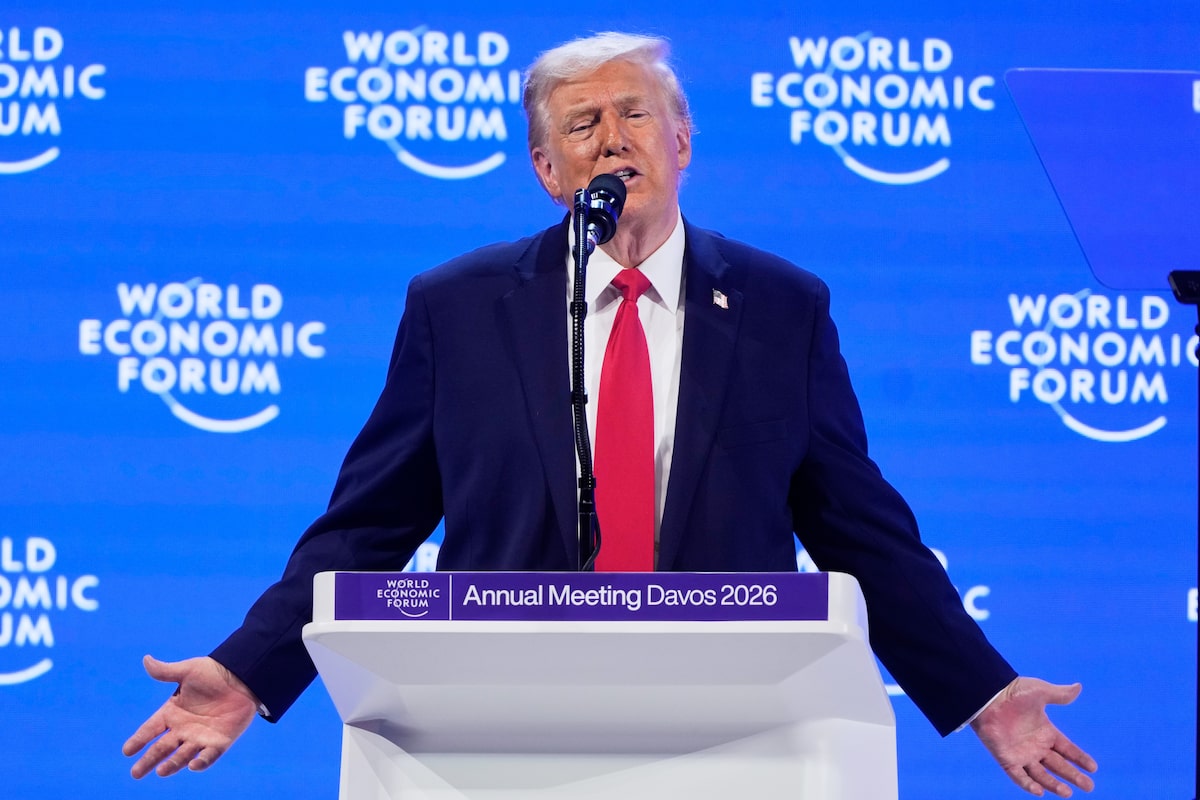
U.S. President Donald Trump speaks during the Annual Meeting of the World Economic Forum in Davos, Switzerland on Wednesday.Markus Schreiber/The Associated Press
Donald Trump’s so-called Liberation Day plans, propelled by an orgy of tariffs, did not go well for the U.S. President last April. The markets went into the tank and bond yields rose, sending interest rates up. Mr. Trump, obviously flustered by his miscalculation, quickly took the edge off his sharp trade policies. The about-face worked – bond yields retreated.
Market redux?
On Tuesday, as Mr. Trump insisted that the United States would buy Greenland and refused to rule out an invasion if Denmark balked at handing over the territory it has controlled for 300 years, the “Sell America” trade swung into action once again. The S&P 500 index fell by 2.1 per cent, the Dow Jones Industrial Average by 1.8 per cent and the Nasdaq Composite by 2.4 per cent. Bond yields ticked up.
Rattled once again, Mr. Trump mounted another retreat. Greenland (which he often confused with Iceland in his rambling, shambling, falsehood-laden Davos speech), would not be taken by force, he vowed. And the eight European countries that had sent military personnel to Greenland in recent days would not be hit with his 10-per-cent punishment tariffs. “Our stock market took the first dip yesterday because of Iceland, so Iceland’s already cost us a lot of money,” he said.
While he insisted that he still wants a deal for Greenland, the markets recovered.
Trump sues JPMorgan for $5-billion, accusing bank of closing accounts for political reasons
There is a lesson here for any country that faces being bullied into submission by Mr. Trump and his no-rules, might-makes-right international order: The capital markets are your best weapon if you lack the military might, or sheer economic bulk (as China does on both counts), to call Mr. Trump’s bluff.
The paradox is that market calm invites Mr. Trump to go on a rampage; market turmoil gets him to back off, or partly back off, as he has at least twice since last spring.
The problem is that, so far, he has actually faced little market adversity beyond those two headline-grabbing incidents. Unless investors double up on their “Sell America” strategy and turn it into a campaign, he will have every incentive to keep his wrecking machine rolling. Certainly, the Republicans in the Senate and the House of Representatives, almost to the man and woman, lack the backbone to rein him in.
We know that Mr. Trump respects – and fears – the markets, especially the debt markets. As a real estate mogul, he would understand well how debt-financed development works and how rising interest rates can trigger rising borrowing costs, which can damage or destroy investment returns. The US$1-billion Trump Taj Mahal casino in Atlantic City, N.J., went bankrupt in 1991, largely because it was financed by junk bonds – high-yield securities rated below investment grade – with interest payments that proved crushing. A few other Trump-related casinos and resorts saddled with expensive debt also gave up the ghost.
In the past year, Mr. Trump has spent a lot of time trying to talk borrowing costs down.
Opinion: America the predator: Trump wants to show the world he can take what he wants
He has threatened to fire Federal Reserve “major loser” chair Jerome Powell several times for allegedly keeping interest rates “artificially high.” Earlier this month, he approved – make that effectively ordered – mortgage liquidity providers Freddie Mac and Fannie Mae to buy US$200-billion of mortgage bonds to try to make mortgage rates more affordable.
You get the picture. The last thing Mr. Trumps needs in a voting year – the midterm Congressional elections are in November – is rising interest rates. If voters are paying higher mortgage and car-lease costs in autumn, the Democrats will benefit and, if they benefit enough, Mr. Trump will turn into a lame-duck president (assuming he does not cancel the elections on some insurrection pretense or similar).
European countries hold trillions in dollar-denominated U.S. assets, including US$2-trillion in Treasuries and a similar amount in corporate bonds, according to Fed figures. If Mr. Trump ramps up his adventurism in Greenland or elsewhere – the Greenland crisis has potentially been postponed, not fixed forever – and European investors turn ugly, they could dump Treasuries in the hopes that Mr. Trump would buckle again.
He may not, of course, depending on severity of the backlash against him. A minor sell-off of Treasuries and other U.S. assets may fail to force him to deter his tariff war and other aggressions, violent and non-violent. But it might not take an avalanche of selling to rattle the Treasury market, especially if some U.S. bond vigilantes were to join the sell-off.
Every freewheeling, free-spending politician would remember the “Liz Truss moment.” Ms. Truss was the British prime minister who, in 2022, announced sweeping unfunded tax cuts that triggered mayhem in the bond market. Borrowing costs soared and she was out of office after just 49 days on the job.
The U.S. is not a parliamentary system and Mr. Trump is not going anywhere until his term ends. But his primeval instincts could be put in check by angry bond investors in countries such as Canada and France, which are leading the anti-Trump liberal democratic coalition.
Mr. Trump is aware of the power of the markets. We know he is worried they could turn against him once more. On Thursday, he threatened “big retaliation” if European countries were to dump their holdings of U.S. debt. What he didn’t seem to understand was that any retaliation would no doubt prompt them to sell more U.S. debt.