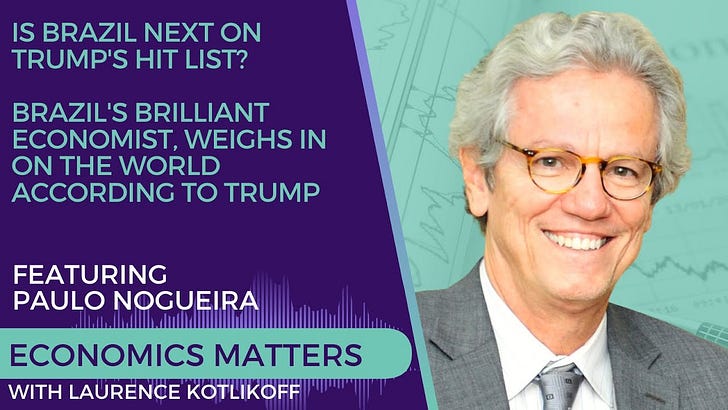
Paulo Nogueira Batista is one of Brazil’s most prominent, influential, and instrumental economists. Paulo was vice president of the New Development Bank, established by the BRICS in Shanghai, from 2015 to 2017, and Executive Director at the IMF for Brazil and 10 other countries in Washington, from 2007 through 2015.
Paulo, as you’ll hear/see, and as his bio clearly documents, is a sober, sophisticated, accomplished global intellectual, actor, and statesman — someone who thinks deeply and carefully before he speaks. Hence, when he pens a column entitled, “Brazil is Running an Existential Risk,” which I reposted in Economics Matters last week, about Brazil’s need to obtain nuclear weapons, it’s time to sit up and listen.
Take a read of Paulo’s column and ponder the meaning of his quote of Clemenceau, “The United States is the first to pass from barbarism to decadence without knowing civilization.” Then watch/listen to this extraordinary podcast.
Excerpts from Paulo’s Wiki Entry
Paulo Nogueira Batista Jr (born April 2, 1955) is a Brazilian economist who was an Executive Director at the International Monetary Fund (IMF) from April 2007 to June 2015.[1] He also was one of the founding members of the New Development Bank (NDB) in Shanghai, where he held the vice-presidency between 2015 and 2017. Author of seven books (two of them in English) and a vast list of economic papers and publications, Nogueira has been also a frequent contributor to Brazilian magazines and websites as Carta Capital and Brasil 247. The relation between nation, nationalism and globalization is one of his favorite subjects.
Since the early 1980s, Nogueira has focused on international economic issues, mostly on financial matters and debt renegotiations. First, as an economic researcher in the Getulio Vargas Foundation in Rio de Janeiro. Subsequently, working for the Brazilian government, where he served as Under Secretary for Economic Affairs, Ministry of Planning (1985-1986) and as Advisor to the Minister of Finance on External Debt (1986-1987). He was also the head of the Center for Monetary and International Economic Studies at Getulio Vargas Foundation in Rio de Janeiro (1986-1989) and a professor of economics at Getulio Vargas in São Paulo (1990-2007). During and after his years at the IMF, Nogueira was known for defending the claims of emerging countries. In 2012, for example, Nogueira said that the IMF staff mostly played down the responsibility of advanced nations for the destabilizing surges in international capital flows with major effects on emerging markets.
Nogueira was nominated Executive Director at the IMF in 2007 by Brazil’s Finance Minister Guido Mantega during the administration of President Luiz Inácio Lula da Silva. He was elected to represent Brazil and its eight other partners in the Executive Board. These countries formed the Brazilian constituency at the IMF, whose interests were represented by Nogueira. Mantega chose Nogueira because they both advocated a package of reforms that would change the IMF quotas and reorganize its governing structure in favor of emerging countries.
Nougueira took a strong stance on the need to make the IMF more representative of the 21st century and together with other executive directors of developing countries managed to produce a shift in quotas and votes in the 2008 and 2010 governance reforms. While not enough to produce a major overhaul in the balance of power within the IMF, these changes shifted some voting power to emerging countries, notably to China and Brazil itself. The Brazilian economist also took part in the internal debate and decisions that produced in 2009 the IMF reform of credit instruments and the tripling of the institution’s resources, which reached the amount of US$750 billion.
Nogueira joined the IMF in Washington, DC, in 2007. A year later, the BRICS cooperation began through an initiative by Russia. Over the course of a few years, the group’s coordination was mature enough to launch a development bank and an emergency reserve fund. “If the existing institutions were doing their jobs perfectly, there would be no need to go to the trouble of creating a new bank, a new fund,” said Nogueira during the 6th BRICS Summit in Fortaleza, Brazil, on July 15, 2014.
He was involved in the negotiations that led to the founding of the New Development Bank (NDB), and the BRICS Contingent Reserve Arrangement. As the first President of the NDB, K. V. Kamath, was Indian, the other four countries could each designate a vice-president. Nogueira was then chosen by the Brazilian government to take office as one of the vice-presidents of the NDB. Following the second meeting of its Board of Directors in November 2015, the institution announced the allocation of formal responsibilities to the four vice-presidents of the Bank and the Brazilian economist took office as Chief Risk Officer, in charge also of strategy, expansion of membership and economic research, a position he held until October 2017.
Nogueira argues that the US has been using its currency more aggressively to pursue political and geopolitical goals. Among others, Russia, Venezuela, Iran were and are targets of sanctions and punitive measures that can only be enforced because the dollar and the American financial system occupy the position they do in the world. According to him, it was in this context that discussions began among the BRICS countries on the convenience of moving towards a monetary association and eventually a common reference currency for international transactions.
Economic Matters – The podcast is hosted by Laurence Kotlikoff, a Boston University Economist, a NY Times Best Selling Author, President of maxifi.com, and Author of Money Magic.