Once a bastion of anti-imperialist solidarity, Latin America is recalibrating its support for Palestine amid US political pressure and far-right shifts
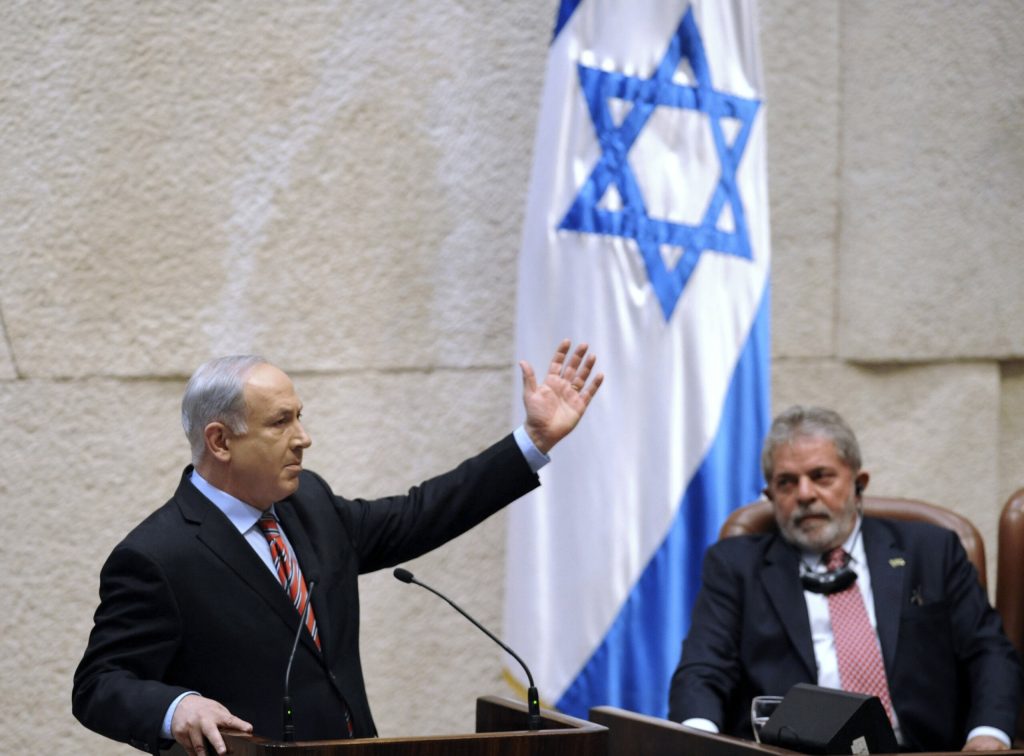
Israel’s prime minister, Benjamin Netanyahu (left), shakes hands with Argentina’s president, Javier Milei (right), at the Israeli parliament on 11 June 2025 (Menahem Kahana/AFP)
US political pressure in Latin America has helped open the door for growing Israeli influence, but longstanding solidarity with the Palestinian cause has not withered away, regional experts have told Middle East Eye.
Several left-wing Latin American governments, which for decades had framed their foreign policy around anti-imperialism and decolonial identity, continue to express solidarity with the Palestinian cause – sometimes elevating symbolic gestures to state-level policy decisions.
During the height of Israel’s war on Gaza, Brazil’s president labelled the devastating offensive a genocide, Colombia suspended diplomatic relations with Israel and Chile sought accountability for Israeli actions in international courts.
But US interventions, including extensive lobbying by US politicians, threats against regional leaders and the recent seizure of Venezuelan President Nicolas Maduro, are geared towards tilting the region towards much closer alignment with Israel.
“Latin American states lack instruments of hard power and are therefore constrained in how they can respond to US pressure,” Ali Farhat, a Latin American affairs specialist, told MEE.
“That limitation creates openings for Israel to consolidate influence, particularly where governments seek to avoid confrontation with Washington.”
In recent years, US officials have explicitly tied Latin American diplomacy to broader US foreign policy goals, framing their cooperation with Washington as a litmus test for “security” and “democratic alignment” that dovetails with closer ties to Israel.
Argentina’s far-right president, Javier Milei, whose government has announced plans to relocate Buenos Aires’ embassy to Jerusalem and deepen security and economic cooperation with Israel, has benefited directly from the US.
‘[Maduro] was among the most uncompromising defenders of Palestine on the continent’
– Ali Farhat, Latin American affairs specialist
Last year, Buenos Aires received an unprecedented $20bn bailout from Washington, which US President Donald Trump defended as backing a “good financial philosophy” despite scepticism about its benefits to the country.
Farhat said that US intervention had played a decisive role in shaping the regional landscape, with Washington’s targeting of Venezuela’s leadership as emblematic of a broader pressure campaign aimed at weakening outspoken supporters of Palestine.
Maduro, long considered one of the most vocal defenders of Palestinian rights in Latin America, had been subjected to sustained international legal and political pressure, which Farhat said had already triggered repercussions.
“He [Maduro] was among the most uncompromising defenders of Palestine on the continent,” Farhat said. “His marginalisation [and now ouster] represents the loss of a fierce advocate for the cause.”
According to Farhat, Maduro – who was seized by US forces earlier this year and is currently standing trial in New York on drugs, weapons and “narco-terrorism” charges – held views that framed the Palestinian struggle as inseparable from anti-imperialism.
“He [Maduro] did not instrumentalise Palestine as a political tool,” Farhat said. “He was genuinely convinced that the US functions as a colonial power and that Israel operates as an occupying state supported by it.”
Recalibrating, not retreating
According to Farhat, since Trump returned to the Oval Office last year, his brash foreign policy strategy has resulted in left-leaning leaders responding by recalibrating, not retreating, when it comes to the issue of Palestine.
Colombia’s Gustavo Petro and Brazil’s Luiz Inacio Lula da Silva, known mononymously as Lula, have attempted to balance their condemnation of Israel’s actions in Gaza with pragmatic diplomacy, aware of the economic and political costs of escalation, he said.
“This caution should not be read as surrender,” Farhat said. “It is an attempt to contain what is perceived as American overreach in a region without credible deterrence tools.”
Brazil, he added, illustrated both the possibilities and limits of diplomacy.
What is Trump’s ‘Board of Peace’ and who will govern Gaza?
While Lula’s stance on Gaza was among the strongest taken globally, it was ultimately constrained by broader geopolitical realities.
“Brazil could have gone further had there been effective Arab and Islamic political backing,” Farhat said. “The rush toward normalisation elsewhere weakened Brazil’s ability to escalate.”
At the same time, the resurgence of far-right governments has accelerated alignment with both the US and Israel.
Argentina’s Milei has marked one of the clearest pivots, framing Israel’s war on Gaza as legitimate self-defence and deepening ties with Israeli officials.
As of 25 January, Argentina is the only Latin American country to have agreed to join Trump’s controversial Board of Peace initiative.
The board describes itself as “an international organisation that seeks to promote stability, restore dependable and lawful governance, and secure enduring peace in areas affected or threatened by conflict”.
Nilto Tatto, a congressman with the Brazilian Workers’ Party, said it was critical that Latin American countries continued to reject offers to join the board and any of its initiatives that undermined Palestinian rights.
“Any framework managed by Washington would not serve peace so much as reproduce hegemony under an international guise,” Tatto told MEE.
“Brazil, evidently, cannot take part in a process whose outcome is already predetermined, namely, one that focuses on the reconstruction of the Gaza Strip only to then keep the territory under US control.”
Julia Perie, a former member of the Argentine parliament, told MEE Argentina’s position towards Israel reflected a broader ideological realignment rather than a targeted attack on Palestinians.
“Argentina’s position is part of a geopolitical vision that prioritises alignment with the United States,” said Perie, who is also president of the Victoria Foundation’s International Relations Observatory.
“It’s not so much a direct punishment of the Palestinian cause as it is a convergence of agendas within a western-aligned axis,”
While far-right governance has limited state-level advocacy for Palestine, Perie said that such moments are cyclical rather than definitive.
“Support for Palestine in Latin America has always fluctuated,” she said. “This is another phase in a longer historical transformation, not the end of solidarity.”
Global South struggle
In countries facing heightened political pressure, observers said support for Palestine was increasingly expressed through legal channels, multilateral institutions and popular movements rather than overt diplomatic confrontation.
Ramon Medero, president of Venezuela’s La Danta TV, described the current phase as one of adaptation rather than retreat.
“It is difficult to argue that the Palestinian cause has suffered a decisive blow,” Medero said.
Why is Argentina becoming a ‘great friend’ of Israel amid its war crimes in Gaza?
“What we are seeing is a repackaging of escalation through legal and multilateral avenues to reduce the costs of sanctions and backlash.”
For Medero, solidarity with Palestine was now firmly embedded within a broader Global South struggle against colonial domination.
“The Palestinian cause has become a structural symbol of liberation, sovereignty and self-determination,” he said. “What is shifting is agency – away from governments and toward popular consciousness.”
He added that far-right advances may intensify grassroots mobilisation.
“The scale of the atrocities in Gaza and the documentation of genocide have awakened popular conscience worldwide,” Medero said.
“Where the far right prevails, these struggles gain even greater meaning.
“The enemies of Palestine and of our America [Latin America] are the same – and the struggles are converging.”