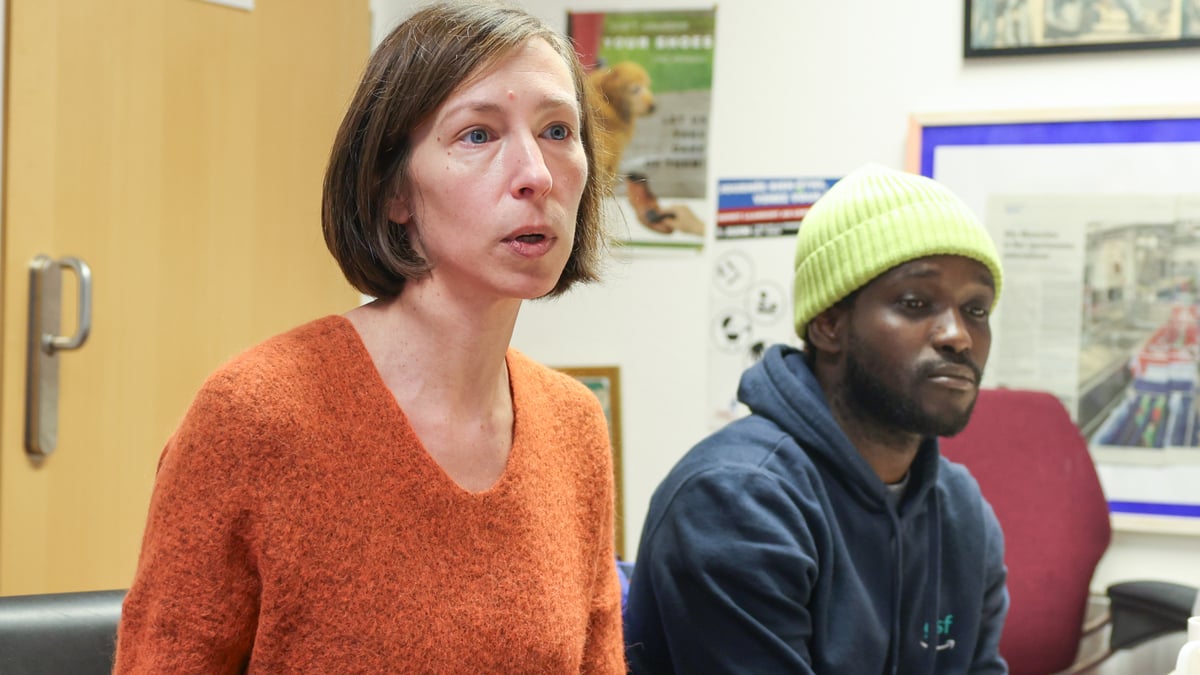
Moussé Bathily tells his story in a gentle voice, recounting the ordeal that began when he left his home country of Mali as a teenager in search of a better future.
Of traffickers who took advantage of him, of promises that turned out to be lies – and ultimately of exploitation in Luxembourg, where he worked without pay for a man who is now under investigation.
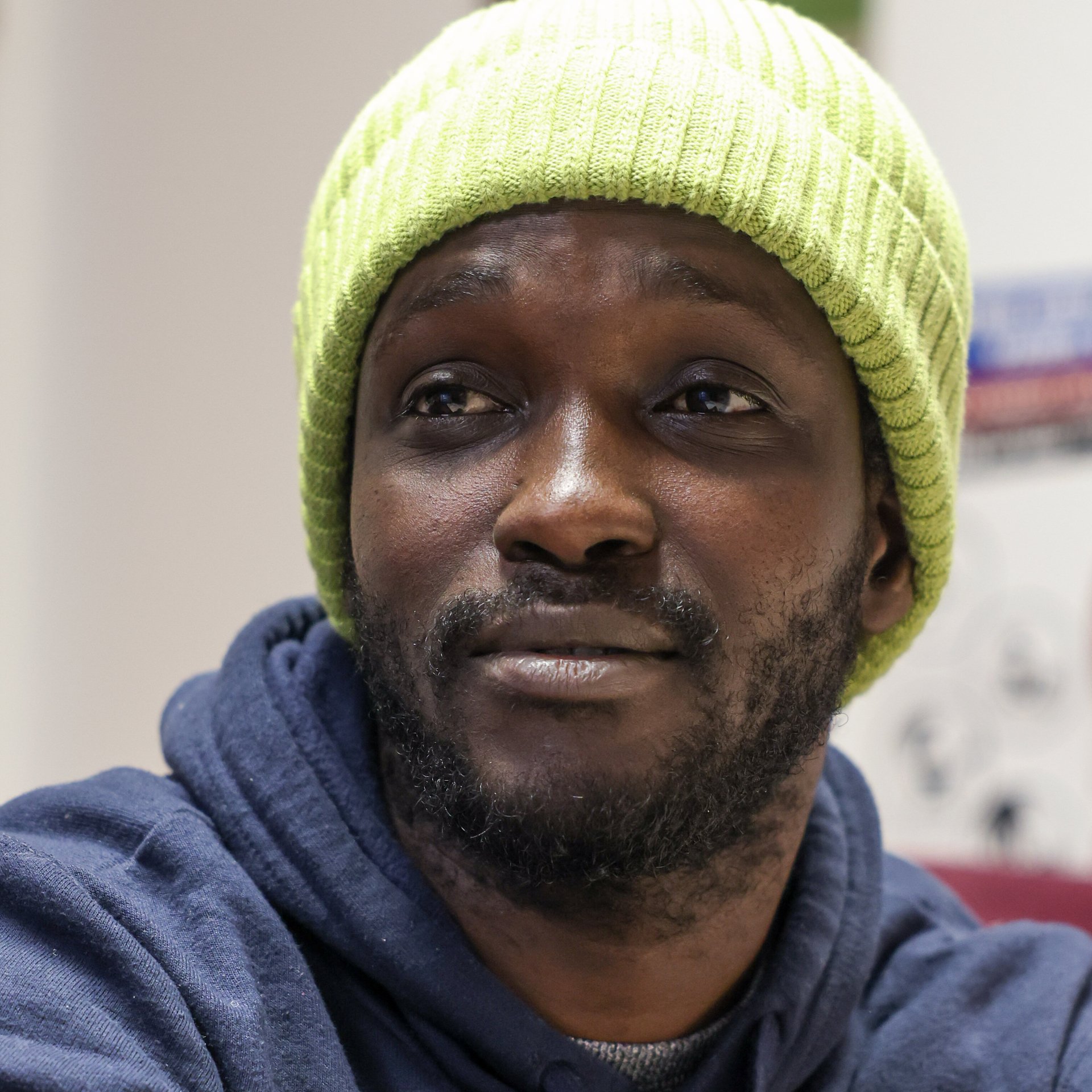
We no longer had a life, hardly anything to eat, no proper place to stay […] Now the baby is here and we are doing well
Moussé Bathily
Young father from Mali, assisted by Kanner Stëmm
“I didn’t know any better back then and trusted this man to help me for too long,” says Bathily, who is now 27 years old. When his wife became pregnant, he had little hope. That changed when the couple came into contact with the Kanner Stëmm, a previously little-known service of the Stëmm vun der Strooss charity.
“We had no life left, hardly anything to eat, no proper place to stay. Without the Kanner Stëmm, we would still be in this hopeless situation today. Now the baby is here and we’re doing well,” says the young father with a smile.
Under the radar
For people like Bathily, the Kanner Stëmm has become an important point of contact. It is often the last hope for families with children who are struggling with social, psychological and health challenges. Despite running since 2021, there is not much information about this key service on the Stëmm vun der Strooss website.
“That’s intentional,” says Stëmm vun der Strooss director Alexandra Oxacelay. “It’s a very small service that nevertheless accomplishes a great deal and is already operating at full capacity. Therefore, we don’t want to draw too much attention to it.”
The Kanner Stëmm service was established five years ago “at the request of the ministry of health to develop and expand social paediatrics in Luxembourg”, Oxacelay recalls.
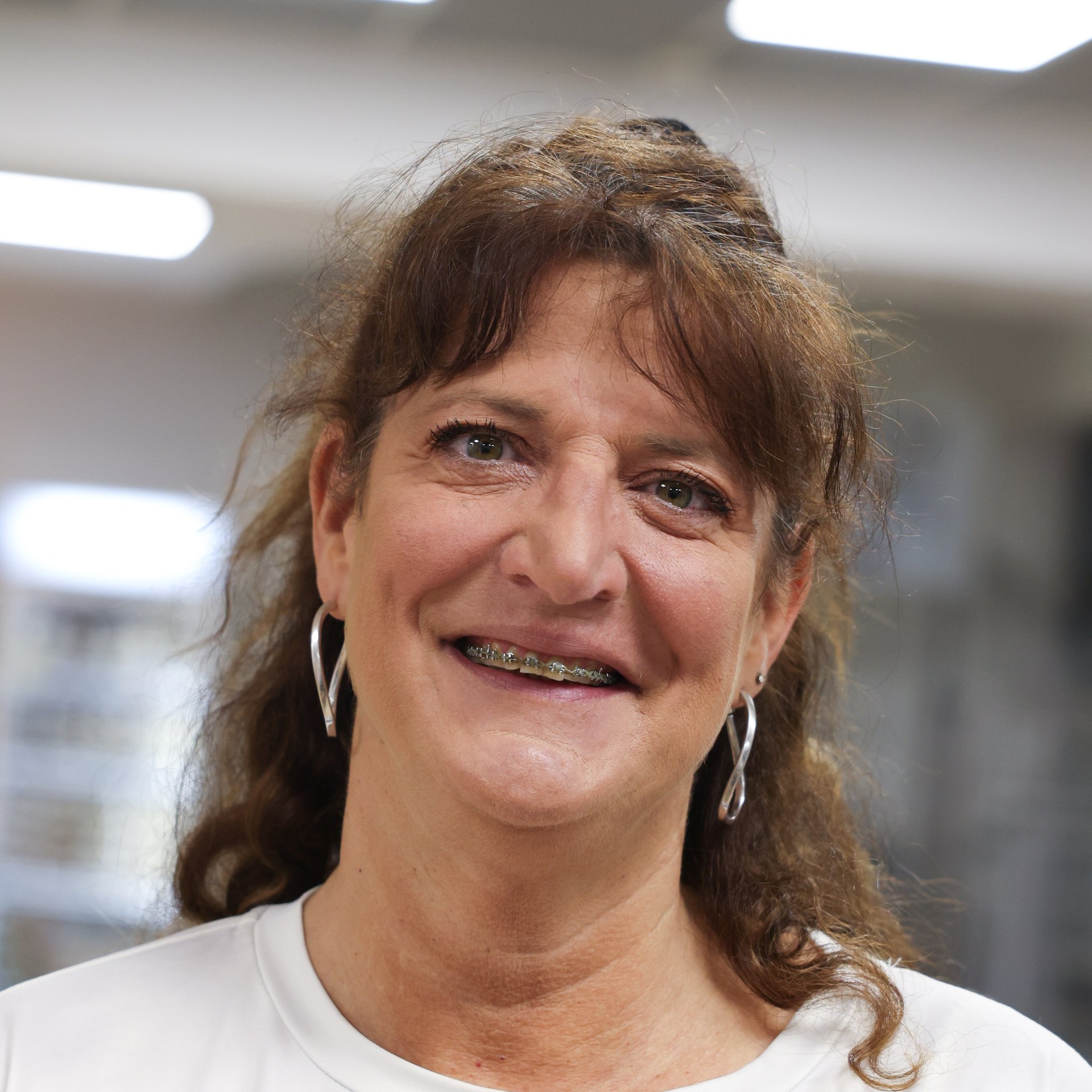
As there is a high risk of situations being repeated from one generation to the next, it made sense and was logical to also become active in the area of children
Alexandra Oxacelay
Director of Stëmm vun der Strooss
“Social paediatrics is a systemic and holistic approach to the care of children. A child can have the flu or a sore throat – but also health problems that are related to their well-being on another level: Poverty, problems at school or within the family. It’s about thinking about all these contexts, understanding the difficulties and working with the whole environment,” says lead social worker Amélie Sadowski.
Also read:The city window which gives free sandwiches and support
The move into assisting families and children was logical, says Oxacelay. “Stëmm vun der Strooss looks after people in particularly difficult circumstances. As there is a high risk of situations being repeated from one generation to the next, it made sense and was logical to also become active in the area of children.”
The driving force in setting up the service was paediatrician Dr Idoya Perez. In addition to social worker Amélie Sadowski, a psychologist was also hired.
A network of support
A functioning network of support from other organisations is central to the work. “There are numerous organisations in Luxembourg that work with children and families,” says Oxacelay. These include organisations such as Alupse (Association Luxembourgeoise de Pédiatrie Sociale), the services of the ONE (Office national de l’enfance), hospitals, courts and the SCAS (Service Central d’Assistance Sociale).
“As soon as a problem or suspicion of abuse or violence is identified, action must be taken. That’s why this network is necessary,” says Oxacelay. Agreements have been concluded with all hospitals – with the exception of the CHL, with whom negotiations are ongoing.
The director of Stëmm vun der Strooss, Alexandra Oxacelay © Photo credit: Marc Wilwert
After Perez’s early departure, no replacement for the paediatrician could be found. “We therefore focused more on the psychosocial level,” explains Sadowski. Even though volunteer paediatricians have supported the small team since then, medical care has never been the central focus of their work. “Basic medical care is covered in Luxembourg. Every child has health insurance. If parents cannot afford treatments, we cover the costs, which are later reimbursed by the CNS,” she says.
Instead, the focus is rather on a comprehensive medical and psychosocial assessment of each situation. “We know that a stable parent-child bond is a key protective factor against abuse and mental illness,” says Sadowski. However, stressed parents often lack the capacity to build such a bond. “They are confronted with too many problems that they cannot cope with alone.”
Also read:22-year-old entrepreneur fights for a fresh start at Stëmm vun der Strooss
Therefore, the first step is to understand the causes, according to Sadowski. “Are there psychological stressors? Are there administrative problems? Are the difficulties related to complex traumas from one’s own childhood? We can’t solve everything. But if we know what the issue is, we can work on it together and support those affected.”
Rising demand for service
In 2025, the social worker and two psychologists looked after 60 families with 93 children. 41 new cases were opened, 19 carried forward from the previous year. “All nationalities are represented. It’s not just migrants,” says Sadowski, “even though we do indeed have many cases from third countries.”
Last year, Kanner Stëmm handled almost 500 appointments with families in need. Plans are underway to hire an additional social worker to meet the increasing demand and to relieve Sadowski of some of her daily workload.
They receive many inquiries, especially from hospitals, for example regarding the prevention of postnatal depression. “Often, it’s about single expectant mothers without support and their anxieties related to pregnancy,” explains Sadowski. Accordingly, Kanner Stëmm intervenes – whenever possible – prior to the birth, for example to raise awareness of topics such as infant nutrition.
If I see a mother living on the street with her child and having nothing, I am obligated to report it. We’ve already had such cases
Amélie Sadowski
Lead social worker, Kanner Stëmm
Sadowski recalls one year in Luxembourg when there were several infanticides. “Back then, postnatal depression was rarely discussed. Today we know how crucial early intervention is,” she says, adding: “If I have serious concerns, I report the case to the public prosecutor’s office. I am obligated to do so if the child’s welfare is at risk.”
People without rights – but with needs
Kanner Stëmm often also supports people without legal residency status. “Nobody wants to or can take care of them because they have no rights – but they are there nonetheless,” says Sadowski, “sometimes with very complex and moving life stories. And then there’s the added challenge of pregnancy. It’s not easy.”
Also read:How a Luxembourg NGO tackles food waste and helps people back to work
The service benefits from a comparatively flexible legal framework. “We don’t have the same strict access requirements as ONE or the social services office,” Sadowski explains. “There are laws and rules for immigration, yes, but we still have to ensure that pregnant women and families with children, in particular, have access to medical care, a roof over their heads, and enough to eat—that their basic needs are met.”
Amélie Sadowski, the lead social worker at Kanner Stëmm © Photo credit: Marc Wilwert
“Of course, our resources are limited, but we can refer those affected to the right places,” Sadowski notes. Organizations like ASTI, CLAE, and Passerelle provide support with legal issues. Stëmm vun der Strooss itself offers assistance with daily needs: affordable meals , clothing, showers, and laundry services.
There is no entry criteria at the Kanner Stëmm. “I conduct an initial consultation and then clarify what we can do,” says Sadowski, stressing that “child protection is our top priority.”
“As a team, we assess whether parenting skills are present and whether the parents are adequately caring for their child despite their current situation. If I see a mother living on the street with her child and having nothing, I am obligated to report it. We’ve already had such cases,” she says.
Growing challenges
The social worker says, without hesitation, that “adapting” to the political environment is the biggest challenge for the future. “I do this job to help people like Moussé Bathily. Nobody wants to experience what they went through.”
This is why she is also concerned about the rise of far-right tendencies – and in particular the narrative that migrants are coming to Luxembourg to benefit from “us”. “That’s not true. The refugees we see here don’t want our money, they want to work. And they want one thing above all: to live in safety,” says Sadowski.
After five years, Kanner Stëmm is performing a key role without much fanfare. “Many families in Luxembourg live in very precarious social situations. You just don’t always see them,” notes Oxacelay, speaking of a “hidden dimension” in Luxembourg society.
The director of Stëmm vun der Strooss describes the discrepancy between the daily work with those affected and the often selective political and social perception of problems. “There is the actual reality of these people’s lives – and then there is the administrative, political and social reality. It often becomes clear that one only sees what one wants to see,” says Oxacelay.
(This article was originally published by the Luxemburger Wort. Machine translated using AI, with editing and adaptation by John Monaghan.)