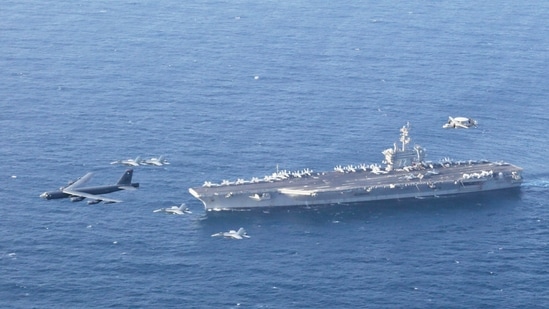
The US aircraft carrier USS Abraham Lincoln is en route to the Middle East amid rising tensions with Iran. Reports from Reuters confirm the deployment but do not comment on the ship’s public visibility.
A ship’s crew may switch off AIS for legitimate safety or security reasons, (AP)
President Donald Trump told reporters aboard Air Force One that the United States had sent an “armada” toward Iran, warning Tehran against restarting its nuclear programme or escalating violence against protesters.
“We have a lot of ships going that direction, just in case … I’d rather not see anything happen, but we’re watching them very closely,” he said, according to Reuters.
US officials speaking on condition of anonymity told Reuters that the Abraham Lincoln and several guided-missile destroyers are expected to arrive in the Middle East in the coming days. One official said additional air-defence systems were also being considered to protect US bases in the region from any potential Iranian strike.
The carrier’s position on civilian ship‑tracking platforms is not publicly confirmed, and any lack of visibility does not mean it has lost communication. Public trackers rely on the Automatic Identification System (AIS), which military vessels may limit or suspend for security reasons, according to marinevesseltraffic.com.
According to the website, AIS is intended to assist a vessel’s watchstanding officers and allow maritime authorities to track and monitor movements. However, a ship’s crew may switch off AIS for legitimate safety or security reasons, as outlined in International Maritime Organization guidelines (Resolution A.917(22)), including when continuous AIS operation could compromise the vessel’s safety or security.
This includes situations such as sailing in areas with a threat of attack, piracy, or other hostile activities.
While AIS is normally required to remain active, temporary suspension is allowed in specific circumstances.
Fox News reported that the Abraham Lincoln strike group could face a credible threat from Iranian drone swarms.
Cameron Chell, CEO and co-founder of Draganfly, told the outlet that Iran’s reliance on low-cost unmanned systems poses a risk to high-value US naval assets, including the aircraft carrier strike group. “By pairing low-cost warheads with inexpensive delivery platforms, essentially remotely piloted aircraft, Iran has developed an effective asymmetric threat against highly sophisticated military systems,” Chell said.
Chell added that Iran could launch large numbers of relatively low-cost drones in attacks that might overwhelm traditional defenses.
A senior US official confirmed to Fox News Digital that the Abraham Lincoln had not yet crossed into US Central Command’s area of responsibility in the Indian Ocean. “It is close, but technically not in CENTCOM yet,” the source said, indicating the carrier strike group is not yet in a position to strike Iran.
Once the carrier strike group enters CENTCOM’s area, it will take several days before a strike capability is fully on station.