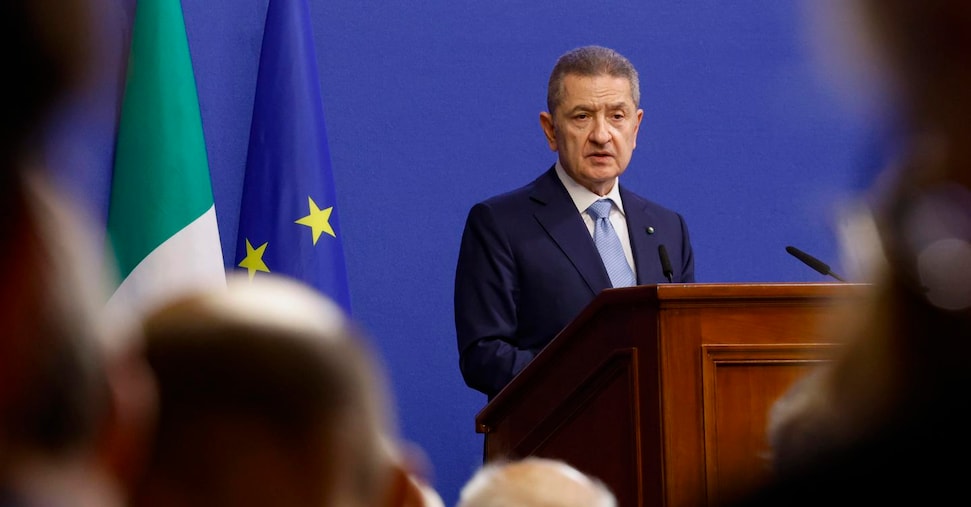
“The world economy is clearly better than we expected last year. After April, when the evidence emerged that we would live for a while in a more antagonistic world, the forecasts became less rosy,” but “in fact the world economy has held up: we have not seen any recessions or slowdowns around the world“. This was stated by the Governor of the Bank of Italy, Fabio Panetta, speaking at the executive committee of the ABI.
It is difficult to make economic assessments
Today ‘the fundamental variables of the economy, on investments, international trade, interest rate trends depend on variables that are less and less the traditional variables, but on geopolitical variables, today I would say increasingly political without the prefix ‘geo”’. For Panetta, it is ‘difficult to make economic assessments, difficult to get a picture of the situation,’ he added. ‘We are witnessing rate movements that sometimes have links with fundamentals, but in most cases depend on other factors’. In particular, he continued, “the announcements on the international scene these days have led to repositioning in the markets, political announcements lead to sudden investment choices that are constantly changing”. Consequently, ‘it is difficult to predict ex ante, but also difficult ex post to understand what is happening’.
Mondo is smarter than constraints, trade reallocated
Although there remain ‘many uncertainties about how tariffs will act, about how international trade will be affected by tariffs‘, ‘in fact the world is smarter than the constraints and international trade has reallocated’. Thus the Governor of the Bank of Italy in another passage to the executive committee of the ABI. ‘Chinese exports have not collapsed,’ he added, ‘US imports from China have fallen a lot, but not those of other Asian countries, which are then intermediate stages to the US. Moreover, and this is not good news for Europe, he concluded, ‘China is pushing hard to expand into other markets’.
Banks profitable and careful, continue with simplification of rules
Today in Italy and around the world ‘banks are generally more profitable, more careful. We have seen a series of shocks without seeing the re-emergence of impaired loans, the banking sector is in better shape’. If, therefore, one does not see a strong need to deregulate the sector, as would be the impetus for this coming from the United States, it is nevertheless useful to ‘simplify where there are redundancies, burdens due only to regulatory complications’. In recent months, Panetta noted, ‘the debate on simplification has grown, it has spread, the Eurosystem has fully embraced this idea of simplification’. The ECB and the Supervision have therefore submitted proposals to the European Commission: ‘It is a first proposal, it is a debate that has started and I believe it should continue’. Panetta mentioned in particular the proposals aimed at ‘making the capital structure of banks a little more streamlined and also a little more understandable’ and those on the subject of ‘proportionality’. The latter is a ‘heartfelt’ issue because the current regulations ‘were written after the financial crisis, there was also a greater element of caution than now, perhaps excessive’ and the rules ‘were applied to all banks as if all banks could operate like the big international banks’.
Ue today is weak because it is not integrated
“We are weak because we have not done integration. The capital markets union and the banking union are just two examples of the lack of European integration’. This was stated by the governor of the Bank of Italy, Fabio Panetta, replying to a question from the chairman of UniCredit, Pier Carlo Padoan, during the Abi executive committee meeting. “If we were integrated, not only economically and financially but also politically, and had a capacity to respond, perhaps we would not be so passive today towards the tensions that come to us from outside,” he added. “Then what it means to be integrated is a big discussion, it depends on what model of Europe we have in mind.”