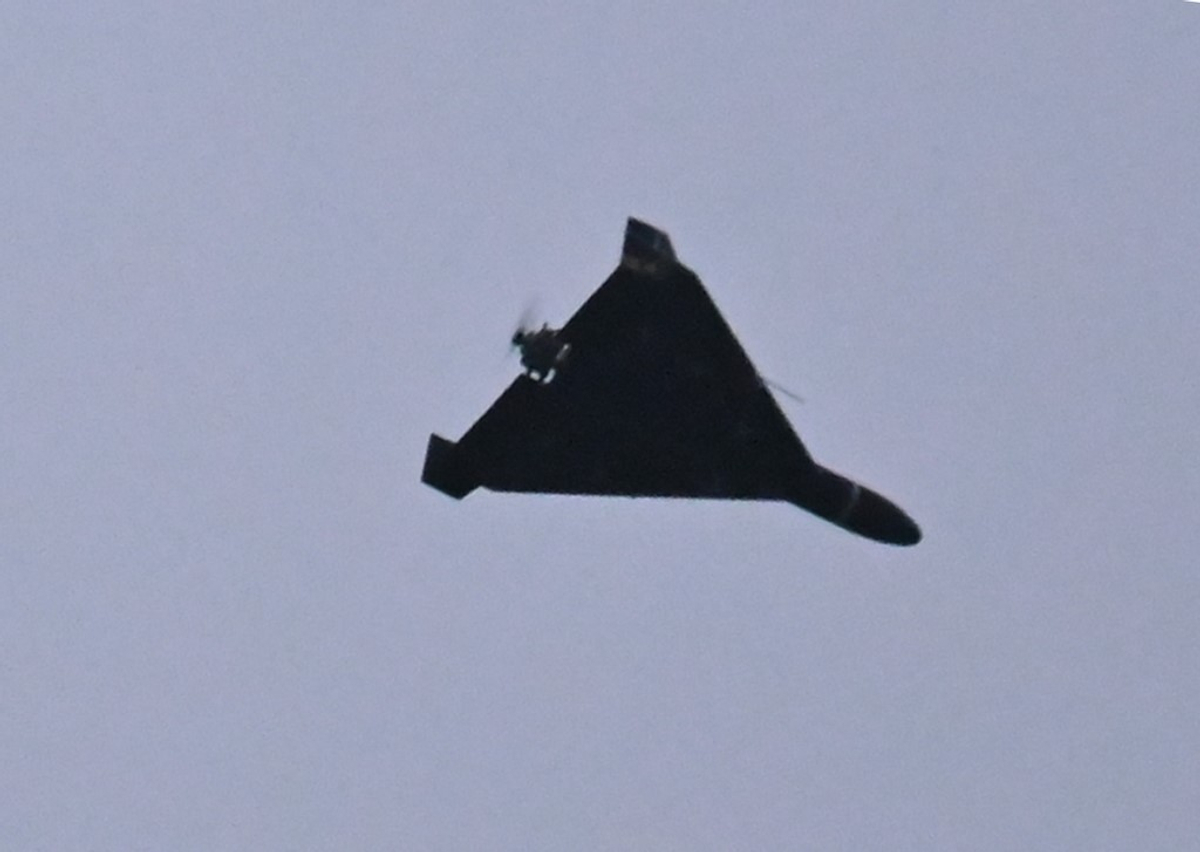
Russian First Person View (FPV) drones attacked and hospitalized three children and a teenager in Ukraine’s southern Mykolaiv region, official statements made public on Monday said.
The explosives-toting quadcopters targeted children aged 3, 7, 10, and 17 on Sunday evening while the victims were outside near their homes, Mykolaiv regional governor Vitaly Kim said. Ambulance crews transported the four to the hospital for treatment and release, news reports said.
Follow our coverage of the war on the @Kyivpost_official.
Over the day, Mykolaiv officials reported at least nine separate FPV attacks hit in the region, mostly in seaside communities. The nearest Russia-occupied territory is 10-15 km (6.2-9.3 miles) away, on the far side of a bay called the Dniprov’ska Zaliva. Russian FPVs also flying across the bay raided into Mykolaiv region and hit civilian buildings and infrastructure four times on Saturday, but didn’t hit any people, a statement from Kim’s office said.
FPV drones used by both sides in the Russo-Ukraine War commonly fly at ranges 15-30 km (9.3-18.6 miles) from operators to carry a grenade or small mortar round-sized munition to a target, putting communities within range under threat of attack.
Since early December, the most punishing Russian strikes by heavy, long-range weapons have concentrated on the capital Kyiv, but the Russian campaign to turn out the lights and freeze out Ukraine’s population has targeted other regions in the country, like the normally relatively quiet region Mykolaiv, Kim said in a personal message to voters published on his personal Telegram channel on Sunday.

Other Topics of Interest
Russia May Sack Black Sea Fleet Chief After Failing to Stop Ukrainian Unmanned Boats
Russian military command is reportedly weighing the removal of Black Sea Fleet chief Sergei Pinchuk after repeated failures to stop Ukrainian naval drone attacks, partisans say.
“They’re (Russian forces) hitting generation and transportation. And because of that, the networks are overloaded and we have blackouts,” Kim said.
The skies above Ukraine’s southern Kherson region, to the east of Mykolaiv region, are the most saturated with Russian FPV drones, thanks to heavy Russian troop presence along the south/left bank of the Dnipro River 2 or 3 km (1.2 or 1.9 miles) away from the city.
Kherson regional spokesperson Vladyslav Voloshyn, in Monday comments to local media, said Russian forces carry out about 400 kamikaze drone strikes against Kherson city and adjacent communities a day, targeting apartment buildings, private homes, vehicles, and critical objects like cellular towers or administrative buildings. Russian artillery across the river shell targets as well.
Particularly feared by local residents are FPV drones that seemingly hunt down civilian vehicles and pedestrians on city streets or in public spaces. In 2025, Ukrainian journalist Zarina Zabrisky produced a documentary called “Kherson: Human Safari” (2025) detailing the effects of Russian FPV drone attacks on the city in a year – 130 civilians killed by Russian hunting drones, including three children; and another 1,195 civilians injured, including 17 children.
According to Kherson regional administration statements, on Saturday, Russian artillery fire hit Kherson city’s Dniprovskyi, killing a man and a Russian drone struck and pierced the roof of a multi-story residential building in the city’s central district. On Sunday, a Russian drone attacked a mobile Ukrainian national postal service minivan in a Kherson region village, damaging the vehicle and interrupting mail service. No injuries or deaths were reported in the incident.
Sunday saw Russian cross-water strikes in the Mykolaiv region as well, local officials said, the worst an unguided artillery rocket attack hitting the city of Ochakiv, and injuring a 68-year-old man working at a local power grid company. He was hospitalized, and on Monday, his condition was stable, a report by the regional news platform Mykolaiv Rayon said.
A Mykolaiv Rayon statement identified the man as an electrician employed by the Mykolaivoblenergo power company, and said he suffered shrapnel wounds to his limbs while working on power transmission equipment. He is expected to recover fully, the statement said.“Explosions significantly damaged the energy equipment of the regional energy company. But under any circumstances, the most valuable thing is human life,” the statement said in part. “We thank all energy workers who fight every day for light and heat in our homes, because while they are repairing, life goes on.”
Elsewhere in Ukraine, other Russian artillery attacks from Sunday to Monday causing loss of civilian life or injury included shell strikes wounding a 38-year-old woman and a 69-year-old man in Zaporizhzhia region, an 80-year-old woman was injured in the Kharkiv region, and seven people, including two children, injured in the shelling in Sumy region, and the total number of Russian artillery or mortar attacks on Ukrainian civilian targets over the past 24 hours was more than 800, a Monday Ukraine army situation report said.
Russia, since its February 2022 invasion of Ukraine, has targeted Ukrainian central heating and power generation infrastructure for ballistic missile, cruise missile, hypersonic missile, aerial bomb, and drone strikes, particularly in winter months.
Kremlin spokesmen have said the bombardment’s objective is to force enough Ukrainian civilians to live in unheated homes without power, so that Ukraine’s national government will capitulate to Russia and seek peace on Russian terms. Kremlin spokesmen have repeatedly denied its forces use drones to terrorize Ukrainian civilians. Most Kherson residents, and visitors to that city, consider it unsafe to walk in the open, because of the chances of being singled out for a Russian drone strike.