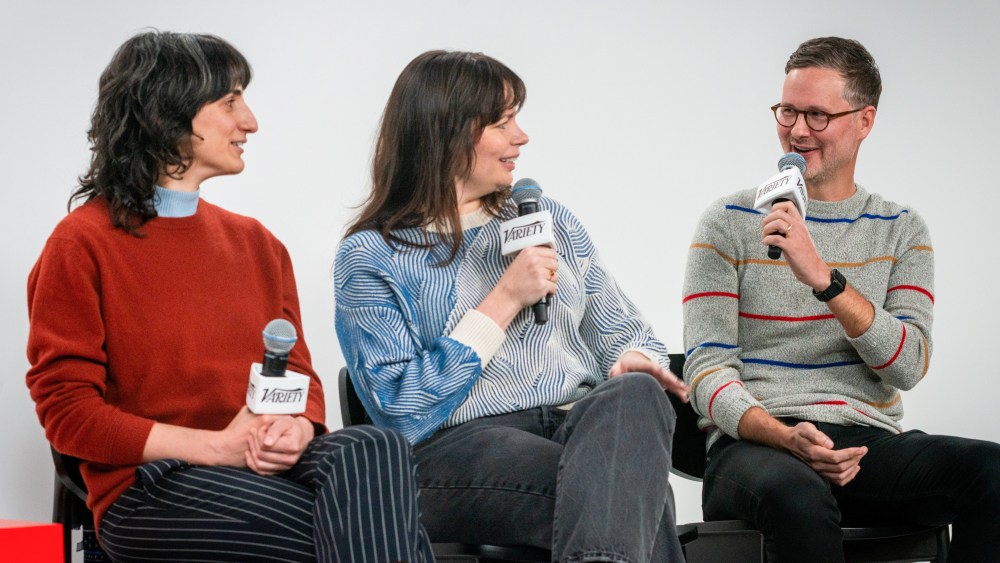
At a Variety & Adobe Creative Collaborators panel at the 2026 Sundance Film Festival, “Time and Water” editors Erin Casper, Mark Harrison and Jocelyne Chaput sat down with Adobe’s product marketing director Meagan Keane to discuss bringing the project to life.
The logline of the film reads: “Facing the death of his country’s glaciers and the loss of his beloved grandparents, Icelandic writer Andri Snær Magnason turns his archives into a time capsule to hold what is slipping away — family, memory, time, and water.”
Casper and Chaput have both worked with “Time and Water” director Sara Dosa before and were later joined by Harrison. Approached by Dosa at a birthday party and asked to watch a rough cut of the film, Harrison said that Casper and Chaput were “amazing in opening up their creative process and recognizing the opportunity to have [him] come on board.”
In addition to the glacier footage provided by Dosa, the editing team drew extensively from Magnason’s writing. “As editors, we really liked to research, especially on archival films,” said Casper. “At the outset of every edit, we’ve watched stuff, and then we convene for an editing retreat where actually we don’t do any editing whatsoever. It’s a time to really talk about the big questions and dream big.”
“So much at the heart of editing is the conversation,” she continued, adding that it was a very tactile process that involved “almost no computers at first” as the team went on several walks and snack breaks together.
Along with Dosa and the film’s producers, the trio divided up scenes into parts of the film, taking turns working on them and exchanging sequences often based on preference.
Despite the team being spread across the United States and Iceland (Casper is based in New York, Harrison in Los Angeles and Chaput in the Bay Area), the editors frequently collaborated in person, usually around the film’s “critical milestones,” such as the first rough cut and the first line cut. “There is something that happens when you’re in person where everything’s just percolating more efficiently in some stages of the process,” said Chaput, adding that they kept in contact constantly via Slack or phone calls. “We feel each other in the room even when we’re remote.”
“It takes deep listening and not just setting your ego aside, it’s actually like letting the film find its voice,” said Harrison. “What are we all trying to say? I think that that’s more powerful than what any one of us has to say.”
After conducting extensive research for “Time and Water,” Casper said the film prompted her to think about climate change. “You can have a sense of inevitability that the future is fixed. But we talked a lot about how the future is not foreclosed and thus changeable.”
Wrapping up the conversation, Chaput took a moment to reflect on the evolution of filmmaking. “I’m optimistic about the talent out there and the filmmakers, both young and old. I don’t think that river of originality is any closer to running dry ever. What concerns me is the ever-evolving landscape of funding and just making sure that independent storytelling is maintained, and that we are not preemptively filtering ourselves as creators while having to pay bills.”