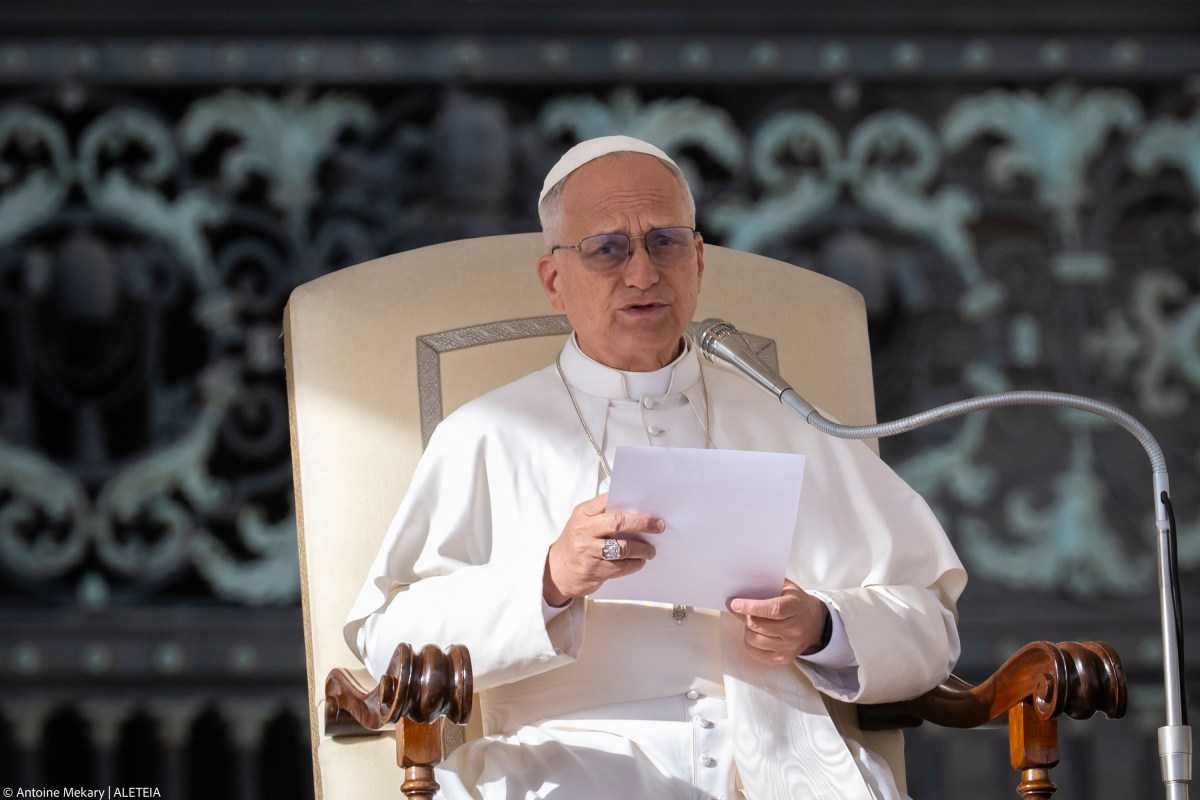
“You are called to guard the truth with rigour but without rigidity, and to exercise charity without omission,” Leo XIV told members of the Roman Rota, received in an audience on January 26, 2026, at the Vatican. He insisted that the proceedings handled by the tribunal, mainly those concerning requests for marriage annulment, must “inspire trust” in the faithful, particularly with regard to the equal treatment of cases.
On Monday morning, the Pope received the prelates of the Roman Rota for the first time, on the occasion of the inauguration of the judicial year, offering them a reflection on the relationship between truth and charity in their work.
The Roman Rota was founded in the 12th century, and is one of the three tribunals of the Roman Curia. It’s made up of a college of 20 prelate auditors, appointed by the pope and placed under the direction of a dean, currently the Spanish Archbishop Alejandro Arellano Cedillo. This tribunal operates as the highest court of appeal of the Church and mainly judges requests for the recognition of marriage annulments.
It is important to note that the recognition of nullity is not a divorce. A validly celebrated and consummated marriage cannot be dissolved (except for the rare cases “in favor of the faith,” under the Petrine or Pauline privilege, distinct from an annulment). Rather, it means that sufficient evidence has been presented before the Church to be able to determine with certainty that the marriage never truly existed, due to a defect in the matter or form of the marriage.
Beware a “dangerous relativization of the truth”
In his long speech, the Pope cited the great recent reformers of the Rota: Benedict XVI, John Paul II, and Pius XII.
Pope Leo XIV, himself an expert in Church law, affirmed that exercising justice was a matter of ethics, but also requires knowing how to reconcile truth and charity, “two intrinsically united dimensions.” He acknowledged, however, that a “dialectical tension often arises between the demands of objective truth and the concerns of charity” in their work.
The Pontiff warned against “excessive identification with the oft troubled vicissitudes of the faithful.” This can lead, he explains, to “a dangerous relativization of truth.” He described this as “misunderstood compassion, even if apparently motivated by pastoral zeal,” seeing it as “dangerous relativization of truth.”
Such an attitude, the Pope warned, “risks obscuring the necessary dimension of ascertaining the truth proper to the judicial office.” He cited in particular the cases of marriage annulment “where it could lead to pastoral decisions lacking a solid objective foundation.”
However, justice cannot be a “cold and detached affirmation of the truth that does not take into account all that love for people requires,” Leo XIV clarified. He asked judges not to omit “those concerns dictated by respect and mercy.”
Charity in truth, for the salvation of souls
Pope Leo XIV dedicated a moment to reflecting on this relationship between truth and charity in the light of verses from St. Paul and St. John the Evangelist. He quotes Benedict XVI: “Truth needs to be sought, found and expressed within the ‘economy’ of charity, but charity in its turn needs to be understood, confirmed and practiced in the light of truth” (Caritas in veritate no.2).
“May your work, therefore, always be motivated by that true love for neighbour that seeks above all else his eternal salvation in Christ and in the Church, which entails adherence to the truth of the Gospel,” Leo XIV said.
He thus reminded his listeners that the “supreme law in the Church” is “the salus animarum,” the salvation of souls — a principle enshrined in Canon Law itself (Can. 1752).
Processes must “inspire confidence”
“Canonical processes must inspire the trust that comes from professional seriousness, intense and thoughtful work, and a convinced dedication to what can and must be perceived as a true professional vocation,” demanded the Pope.
“The faithful and the entire ecclesial community have a right to the proper and timely exercise of procedural functions, because it is a journey that affects consciences and lives,” he insisted.
The Pontiff also highlighted the work of lawyers registered with the Roman Rota, who defend the faithful in annulment trials, and “defenders of the bond,” prelates who defend the validity of marriage, warning them against a “purely bureaucratic approach” to their duties.
He stressed the importance of the principle of the “adversarial process,” calling for respect for “the presumptions of the validity of marriage and the innocence of the defendant, until proven otherwise.”
He also warned against the risk of “favoring unjustified disparity in the treatment of similar situations.”
As an example, Leo XIV cited the shortest form of marriage annulment proceedings, which take place before the diocesan bishop, calling for great care in judging all cases, even when, “prima facie,” the grounds for annulment seem obvious. This procedure was established in 2015 by Pope Francis.