Last Updated:January 27, 2026, 20:22 IST
The India-EU Free Trade Agreement is more than just a trade deal. It is a statement of intent about India’s place in the global economic order of the coming decades



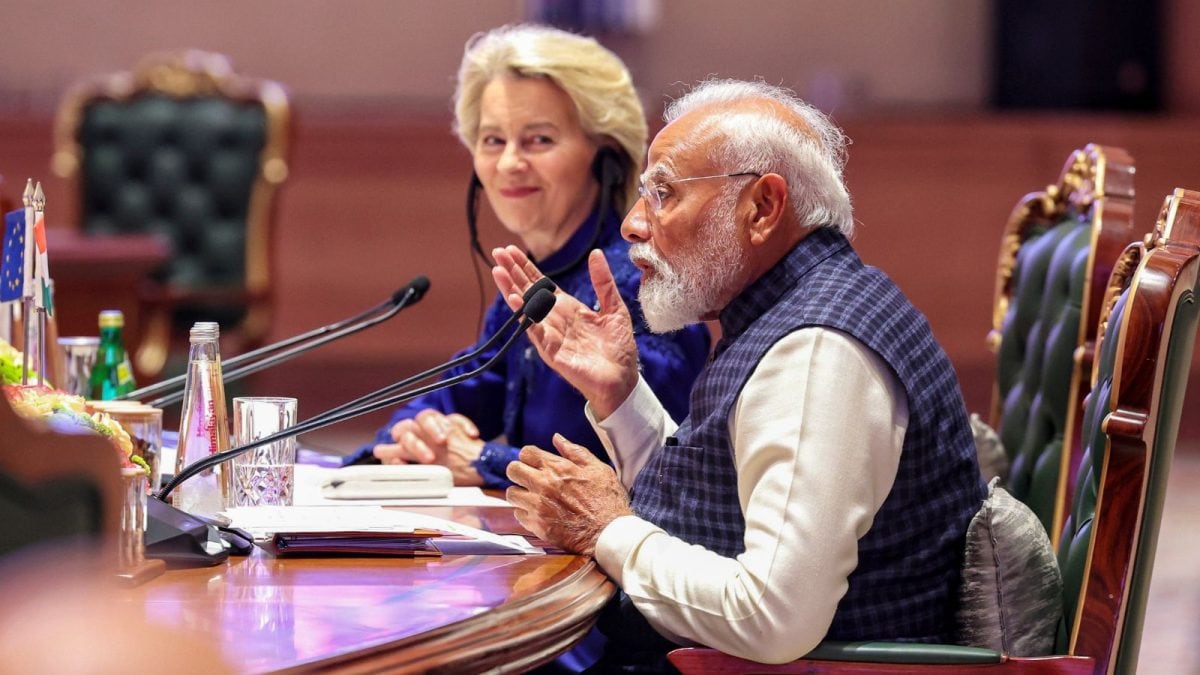
PM Narendra Modi and European Commission President Ursula von der Leyen during the India-EU Business Forum, in New Delhi on January 27, 2026. (Image: PMO/PTI)
In a global economy increasingly grappling with fragmentation, tariffs and geopolitical risk, the India-EU Free Trade Agreement marks a decisive assertion of strategic economic confidence.
This is not merely a trade deal concluded after years of negotiations; it is one of the most consequential economic alignments of the decade, binding the world’s most populous nation with the largest integrated economic bloc.
Together, India and the European Union represent nearly 1.9 billion people, around a quarter of global GDP, more than one-fifth of global merchandise trade, and close to a third of global services output. Few agreements in modern trade history operate at this scale. The timing of the deal, of course, makes it all the more special.
For India, the timing could scarcely be more important. Global trade growth has slowed to below 3 percent annually, protectionism is rising across advanced economies, and supply chains are being reconfigured amid strategic rivalries. Against this backdrop, the India-EU FTA anchors India firmly within the world’s most rules-based, high-value markets, signalling that India is prepared to compete and lead within the most demanding trade ecosystems.
Even before the agreement, the EU was India’s largest trading partner with annual bilateral trade of approximately 120 billion to 125 billion euros, accounting for over 15 percent of India’s total trade. With the FTA now in place, credible projections suggest this figure could cross 200 billion euros within a decade.
That would make the India-EU trade corridor larger than India’s trade with ASEAN, Japan, and South Korea combined, underscoring the transformative potential of the agreement. What distinguishes this FTA is not just its size, but its depth. The agreement eliminates or substantially reduces tariffs on over 96 percent of tariff lines, covering nearly the entire value of bilateral trade over time.
For Indian exporters, this represents a decisive breakthrough into one of the world’s most affluent and regulated markets. Duties of up to 12 percent on textiles and garments are phased out, enhancing competitiveness for an industry that employs millions. Indian pharmaceuticals and generics, already critical to Europe’s healthcare systems, gain more predictable market access. Engineering goods, leather products, and processed agricultural exports similarly stand to benefit from a level playing field long denied by tariff and non-tariff barriers.
European exporters, in turn, gain access to India’s rapidly expanding consumer market. Automobiles that once faced tariffs exceeding 100 percent, and wines and spirits burdened with duties as high as 150 percent, now enter a calibrated liberalisation framework. For Indian consumers, this translates into greater choice and lower prices; for Indian industry, it injects competitive pressure that drives efficiency, technology absorption, and higher standards.
Yet the true strategic value of the India-EU FTA lies beyond tariffs. This is a modern, next-generation trade agreement that places services, investment, and regulatory cooperation at its core.
India is the world’s largest exporter of digitally delivered services, while the EU accounts for nearly a third of global services exports. Improved access for Indian IT firms, professionals, and service providers into Europe’s markets reinforces India’s position as a global services powerhouse. Simultaneously, stronger investment protection and regulatory clarity are expected to accelerate European foreign direct investment into India, which already exceeds 100 billion euros in cumulative stock.
This matters profoundly for India’s long-term growth trajectory. As global firms pursue “China-plus-one” strategies and seek resilient supply chains, India is emerging as a credible manufacturing and innovation hub.
The FTA strengthens this positioning by offering European companies a stable, rules-based framework to expand production in India across electronics, pharmaceuticals, clean energy equipment, electric vehicle components, and advanced engineering. It directly complements India’s ‘Make in India’ vision and production-linked incentive schemes, while aligning with Europe’s own strategic push for diversified and trusted supply chains.
The agreement’s sustainability framework further reflects its forward-looking character. By embedding commitments aligned with the Paris Agreement and cooperation on clean energy and green technologies, the FTA prepares Indian industry for the regulatory future of global trade.
This is particularly relevant in the context of the EU’s Carbon Border Adjustment Mechanism (CBAM). Rather than reacting defensively, India now has a structured pathway to engage, adapt, and shape evolving global climate-linked trade norms.
The diplomatic significance of the agreement should not be underestimated. Negotiations began as far back as 2007 – stalled for years over automobiles, agriculture, intellectual property, and data governance – were revived only in 2021 amid a rapidly changing global order. That these differences have now been resolved reflects political maturity on both sides and a shared recognition that economic strength today flows from integration, not isolation.
Equally important is the strategic insulation the FTA provides India in an uncertain global trade environment. Alongside the recently concluded India-UK agreement, India now enjoys preferential access to markets representing nearly $20 trillion in combined GDP.
This diversification reduces dependence on any single export destination and helps cushion Indian exporters against potential tariff actions elsewhere. For sectors such as pharmaceuticals, textiles, engineering goods, and digital services, Europe and the United Kingdom offer stable, high-value demand that enhances India’s export resilience.
The India-EU FTA is not merely about incremental trade gains. It is about positioning India at the centre of a reconfigured global economy, strengthening its manufacturing and services base, and asserting its role as a rule-maker rather than a rule-taker in international commerce. At a time when globalisation is under strain, this agreement demonstrates that India is not retreating from the world – but engaging it on confident, competitive, and strategic terms.
In that sense, the India-EU FTA is more than just a trade deal. It is a statement of intent about India’s place in the global economic order of the coming decades.
(The writer is a national spokesperson of BJP, besides being an acclaimed author. Views expressed in the above piece are personal and solely those of the author. They do not necessarily reflect News18’s views)
January 27, 2026, 20:22 IST
Read More