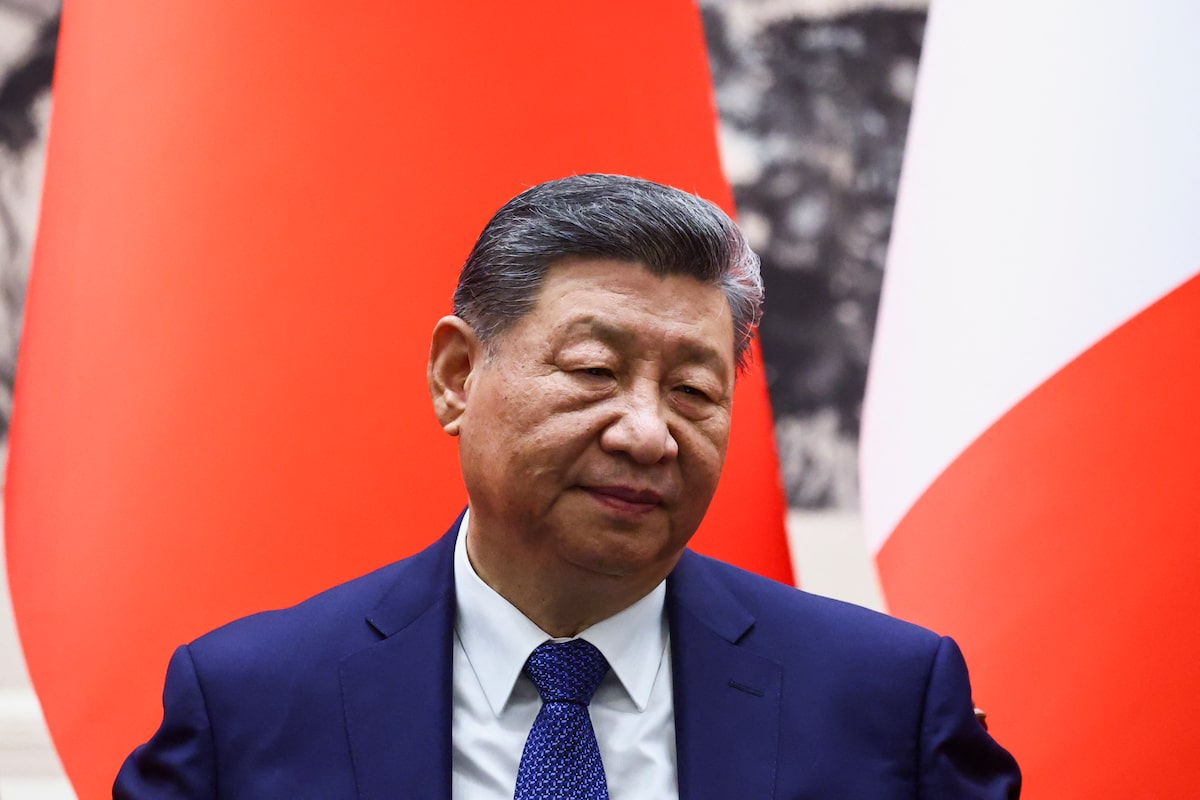
General Zhang Youxia, who was removed over the weekend from China’s Central Military Commission, was a friend and close ally of President Xi Jinping, shown in a Dec. 4 photo.SARAH MEYSSONNIER/AFP/Getty Images
When Chinese leader Xi Jinping moved forward a modernization target to 2027, almost a decade after assuming absolute authority over the People’s Liberation Army, he set off a storm of speculation in parts of the West, with many warning Beijing was in fact outlining a tacit deadline to be ready to invade the self-ruled island of Taiwan.
Mr. Xi has denied ever setting such a goal, but his transformation of the PLA, the world’s largest fighting force, has continued apace, as has a twin campaign to purge the top military ranks of alleged corruption, which over the weekend nabbed its most high-profile target: General Zhang Youxia.
As vice-chairman of China’s Central Military Commission, Gen. Zhang was the highest ranked PLA commander in the country, second only to Mr. Xi himself. His removal, along with senior staff officer General Liu Zhenli, leaves the CMC with only two members – one of whom is Mr. Xi – instead of the normal seven.
Taiwan vows to defend its sovereignty after Chinese military drills
In an editorial Sunday, the People’s Liberation Army Daily, an official military mouthpiece, said Gens. Zhang and Liu had “seriously trampled on and undermined the system of ultimate responsibility resting with” Mr. Xi as CMC chairman.
“They have severely fuelled political and corruption problems that threaten the Party’s absolute leadership over the armed forces and undermine the Party’s governance foundation,” the editorial said, in an unusually pointed reference to potential political differences within the top ranks of the military. Previous purges of senior generals have involved instances of more cut-and-dry corruption, including allegations of selling secrets, or missiles filled with water rather than fuel.
Gen. Zhang was a friend and close ally of Mr. Xi’s throughout the latter’s rapid rise to the height of Chinese politics, and one of the rare combat veterans in the senior ranks of the PLA, having fought in border skirmishes against Vietnam in the seventies and eighties – making his removal all the more remarkable.
Drew Thompson, a former China specialist at the U.S. Department of Defense, said he was “genuinely surprised and frankly shocked,” by Gen. Zhang’s removal. While corruption is “endemic,” in the PLA, and there have been rumours about a potential investigation of Gen. Zhang for years, Mr. Thompson wrote on his Substack Monday, “I thought his lifelong relationship with Xi Jinping would be his insurance.”
Gen. Zhang, shown in April, 2024, was the highest-ranked People’s Liberation Army commander in the country, second only to Mr. Xi.Florence Lo/Reuters
Politics in China, particularly at the highest level, is a black box, and has become even more so under Mr. Xi, making parsing his latest moves difficult, including what purging the PLA could mean for any plans to seize Taiwan, which Beijing has said is a vital step toward the goal of national rejuvenation.
On one hand, allegations of corruption involving two of the PLA’s top figures do not speak well to the Chinese military’s readiness to fight what would be one of the most complicated and costly wars in history, pulling off an immensely difficult seaborne invasion against fierce resistance while staving off intervention by the U.S. and Japan, and dealing with the inevitable economic consequences, including potentially triggering a global market crash.
On the other, many observers have said it is fear of the potential fallout from any attempt to seize Taiwan – including threatening the survival of the Communist Party itself, should such an invasion fail or plunge the PLA into a Ukraine-like quagmire – that has long stayed Beijing’s hand. Purging Gen. Zhang potentially removes a voice of caution from the CMC and further concentrates decision-making in Mr. Xi, who may be motivated by his own political survival, or ambition, when it comes to triggering a war for Taiwan.
“He was the one active duty PLA officer who could give Xi the best, most objective advice about PLA military capabilities including the PLA’s shortcomings, and crucially the human cost of military conflict,” Mr. Thompson said of Gen. Zhang. “He could assess U.S. and Taiwan military capabilities objectively and explain to Xi Jinping what the military risks and costs of an operation to take Taiwan would be.”
He added, “A sycophant with no combat experience has to tell Xi what Xi wants to hear. I worry about the consequences of someone other than Zhang Youxia providing Xi Jinping with military advice.”
Trump administration announces more than $10-billion arms package for Taiwan
Previous purges and corruption scandals within the PLA have highlighted issues with readiness and capacity, exposing the Chinese military as a potential “paper tiger” without the ability to project power in practice. Mr. Xi’s dramatic actions may be a response to this, seeking to ensure that if and when the time comes, the PLA is ready for war.
In the immediate term, Gen. Zhang’s removal and the inevitable chaos this will cause within the PLA’s leadership, “probably reduces the chance of China taking imminent, deliberate military action to seize Taiwan,” analysts at the Australian Strategic Policy Institute said in an assessment Tuesday.
“Purges at this level usually signal doubt, not confidence,” wrote Nathan Attrill and Andrew Wilford in the assessment. “Removing senior commanders and corrupt procurement networks suggests Xi believes internal reporting is unreliable, readiness overstated and critical systems compromised – or that the military is failing to meet the high performance benchmarks he has set.”
However, they agreed with Mr. Thompson in that concentrating power further in Mr. Xi’s person raises the risk of ill-informed or self-serving decision making.
“The purge does not signal de-escalation. It may increase the risk of sharper coercive pressure short of invasion, and it reinforces the point that 2027 is not a fixed invasion deadline,” the analysts wrote. “Xi will act on his own assessment of confidence and control.”
For its part, Taiwan’s military said it was continuing to “closely monitor abnormal changes among the top levels of China’s party, government, and military leadership.”
Speaking to reporters, Defence Minister Wellington Koo said Taipei’s position “is based on the fact that China has never abandoned the use of force against Taiwan.”