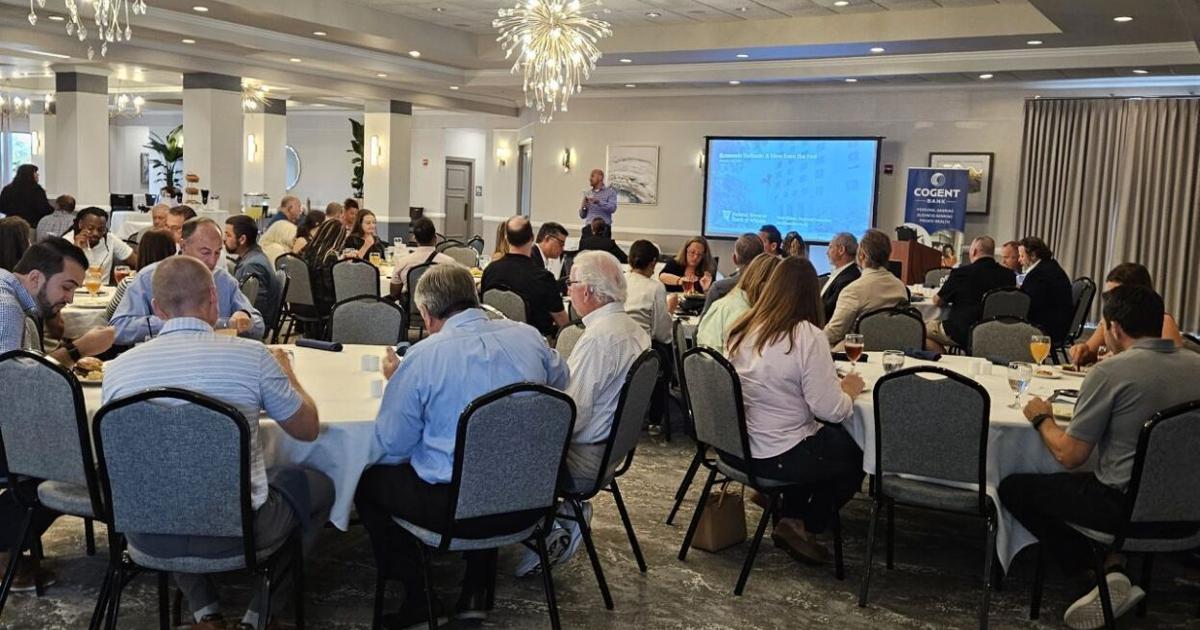
Southwest Florida business leaders packed a country club ballroom in Bonita Springs earlier this month to hear Federal Reserve Bank of Atlanta regional executive Shari Bower deliver her economic forecast for 2026 at an event hosted by Orlando-based Cogent Bank.
Bower shared recent data on the Fed’s primary focus areas — inflation and employment — suggesting the U.S. economy is performing just OK. After a year marked by volatility and uncertainty, audience members pressed her for clearer answers, asking about everything from the price of gold to how much cash the Treasury is printing.
Repeatedly, Bower said she did not have definitive answers, reflecting the uncertainty among Federal Reserve policymakers. In recent months, board members have been split on whether to cut interest rates further in 2026.
“I have probably left you with about as much certainty and clarity as the members of the (The Fed) feel right now,” Bower concluded. “And that was sort of my intention.”
She did, however, respond to one question: If the 2025 economy could be summed up in a single word — uncertainty — what word would define 2026?


Shari Bower, a regional executive with the Federal Reserve Bank of Atlanta, delivered a 2026 economic forecast to Southwest Florida business leaders at a Cogent Bank event in Bonita Springs.
Federal Reserve
“Meh,” Bower said, prompting murmurs from the audience.
If the 2026 economy proves unexceptional and even boring, as her reaction suggests, that could be a welcome contrast to the turbulence of the past year. A steady economy may reduce the likelihood of surging inflation, a stock market crash or a deep recession.
“Meaning, it’s going to be fine and no big movement one way or the other,” said Cogent Bank Market President Brandon Box, reflecting on Bower’s remarks the following day.
Box, who is based in Naples and leads Cogent’s Southwest Florida commercial lending operations, considered what a “meh” economy might mean for his clients, which include small to midsize businesses in the trades, professional services and nonprofit sectors.
The outlook carries both positives and risks. If little changes in 2026, uncertainty remains around the effects of federal tariff policies, artificial intelligence investment and other forces shaping the economy.
Based on Bower’s presentation and his own experience, Box said rising inflation and its impact on employee recruitment in a tight labor market remains the top concern for Southwest Florida businesses. Although Fed policies have slowed inflation, recent reports show it remains just under 3%, slightly above the central bank’s 2% target.
“I think really what we feel down here the most, at least my clients, is the inflation side of it,” Box said. “We all feel the prices going up.”

Brandon Box, market president for Cogent Bank in Southwest Florida, reflects on the Federal Reserve’s 2026 economic outlook following a business forum in Bonita Springs.
Cogent Bank
Along with higher grocery and consumer prices, housing costs remain a major challenge. Wages often fail to keep pace, particularly in high-cost markets. Bower cited the traditional guideline that households should spend no more than 30% of income on housing, noting that Collier County residents average 56.6% compared with 43.2% nationally.
“Our country is really based around having a strong middle-class workforce,” Box said. “If that deteriorates or people can’t get a fair wage to survive, what happens then? Do they move to markets that are less expensive? What are the other side effects of that? I think labor to me is the scariest thing.”
Inflation also is eating into otherwise solid revenue streams, leading to muted profit growth.
“[Inflation] results in income levels that are OK. It’s not great, but it’s not horrible,” Box said.
Tariffs have had a more modest impact so far, but Box expects their effects to intensify over the next 12 to 18 months as costs move through the economy. Companies may absorb the increases or pass them on to consumers.
“Either scenario is probably not great,” he said. “One hurts the stock market; one hurts the consumer.”
Still, consumer spending has remained resilient, supported largely by high earners, who account for nearly half of national spending. Box warned that a market downturn or technology-sector disruption could quickly curtail that high-end consumption.
Business investment is another bright spot. Developers across Southwest Florida are investing in industrial and mixed-use projects, while potential new federal tax incentives and declining interest rates for Small Business Association and commercial loans could further stimulate borrowing.
Box also sees AI as a possible long-term counterweight to inflation through efficiency gains and emerging technologies, including 3D-printed housing.
“Maybe that could be a sort of counter against inflation,” he said.
Time will tell.