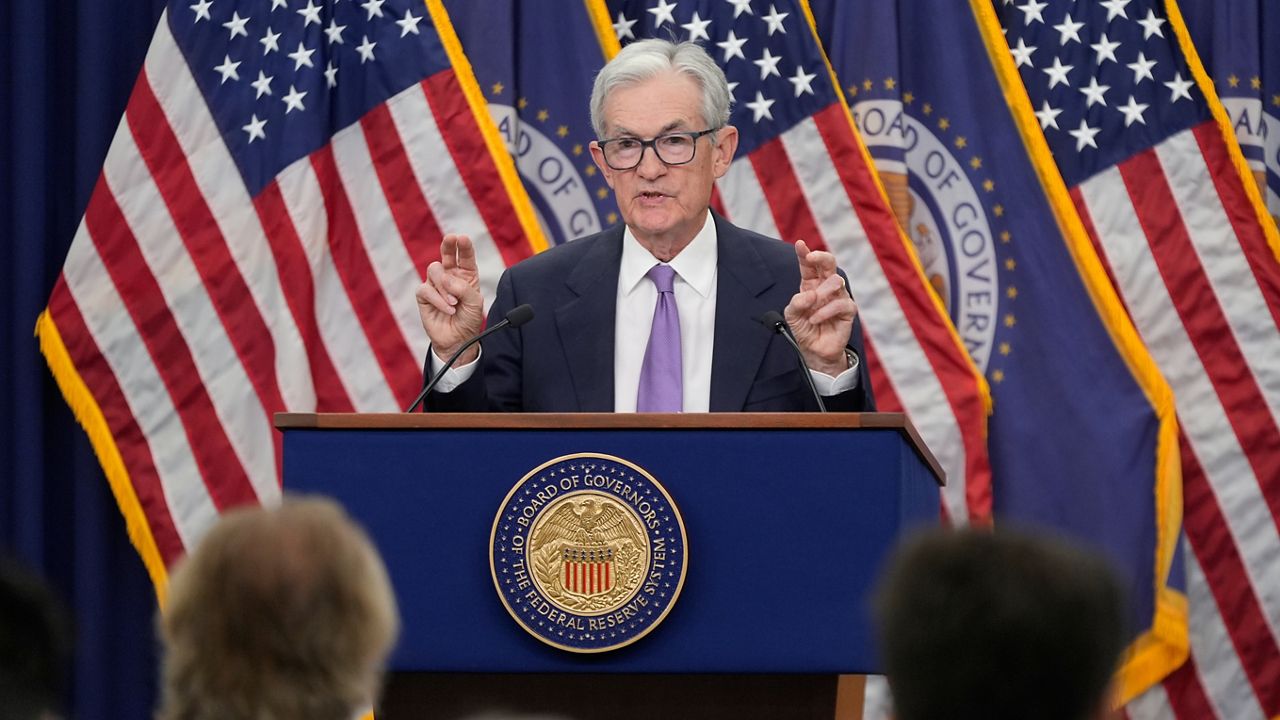
Federal Reserve officials began their two-day meeting Tuesday –– a day ahead of their scheduled vote on whether to lower interest rates.
Laura Jackson Young, an economics professor at Bentley University, said she is expecting that the central bank will leave the federal funding rate –– the rate that banks charge one another for overnight lending –– unchanged.
Market participants and economists surveyed by CNBC and Bloomberg have also predicted that the committee will vote to keep the current rate of 3.5%-3.75% and are anticipating only two additional 25-basis-point rate cuts this year.
“Really, I’m looking at how they talk about future changes to see if they expect to be patient, especially because of the weakness in the labor market,” Jackson Young said.
‘Threats on Fed independence’
Wednesday’s vote will be the first since Federal Reserve Chairman Jerome Powell announced he is under investigation by the Justice Department.
“I would like to say they probably would want to try to compartmentalize, but it’s really challenging, especially when you look at the threats on Fed independence,” Jackson Young said. “If anything, it’s almost pushing them perhaps more towards establishing independence to show that they’re definitely setting policy in response to the data and very clearly not succumbing to external pressures.”
Powell announced in a social media video earlier this year that prosecutors had served the central bank with subpoenas and threatened a criminal indictment over his testimony about renovations at the central bank’s Washington, D.C., headquarters.
“Those are pretexts,” Powell said in the video. “The threat of criminal charges is a consequence of the Federal Reserve setting interest rates based on our best assessment of what will serve the public rather than following the preferences of the president.”
President Donald Trump told NBC News shortly afterward that he was not aware of the investigation into Powell.
Trump, who has long railed against the Fed chair in frustration over interest rates, has also suggested that he may soon name Powell’s replacement.
“We’re going to have somebody that’s great, and we hope he does the right job,” Trump said during his remarks in Davos, Switzerland, last week without naming the person he plans to nominate.
Powell’s four-year term as chair is scheduled to end in May, but he could opt to stay on as a governor through January 2028 –– a move that would partly block the president’s effort to reshape the Board of Governors.
Trump also sought to oust Federal Reserve governor Lisa Cook in August. The Supreme Court heard oral arguments over her firing last week but has allowed her to remain in the role as the legal proceedings play out.
The Trump administration has accused Cook of claiming that properties in Michigan and Georgia would both serve as her primary residence in mortgage agreements. Her lawyers said that she “vigorously contests” the allegations that pre-date her joining the Fed.
“The big impact, I think, is that a lot of these constant news headlines of something in terms of putting pressure on the Fed is just creating an environment kind of, of uncertainty,” Jackson Young said. “So that uncertainty itself, regardless of what they do with policy, the uncertainty itself can affect how people choose to spend and businesses choose to invest.”
U.S. economy showing mixed signals
In addition to the seven members on the Fed’s Board of Governors, the president of the Federal Reserve Bank of New York as well as four of the remaining 11 Reserve Bank presidents — who rotate in for one-year slots — make up the 12 votes at each Federal Open Market Committee.
The committee voted to lower interest rates three times last year –— each by a quarter of a percentage point. When the Federal Reserve reduces the federal funding rate, that often causes a ripple effect of lower borrowing costs for mortgages, auto loans and credit cards.
In December, Powell emphasized the dual mandate for the Fed: to foster maximum employment and price stability.
“In the near term, risks to inflation are tilted to the upside, and risks to employment to the downside, a challenging situation,” Powell said at a news conference last month. “There is no risk-free path for policy, as we navigate this tension between our employment and inflation goals.”
The most recent monthly jobs report released by the Commerce Department showed sluggish hiring even as unemployment remained low.
While, the Consumer Price Index rose 2.7% over the prior 12 months — and increased 0.3% in December from the previous month –– according to the most recent data from the Labor Department. The Federal Reserve has a target of 2% for inflation.
“What (data) we were able to capture after the government shutdown is that the jobs numbers are weakening a little bit. So there’s kind of some softness I think in the labor market,” Jackson Young said. “But inflation is still rather stubborn and above what they’re looking at for their target.”
Some of the data has also been showing what Jackson Young described as “discrepancy depending on where you are in income distribution.”
“This idea of the K-shape is that those at the upper end of the income distribution –– those are the ones really enjoying the gains of the strong stock market that we saw,” she said. “While those at the lower end of the income distribution are really getting squeezed.”