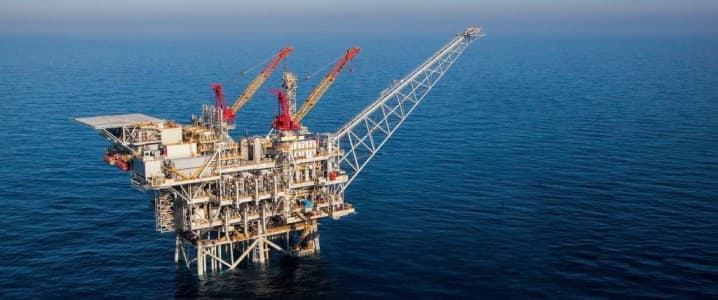
Israel is set to achieve record natural gas production in 2026, with expansion projects in the Leviathan and Tamar fields expected to push total output above 3 billion cubic feet per day (cfd) for the first time ever. According to the experts, the Chevron (NYSE:CVX) operated fields are expected to add a combined 600 million cfd in the coming months, with the bulk of the extra gas piped to Egypt after the removal of bottlenecks in the export pipeline network. Israel’s gas output in 2025 is estimated to have dropped slightly from a record 2.587bn cfd achieved in 2024 as fields were shut-in during Israel’s conflict with Iran in June.
Chevron and its partners NewMed Energy (OTCPK:DKDRF) and Ratio Energies (OTCMKTS:RTEXF) confirmed a $2.36 billion Final Investment Decision (FID) in January 2026 to expand the Leviathan field, increasing production capacity from 12 bcm to roughly 21 bcm annually. The expansion involves drilling three additional offshore wells, installing new subsea infrastructure and enhancing the platform’s processing capabilities. The expansion aims to significantly increase natural gas exports to Egypt and Jordan. The companies managed to boost production at the Tamar field to increase capacity from approximately 1.1 billion cubic feet per day (bcf/d) to 1.6 bcf/d in 2025.
Debottlenecking of the export pipeline network is enabling higher volumes to reach Egypt, helping to fill their domestic supply gapsKey projects, including upgrading the Ashdod-Ashkelon pipeline and constructing the Nitzana pipeline (expected to be operational by 2028). The projects are designed to boost exports to Egypt and Jordan by 1.8 billion cubic feet per day. The 46-km offshore natural gas Ashdod–Ashkelon pipeline is undergoing upgrades scheduled for completion in the current year to handle increased capacity. Approximately 55% of the gas flows through the offshore Eastern Mediterranean Gas (EMG) pipeline, while 45% is transported via the Arab Gas Pipeline through Jordan.

The Arab Gas Pipeline (AGP) is currently operating in reverse for localized, regional supply, rather than its original Egypt-to-Turkey export purpose. In August 2025, the 63-km Kilis-Aleppo pipeline was revived, connecting Turkey’s grid to Syria to supply 3.4 million cubic meters a day (MMCM/D), with a target to increase flows to 6 MMCM/D. Jordan utilizes the AGP to transport imported LNG from its Aqaba terminal northward. Meanwhile, a new 6 billion cubic meter (bcm)/year capacity onshore pipeline from Ramat Hovav to the Egyptian border is under development. The pipeline is expected to be operational by 2028 and will facilitate greater export capacity to Egypt.
Last year, Israel approved a historic, 15-year agreement to supply Egypt with 130 billion cubic meters (BCM) of natural gas worth $35 billion from the offshore Leviathan field through 2040. The gas deal, the largest in Israel’s history, aims to ease Egypt’s severe energy shortages while strengthening economic ties, driven by U.S. diplomatic efforts. The deal is expected to generate significant revenue for the Israeli state treasury, estimated at around $18 billion in taxes and royalties over the contract’s life. The agreement is considered a significant step in strengthening regional energy cooperation and stability, despite ongoing political tensions between the two nations. Egypt’s ambitions to be a regional gas hub have reversed over the past couple of years, turning it into a net importer due to declining production at major fields like Zohr coupled with surging domestic demand. The country’s output has dropped by about a third since 2019, with insufficient investment and infrastructure issues crippling export capacity.
The Leviathan and Tamar gas fields are key Israeli offshore natural gas assets, with current capacities of approximately 12 billion cubic meters (BCM) per year and 11 BCM per year, respectively. Both fields are expanding, with Leviathan projected to increase to 21–23 BCM annually to meet rising regional demand and exports. Still, the Middle East oil giants have potential for higher gas production.
As of 2022, Israel had approximately 1,087 billion cubic meters (BCM) of proven natural gas reserves, considerably lower than Egypt’s proven reserves at 77 trillion cubic feet (Tcf). Iran and Qatar share the South Pars/North Dome field, the world’s largest natural gas field, with 51 trillion cubic meters (tcm) in total reserves, of which 36 tcm are recoverable. Iran holds 14 tcm (South Pars), while Qatar holds the majority reserves in the North Field.
Iran is the second-largest global gas reserve holder behind only Russia, focusing on domestic use, whereas Qatar is a top global exporter. Russia holds the largest proven natural gas reserves in the world, with estimates around 1,688 trillion cubic feet (Tcf) or approximately 38 trillion cubic meters, accounting for nearly 20% of the global total.
By Alex Kimani for Oilprice.com
More Top Reads From Oilprice.com