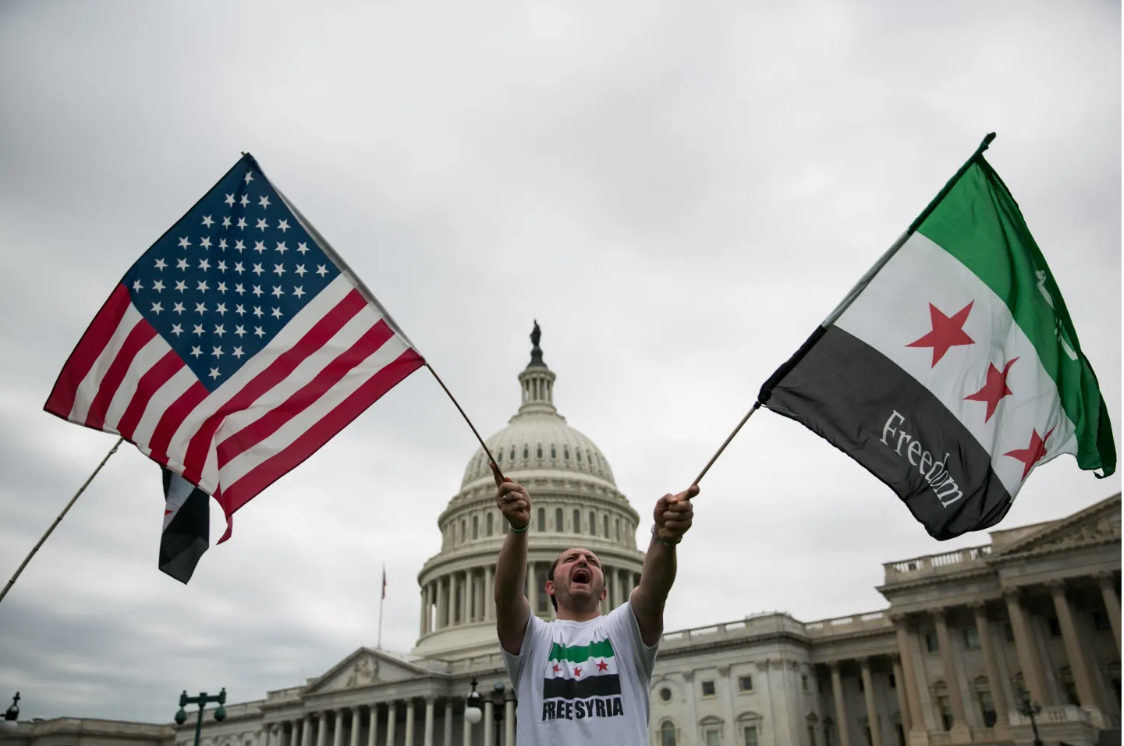
Following the collapse of the Assad regime in Syria, a new force declared its sovereignty. A government claiming to be the latest democracy in the Middle East, a statement not entirely supported by evidence. Headed by Ahmed al-Sharaa, a former U.S.-designated terrorist who until recently had a $10 million bounty on his head, has divided much of the international world.
Syria resides in a geopolitical purgatory as the country’s future remains in flux, balanced between the risk of further collapse and gradual recovery. While the outcome is unknown, it is up to the international community to ensure the strongest possible support rather than resign to Syrian failure.
As a nation, Syria is plagued by a number of issues, ranging from a refugee crisis that remains a global challenge, a lack of control over the northern regions of the country, and a crumbling infrastructure. Despite this, there is still hope for the future; the country could be poised for economic and political growth, provided Syria can move beyond pressing security and legitimacy complications.
Washington, D.C., has recognized the critical juncture in Syria and has begun to take action in the region. In a meeting with Al-Sharaa at the White House, President Donald Trump ended sanctions and worked to normalize relations. This initial engagement, while progress, is insufficient and could be at risk of prematurely legitimizing U.S. involvement or misrepresenting Syrian recovery.
Syria faces a long and difficult road toward prosperity. The United States should move beyond its symbolic involvement and actively support the Syrian people and the transitional government in their pursuit of genuine economic and political recovery.
This fragile opening creates a crucial opportunity for the United States to act. The U.S. investment in Syrian democracy would be an essential step in strengthening the base upon which a new Syria is founded, while creating a strong regional partnership for the future.
Democracy promotion has failed before; U.S.-created political systems in fellow Middle Eastern country Iraq have underperformed in addressing public needs and are instead dependent on divergent sectarian interests. These outcomes demonstrate that durable and lasting democratic success depends on domestic institutions rather than foreign will. Failure in Iraq, however, does not justify disengagement. It underscores the need for humility: the U.S. should learn from past mistakes and apply them constructively in Syria, advancing democracy abroad through partnership rather than prescription.
The United States already operates within a complex web of Middle Eastern allies, notably Israel and Turkey, both strategically valuable but domestically contested partners. Cultivating a credible regional ally in the heart of the Levant would provide the United States with a window into Islamic political structures while strengthening our regional stance. Supporting a Muslim country such as Syria would counter perceptions of the United States as an outsider only interested in its regional interests. Although perspectives vary across states and populations, this approach would transform the United States from a meddling external power into a partner to engage with.
Syria provides an opportunity to not repeat the mistake made by the U.S. in 1953 in its undemocratic overthrow of Iran’s government, resulting in authoritarian governance and a suppressed people. While the U.S. has long used democracy as a foundational tool of soft power abroad, helping to develop other nations and make the world safer. A democratic Syria provides the United States with a unique opportunity to build upon this legacy. Syria’s lack of institutions, security, and unity is a symptom of a deeply troubled country and region. This is a reason for pause but not for ceasing altogether. Despite the convoluted nature of Syrian politics, this is an immense opportunity for the United States to indirectly be a steward of peace and prosperity in the Middle East long-term.
Although Syria represents a strategic opportunity for the United States amid a precarious regional balance, the moral imperative posed by the Syrian refugee crisis is arguably a more pressing matter. The 7.4 million displaced people and 4.4 million refugees are in dire need of support, and the United States is in a position to assist. Despite the defunding of USAID and the cutting of more than $237 million in aid, the U.S. can still leverage the UNHCR, the Red Cross/Crescent, and the IRC to encourage philanthropic action and investment in the region.
Policy failure has created this crisis, and Syrian refugees are the lasting legacy of a world desensitized to humanitarian crises. Humanitarian aid is the least controversial obligation and should be a bare minimum contribution. The U.S. was founded on ideals of philanthropic action and liberty, and we would be doing a grave disservice to our shared history if we were to allow international humanitarian norms to continue to be violated.
Despite this idealistic view of what the Syrian state could be, there is a reasonable cause for concern. President Al-Sharaa’s former involvement with al-Qaeda and the complete lack of infrastructure are severe complications in the long road to Syrian prosperity. U.S. engagement carries risk; it has the chance to legitimize instability in the region, further complicating the Middle East.
Al-Sharaa and his transitional government have shown tentative interest in working with Washington, joining the Global Coalition to defeat ISIS following a meeting with President Trump. Although a geopolitical move, his tactical cooperation could evolve into meaningful alignment over time. His previous ties notwithstanding, he has demonstrated a desire to improve his country.
Regardless of his previous ties, he should be encouraged to look at the United States as an ally rather than an enemy, as his predecessor did, shifting more power away from the Russians and Chinese in the region. Al-Sharaa has an incentive to pursue multivector diplomacy, and the United States should acknowledge this while making itself the most favorable option.
Regarding infrastructure, United States investment will introduce this much-needed aid to the regions in crucial need. The U.S. could achieve this through economic investment in Syrian and American companies, selling contracts to produce and develop quality hospitals, roads, schools, and power plants.
This initiative should include language that provides essential oversight and anti-corruption measures while ensuring that the companies operate in a local capacity. Working in conjunction with Syrian counterparts, the U.S. would be able to create real positive change in the region and create jobs to sustain the local populations.
As with any foreign policy decision, there must be stipulations in the United States’ involvement. If there were to be any investment or aid, there must be a strong commitment to democracy. This would be a continuation of Al-Sharaa’s stated goals and should be seen through constitutional governance. Further, there should be under no circumstances the diminishing or oppression of minority groups in the country, another of Al-Sharaa’s stated goals that should be measured through regular non-partisan, third-party reports by the UNHCR.
The United States should continue to support developing nations throughout the world. We have long been stalwart allies of democracy, and Syria should be no different. Long after diplomatic initiatives fade, the legacy of the Syrian conflict will not be of democratic success but will instead be measured in loss and human survival. The country has been the victim of policy failure and international hesitation; whatever course the United States chooses, the humanitarian cost must remain front of mind.
Democracy is not a one-size-fits-all solution, but instead a step toward a functional government for the Syrian people. Syria’s future is for Syria, but the choices Washington D.C. makes will define this geopolitical moment, forever remembered as either cautious engagement or missed responsibility.