January 28, 2026 — 11:58am
AAA
In the face of Donald Trump’s trade war on everyone, other countries have no option but to try to diversify their trade relationships to hedge the risk of overexposure to US sanctions. The European Union and India have just done that.
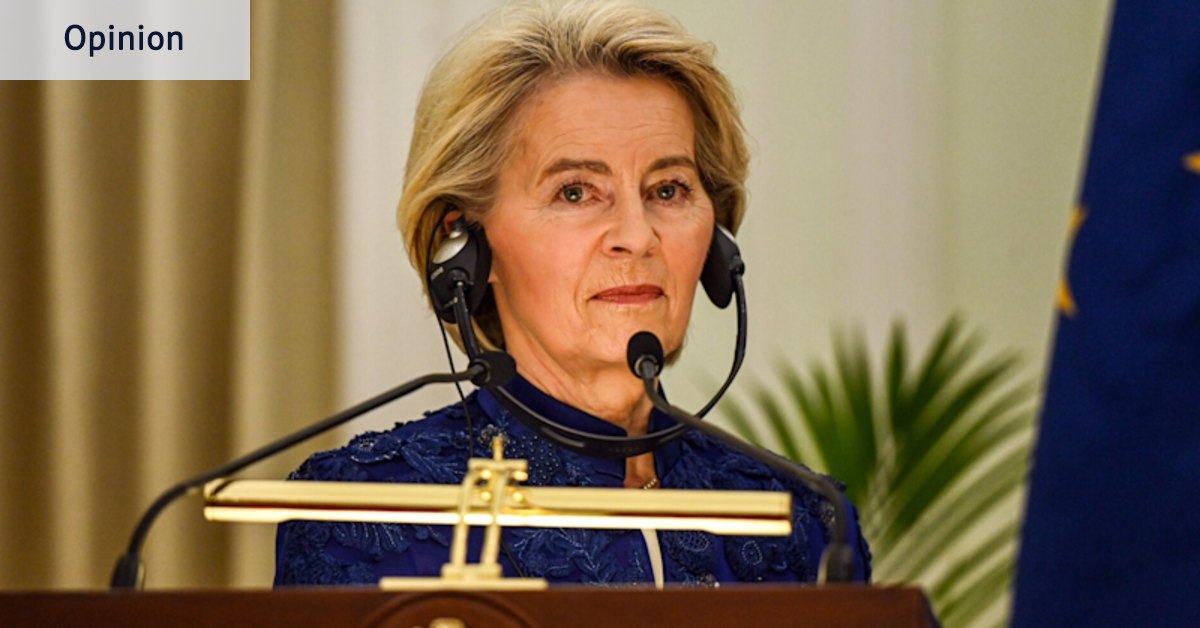
On Tuesday in India, the two powerhouses signed what the EU Commission’s president, Ursula von der Leyen, described as the “mother of all deals” – a free trade agreement that creates a market of nearly two billion consumers and a quarter of the world’s GDP.
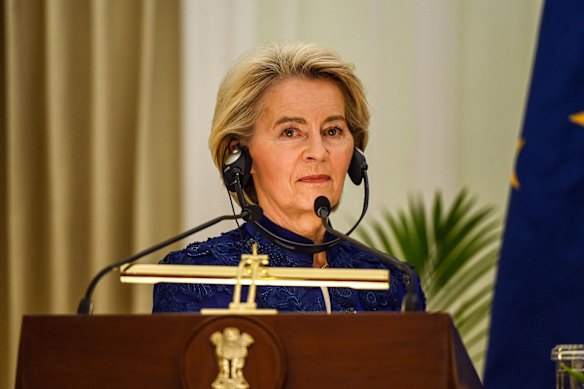
European Commission President Ursula von der Leyen said the deal sent a strong message to the rest of the world.Bloomberg
Tariffs on a majority of their trade will eventually be eliminated as Europe opens its market to India’s more labour-intensive goods and India, one of the world’s more protected economies, imports European cars, machinery, capital and beverages. About 96 per cent of the EU exports to India will see their tariffs either eliminated or reduced.
The deal is part of a scramble by America’s trading partners to sign trade deals with non-US counterparties.
The EU-India deal was nearly two decades in the making, but was accelerated by Trump’s tariffs and threatened tariffs on both countries.
Related Article
India has been the target of America’s most punitive tariffs – 50 per cent – while the EU, despite having agreed a deal with the US (not yet ratified), has still faced threats of new, higher tariffs, most recently after some of its members upset Trump by opposing his (absurd and unnecessary) ambition of acquiring Greenland.
India has recently struck more limited trade pacts with the UK, New Zealand and Oman, while the EU, after a quarter of a century of negotiations, has finally agreed a deal with the four South American countries – Argentina, Brazil, Paraguay and Uruguay –that form the Mercosur trade bloc.
This week, UK Prime Minister Keir Starmer is in China on a mission for more trade and investment that risks Trump’s ire.
Trump has threatened Canada with 100 per cent tariffs after Mark Carney’s government agreed a deal with China that will allow imports of up to 49,000 Chinese electric vehicles in exchange for increased sales of Canadian agricultural products to China.
These deals also risk Trump’s ire and the threat of even more tariffs. However, the president’s willingness to threaten these in response to any action or comment that he perceives as damaging to America’s interests, or his own ego, means it is a risk worth taking – indeed one that has to be taken to reduce countries’ exposures to America’s now-volatile and more aggressive relationships with even its former closest allies.
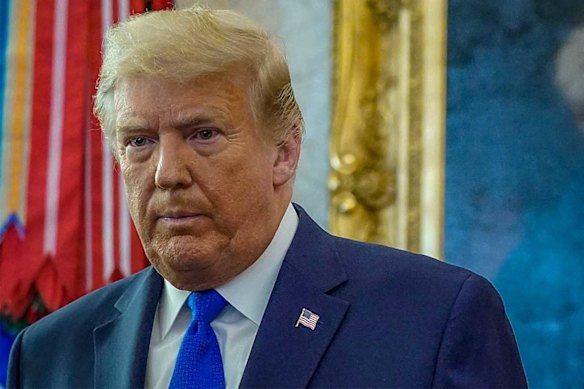
Donald Trump has left the rest of the world with little choice but to pursue alternative deals.AP
Canada, which along with Mexico negotiated the USMC (United States-Mexico-Canada) free trade agreement with the US during Trump’s first term as president, replacing the North American Free Trade Agreement (NAFTA), is a case in point.
Ever since regaining office, Trump has criticised and threatened Canada with punitive tariffs, despite the level of integration and mutual dependency between the two economies and a trade relationship that tilts only modestly in Canada’s favour.
His latest threat seems to have been sparked not as much by the narrow deal Canada agreed with China, but by Mark Carney’s speech at Davos, in which he urged middle powers to act together in response to “hegemons” because “if we’re not at the table, we’re on the menu”.
Canada, he said, had agreed a comprehensive strategic partnership with the EU and had signed 12 other trade and security deals in the past six months. It was negotiating new partnerships with China and Qatar, and free trade pacts with India, ASEAN, Thailand, the Philippines and Mercosur.
While he didn’t mention Trump by name, the acclaim Carney (who Trump disrespectfully calls “Governor Carney”, in line with his repeated and sometimes threatening references to Canada as America’s 51st state) received for what was a powerful speech seems to have annoyed Trump, whose long-winded and boastful meanderings at the same event weren’t received as enthusiastically.
Another US ally in Trump’s sights is South Korea, which struck a deal, under the threat of hefty tariffs, to invest $US350 billion ($500 billion), including $US20 billion this year.
That pledge, however, triggered a massive outflow of funds and a plunge in the value of Korea’s currency that has caused fears of a financial crisis if it delivers on its promise. Trump has slapped a 25 per cent tariff on the country’s exports in response.
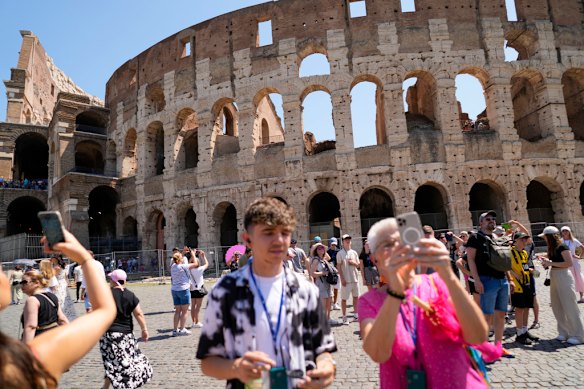
The free trade agreement creates a market of nearly two billion consumers and a quarter of the world’s GDP.AP
Most of Trump’s trade deals aren’t fully developed and signed, but “framework” agreements without the detail and legal commitments of conventional free trade pacts, raising a question mark over whether the massive investment promises extracted in exchange for lower tariff rates will ever be fully honoured.
Meanwhile, countries will seek to reduce their economic exposure to the US. Trump is redirecting global trade flows away from the US.
The trade agreement the EU and India have struck won’t suddenly diminish America’s importance to the EU as its major trading partner, although it will make the EU a bigger market for India than the US. Over time, however, it and the trade deals both seek with other countries and regions will make each of them less dependent on the US and less vulnerable to US tariffs.
It will add an estimated $US19 billion a year in export revenue for the EU, about a quarter of its export losses as a result of Trump’s tariffs, and boost India’s exports to the EU.
Trade between the EU and India – the world’s second and fourth-largest economies – is already slightly larger than the $US132 billion in trade India had with the US, which has been hit hard by the 50 per cent tariff.
Trump is redirecting global trade flows away from the US.
Now the EU will be able, over a decade, to lift its exports of cars, currently levied at 110 per cent, but reducing to 10 per cent as a result of the deal, up to a quota ceiling of 250,000 vehicles a year. Duties of 44 per cent on machinery will be largely eliminated, as will a 36 per cent rate on food products, a 22 per cent rate on chemicals and an 11 per cent rate on pharmaceuticals.
India’s exports of apparel, textiles, plastics and jewellery will drop from between 4 and 26 per cent to zero, with estimates that its current 2 per cent share of EU trade will double once the deal’s full benefits are realised. India’s technology service sector, increasingly shut out of the US, should also benefit.
The EU will also provide India with expertise and €500 million ($860 million) to lower its emissions and avoid the EU’s new carbon tax on imported steel and other carbon-intensive goods.
Related Article
The EU’s von der Leyen said the signing of the deal sent a strong message to the rest of the world that co-operation was the best answer to global challenges, creating levels of growth that neither country could achieve alone and reducing strategic dependencies.
“Today, we are taking our partnership to the next level. As the two largest democracies in the world, we are working hand in hand to deliver concrete benefits for our citizens and to shape a resilient global order that underpins peace and stability, economic growth and sustainable development.”
She didn’t name the US or Trump in her comments. She didn’t need to.
The Business Briefing newsletter delivers major stories, exclusive coverage and expert opinion. Sign up to get it every weekday morning.
 Stephen Bartholomeusz is one of Australia’s most respected business journalists. He was most recently co-founder and associate editor of the Business Spectator website and an associate editor and senior columnist at The Australian.Connect via email.
From our partners