
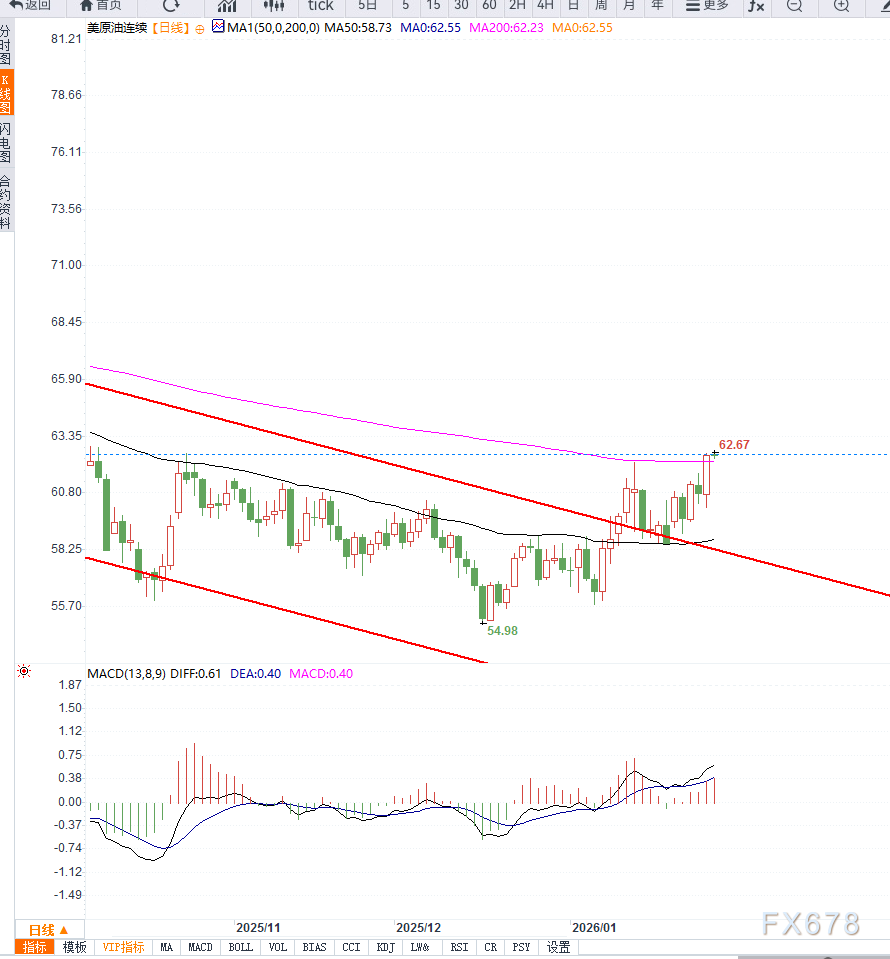
During the Asian session on Wednesday, WTI crude oil extended its gains, trading near $62.50 per barrel, breaking through the resistance level of the consolidation range and reaching a new high since last October. Market sentiment has clearly shifted to caution as traders begin to reassess the impact of geopolitical factors and short-term supply disruptions on oil prices.
The core driver behind the rise in oil prices stems from tensions in the Middle East. US President Trump stated that the United States is strengthening its military presence near Iran, although he emphasized that ‘no conflict is desired.’ Nevertheless, such remarks have significantly heightened market concerns over potential supply risks.
The situation in the Middle East has always been one of the most sensitive variables in the oil market, with any military developments quickly translating into risk premiums in prices. At the same time, support from macro-level factors is also evident.

 An index measuring the movement of the US dollar fell to its lowest level in four years. The weakening of the dollar increased the attractiveness of dollar-denominated commodities for non-US investors, providing additional upward momentum for oil prices.
In terms of fundamentals, while the market generally expects global crude oil supply this year to remain relatively loose, localized supply disruptions are altering the short-term supply-demand balance. Obstructions to Kazakhstan’s crude oil exports have tightened supplies in the European market, while recent widespread winter storms in the United States briefly impacted operations at some refineries along the Gulf Coast and slightly reduced crude output.
Changes in the derivatives market are also worth noting. The bullish option skew for WTI crude oil futures has remained for nearly two weeks, marking the longest duration since October 2024, indicating that capital is increasingly hedging against the risk of rising oil prices.
Looking at other energy commodities, after a surge in natural gas prices driven by a cold wave, US natural gas futures retreated, and New York heating oil futures moved lower simultaneously, showing that the impact of extreme weather is diverging across different energy types.
From a technical perspective, WTI crude oil recently completed a key breakout from its range, with prices moving away from the multi-week consolidation platform, indicating that bulls have regained short-term control. On the daily chart, oil prices have consistently closed above both short-term and medium-term moving averages, with the moving average system starting to show an upward divergence, suggesting that the market trend is gradually shifting from consolidation to a bullish structure.
Regarding momentum indicators, the Relative Strength Index (RSI) remains in a strong region after a rapid ascent but has not yet shown clear signs of extreme overbought conditions. This indicates that the current rally is not entirely sentiment-driven and still has some technical basis for continuation.
Additionally, the increase in trading volume accompanying the price breakout further validates the strength of this upward move, signaling that capital is not rushing to exit at higher levels. Observing the price structure, the $62 level, which previously acted as a resistance zone, has now transformed into short-term support, making it a critical level for subsequent movements.
If oil prices can stabilize within this range during the pullback, the technical pattern will remain intact, and the bulls may continue to test the previous high-density trading zone between $63.50 and $64.00. However, this level coincides with historical highs and psychological thresholds, which are expected to trigger profit-taking pressures. As such, there is a higher likelihood of volatility in the short term as prices move around this region.
Overall, WTI crude oil is currently in the confirmation phase following a strengthening trend. The technical outlook remains bullish overall, but as prices approach key resistance zones, market volatility may rise simultaneously. Unless geopolitical and macro factors show significant easing, oil prices are more likely to trade in a volatile manner at high levels with a gradual upward shift rather than experience a rapid one-sided decline.
Editorial View:
From the perspective of the current market environment, the rise in oil prices reflects more the return of risk pricing rather than a fundamental reversal in supply-demand dynamics. Geopolitical uncertainties, a weakening US dollar, and short-term weather disruptions have collectively heightened market sensitivity to potential risks.
However, it is important to note that the logic of relatively loose global supply in the medium term has not disappeared. OPEC+ is highly likely to maintain its predetermined production strategy, meaning further upside in oil prices will still heavily depend on the persistence of external shock factors.
Therefore, in the short term, oil prices may remain volatile at high levels with rapid fluctuations. Attention should be paid to marginal changes in geopolitical developments and macro-financial conditions.