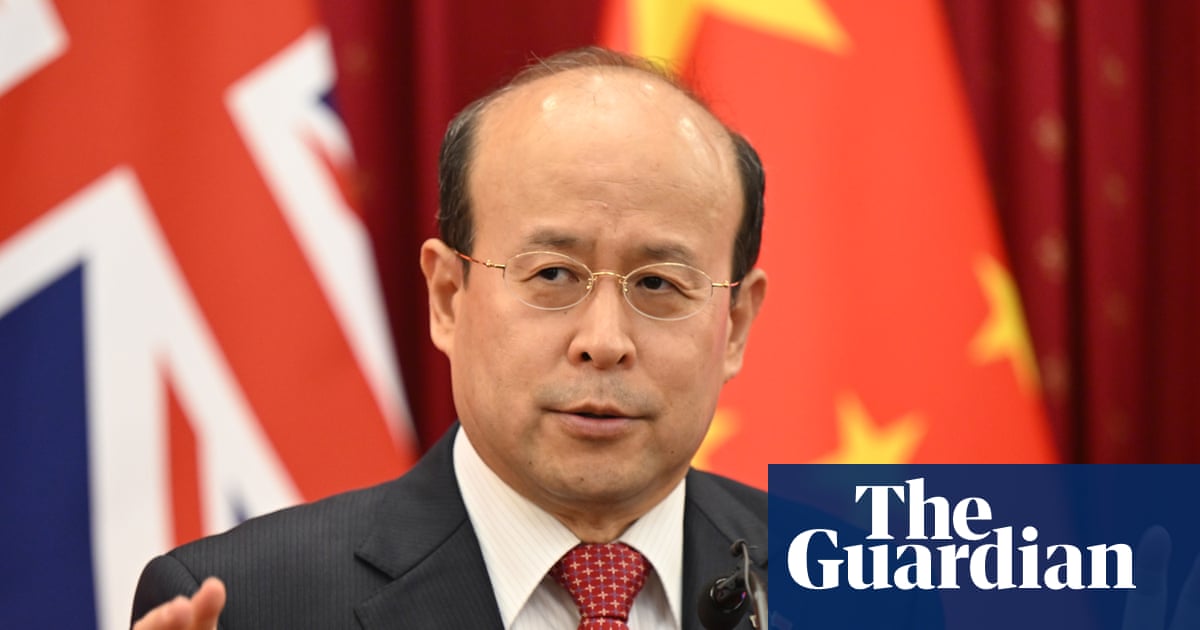
China’s ambassador to Australia says plans by the Albanese government to remove the Port of Darwin from Chinese ownership will put at risk future trade growth and force an intervention by Beijing.
Ambassador Xiao Qian hit out at Labor’s policy to force the Chinese-owned company Landbridge to sell its 99-year lease on the port, sparked by pre-election national security concerns from both Labor and the Coalition.
The government is yet to announce a timeline for the forced sale.
When Landbridge, owned by the Chinese billionaire Ye Cheng, first bought the port in 2015, it did not require federal approval, but the sale quickly sparked complaints from national security agencies and even the then US president, Barack Obama.
Conducting a press conference on Wednesday, Xiao said Canberra and Beijing, as well as the company’s owners, had discussed the port in the months since the 2025 election.
“Over the last 10 years, Landbridge has invested a lot,” he said. “Starting from last year, the Darwin port has stopped losing money and started to make money.
“Suddenly we hear the government of Australia wants to take it back.
“When you’re losing money, you lease it to foreign country company, and when it has started making money, you want to take it back. That’s not a way to do business.”
Sign up: AU Breaking News email
Landbridge paid $506m to secure a 99-year controlling lease over the port. Last financial year, the company recorded a $9.6m profit, up from a $37m loss the previous year.
Speaking at China’s embassy in Canberra, Xiao said it was up to the company to decide its ongoing role in the port, but warned “the Chinese government has an obligation to protect the interest legitimate interests of Chinese companies overseas.”
“If anything happens, like the port [being taken] back by force or forceful measures, then we have an obligation to take measure to protect the Chinese company’s interest.
“Should Landbridge be forced to leave that port, I think it might also affect the substantive investment, cooperation and trade between Chinese companies and that part of Australia. That is not in the interest of Australia either.”
China is Australia’s largest two-way trading partner, accounting for 24% of all goods and services trade last financial year, worth $309bn.
Anthony Albanese announced plans for a forced sale in a hastily scheduled radio interview during the election campaign last year. The prime minister said Landbridge had not invested enough in the port’s operations, even after previously ruling out moves to cancel the lease.
Two government reviews of the port sale, commissioned by both the Coalition and Labor, concluded there were no national security grounds to terminate the lease.
The then Coalition government scrambled after the sale to give the Foreign Investment Review Board greater powers.
Xiao played down deployments of Chinese People’s Liberation Army (PLA) navy to waters around Australia last year.
Defence tracked a group of ships in December, while in February 2025 a Chinese naval task group raised concerns at the highest levels by circumnavigating Australia and conducting live-fire exercises near the country’s waters.
Xiao called the incident “a coincidence”.
“It just happened to be connected in that region, in that part of the world. It happened to be near Australia, but not in Australian territory, or even in the EEZ, the exclusive economic zone,” he said.
“It has nothing to do with Australia.”
Xiao has urged Canberra to prepare for dealing with a “reunified China”, describing opposition to moves by Beijing to control Taiwan as unacceptable. Australia supports the status quo for Taiwan and opposes any unilateral move by Beijing to control the self-governed island.
“We’re somewhat flexible in managing some of the issues of differences between our two countries, for example, trade relations and issues in other areas,” Xiao said.
“But the question of Taiwan is not a question the region should compromise or be flexible with. There’s no room for us to do that.”