Kia Corp. expected its earnings will recover this year after US auto tariffs drove a nearly 30% drop in operating profit last year, overshadowing record revenue and the highest vehicle sales in the company’s history.
The South Korean automaker is betting on new mass-market models and an expanded hybrid and electric lineup to lift margins and volumes.
In 2025, operating profit fell 28.3% from a year earlier to 9.1 trillion won ($6.4 billion), Kia said in a regulatory filing on Wednesday.
Revenue rose 6.2% to a record 114.1 trillion won, marking a second straight year above the 100 trillion won threshold, while net profit declined 22.7% to 7.6 trillion won.
The operating margin narrowed to 8.0% from 11.8% in 2024.
Kia said higher US import tariffs and weaker sales in parts of Europe weighed on profit, while favorable exchange rates, cost controls and strong demand for electrified vehicles helped cushion the impact.
Screenshot captured from Kia Q4 earnings report
TARIFFS WEIGH ON MARGINS
US auto tariffs were the single biggest drag on earnings, Kia said, adding that tariffs reduced its operating profit by 3.1 trillion won over the full year.
The tariff rate was lowered to 15% from 25% starting Nov. 1 under a Korea-US agreement, helping its profitability improve somewhat.
But vehicles already in US inventory were subject to the higher rate for roughly two months, limiting the benefit in the fourth quarter, it added.
Kia said US tariffs reduced 1 trillion won from operating profit in the final three months of the year.
Fourth-quarter operating profit totaled 1.8 trillion won, down 32.2% from a year earlier but up 26.0% from the previous quarter. Quarterly revenue climbed 3.5% to a record 28.1 trillion won.
HYBRIDS AND SUVS DRIVE GROWTH
Screenshot captured from Kia Q4 earnings report
For the full year, Kia’s global shipments increased to a record 3.14 million vehicles, up 1.5% from the previous year.
Growth was driven less by volume than by a richer product mix, with buyers gravitating toward higher-priced hybrids, electric vehicles and SUVs, the company said.
Sales of eco-friendly vehicles jumped 17.4% to 749,000 units, with hybrid sales up 23.7% to 454,000 vehicles, plug-in hybrids up 19.4% to 57,000 units and electric vehicle sales 18.9% higher to 238,000.
Electrified models accounted for 24.2% of total sales, up 2.8 percentage points from a year earlier.
By region, hybrids and electric vehicles supported growth in North America and Europe, while compact SUVs continued to gain traction in India, where Kia is expanding local production and refreshing its lineup.
RECOVERY AHEAD IN 2026
For 2026, Kia targets global vehicle sales of 3.35 million units, up 6.8%, with revenue projected to rise 7.2% to 122.3 trillion won.
Operating profit is expected to rebound to 10.2 trillion won on a lower US tariff rate, with an operating margin of 8.3%, supported by improved product mix and pricing.
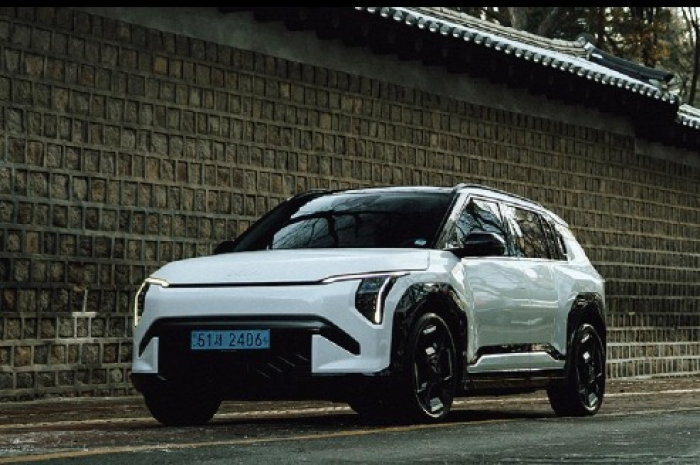
Kia EV3 (Courtesy of Kia)
Kia said it is targeting growth across its three core markets, setting sales goals of 915,000 vehicles in the US, 594,000 in Europe and 302,000 in India with new model launches.
“We aim to raise sales in Europe by 11.1% with electric vehicles and US sales by 4.7% on the back of hybrids,” Kia Chief Financial Officer Kim Seung-jun said, calling the company’s sales target for this year “ambitious.”
In the US, Kia will roll out new and updated models, including hybrid versions of the Telluride in the first quarter, as demand for hybrids has surged since the federal electric vehicle subsidy program ended in October.
In Europe, it plans to launch the EV2 early this year, completing a mass-market electric lineup spanning the EV3 through EV5.
In India, the company aims to strengthen its position in the premium SUV segment with the introduction of new Seltos models.
Despite the earnings hit from tariffs, Kia said it will step up shareholder returns, setting its annual dividend at 6,800 won per share for this year, up 4.6% from last year.
Kia shares ended down 2.5% at 149,700 won on Wednesday.