
The state also plans to launch country’s first free trade zone in Anwara
Chowdhury Ashik Mahmud Bin Harun, executive chairman of the Bangladesh Investment Development Authority (Bida) and the Bangladesh Economic Zones Authority (Beza), speaks at a press briefing in Dhaka on 26 January 2026. Photo: TBS
“>

Chowdhury Ashik Mahmud Bin Harun, executive chairman of the Bangladesh Investment Development Authority (Bida) and the Bangladesh Economic Zones Authority (Beza), speaks at a press briefing in Dhaka on 26 January 2026. Photo: TBS
HigBangladesh has taken a set of policy decisions aimed at accelerating investment and attracting foreign direct investment (FDI), which includes plans to set up a defence industrial park in Mirsarai and to establish the country’s first free trade zone (FTZ) in Anwara.
TBS Highlights
“>
TBS Highlights
The decisions were approved today (26 January) at a joint meeting of the governing boards of investment-related agencies, chaired by Chief Adviser Professor Muhfammad Yunus.
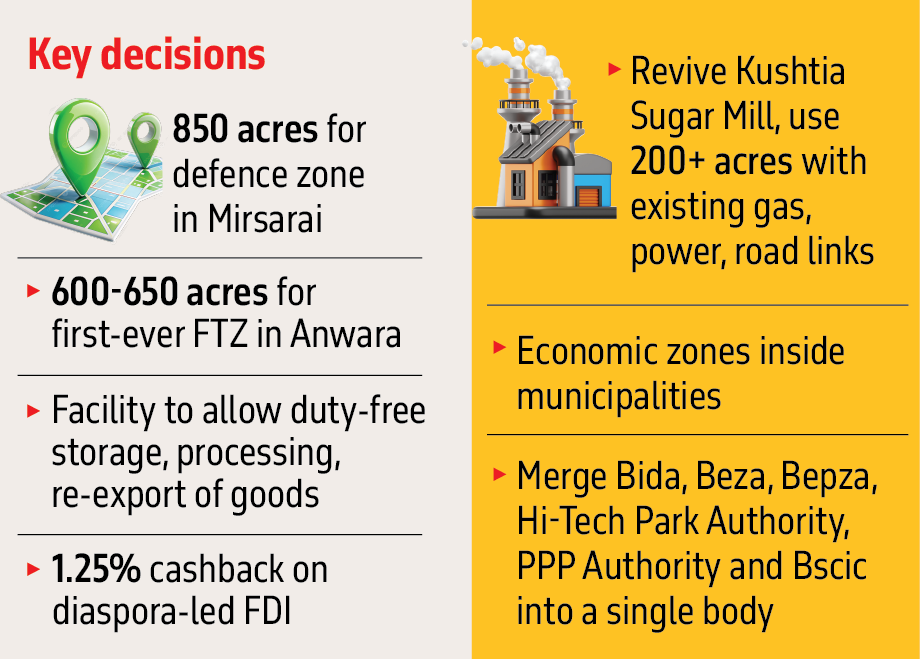
The meeting also cleared initiatives to revive the Kushtia Sugar Mill, allow economic zones within municipal areas, offer a 1.25% cash incentive on FDI brought in by expatriate Bangladeshis, and reaffirm plans to merge six investment promotion agencies.
Briefing reporters at the Foreign Service Academy after the meeting, Chowdhury Ashik Mahmud Bin Harun, executive chairman of Bangladesh Investment Development Authority (Bida), said several important decisions have been taken to simplify investment procedures and attract foreign investors.

He also noted that holding a meeting often takes a long time because there are many boards related to investment that need to be coordinated. “This is only the second such meeting during the tenure of this government.”
Defence industrial park in Mirsarai
Ashik said one of the key decisions at the meeting was to repurpose land earmarked for a foreign economic zone into a defence industrial park.
He said about 850 acres in Chattogram’s Mirsarai area would be designated as a defence industrial zone. The land had previously been allocated for an Indian economic zone, but the project was cancelled, leaving the site available for reuse.
The area will now be included in Bangladesh Economic Zones Authority’s master plan as a defence industrial park, he added.
“In the current global context, demand for defence products is rising, and supply constraints have highlighted the importance of having domestic production capacity,” he said.
Responding to questions about investment and operations, he said Bangladesh currently has one state-run arms manufacturing facility, but the new zone would be developed by the private sector with both local and foreign investment. “Defence equipment produced here will be exported abroad,” he added.
First free trade zone planned in Anwara
Beza’s governing board also gave policy-level approval to introduce free trade zones in Bangladesh for the first time. There is currently no FTZ framework in the country.
An FTZ allows goods to be stored, processed, manufactured and re-exported without customs duties, effectively operating as a deemed overseas territory.
Ashik said an FTZ would strengthen Bangladesh’s position in global supply chains. As a first step, around 600 to 650 acres in Anwara, Chattogram, have been identified for the project. Following policy approval, the proposal will be placed before the cabinet for final clearance.
To explain its importance, he gave the example of cotton imports for the garment sector.
“At present, cotton from the United States takes a long time to arrive, which limits its use in the garment sector. If that cotton can be stored in a free trade zone in Bangladesh, it can be quickly re-exported to Bangladesh or other countries as needed,” he said.
He added that during the board meeting, Dubai’s Jebel Ali Free Zone (Jafza) was cited as a successful global example. Jafza alone handles about $190 billion in trade annually and contributes around 36% to Dubai’s GDP.
Policymakers expect Bangladesh’s free trade zone to emerge as a future hub of trade and economic activity, he said.
Move to revive Kushtia Sugar Mill
The meeting also took a policy decision to revive the Kushtia Sugar Mill.
Ashik said many of the country’s sugar mills have been running at a loss for years, prompting discussions on their effective use. The Kushtia Sugar Mill area already has gas, electricity and road infrastructure, making it suitable to be brought under an economic zone and used for new industrial activities.
Policymakers believe the initiative could create jobs in the south-western region and ensure productive use of more than 200 acres of land, he added.
Meanwhile, another important decision was to allow the establishment of economic zones within municipal areas.
The Bida executive chairman said the 2012 law had excluded municipal areas from economic zones. However, with the number of municipalities rising to 331, setting up zones outside towns has increased pressure on agricultural land.
As a result, a policy decision has been taken to allow economic zones to be set up within municipal areas by bringing closed or abandoned industrial units back into economic use, he added.
1.25% cashback on diaspora-led FDI
The governing board of the Bida also approved a policy to offer a 1.25% cash incentive on FDI brought in through expatriate Bangladeshis.
At the press conference, Ashik said the aim was to leverage the international networks of expatriates to attract foreign investors. “Expatriates can play a role by introducing their business contacts to Bangladesh,” he said.
He explained that if an individual brings $100 million in foreign investment to the country, the government would provide $1.25 million as a cash incentive, structured similarly to existing remittance incentives.
He also said a decision had been taken to open Bida sub-offices abroad, including in China, South Korea and Japan.
“These offices will be run by local people of those countries, more like agencies. If they succeed in bringing in FDI, the 1.25% incentive paid by the government will cover their operating costs,” he said.
The meeting also reiterated the policy decision to merge six investment promotion bodies – Bida, Beza, Bepza, the Hi-Tech Park Authority, the PPP Authority and Bscic – in the future.
An independent third-party consultant will be appointed to design the framework for the merger, the Bida executive chairman said.