Ten days ago, Hungarian oil and gas company MOL Group said it has signed a binding heads of agreement with Gazprom Neft to acquire the Russian state-owned company’s 56.15% stake in Serbian oil and gas company Naftna Industrija Srbije (NIS).
The transaction was prompted by sanctions that the United States imposed on NIS because of its Russian ownership. Given that NIS operates the only refinery in Serbia, it raised the question if Croatia’s only refinery, in Rijeka, would be closed.
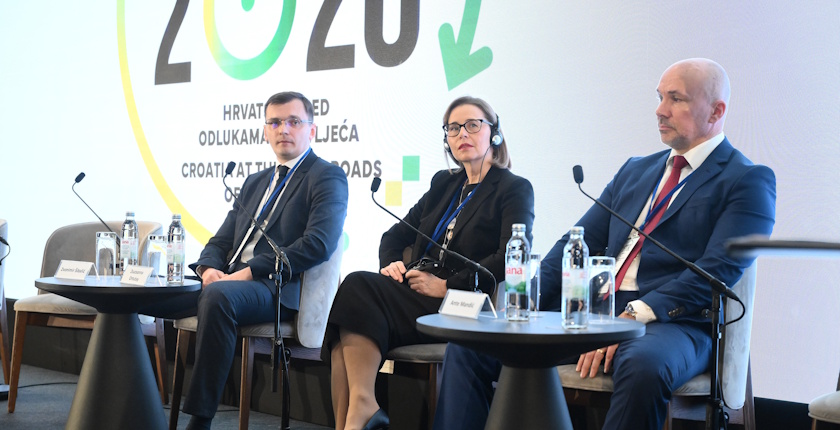
Speaking at the Jutarnji List energy conference on Croatia’s decisions for the following decades, INA CEO Zsuzsanna Ortutay said that over the past two weeks there has been a lot of speculation, but that nobody actually gave her the chance to answer.
Pančevo is far from Zagreb, Rijeka
“The futures of Pančevo and Rijeka have nothing to do with each other. And it’s regardless of who owns the Pančevo refinery,” she stressed.
Ortutay added that, first of all, the facility in Serbia doesn’t have capacity to produce fuel for Croatia.
The Pančevo refinery can produce 2.8 million tons of motor fuel per year. This is pretty much equal to the Serbian demand.
There is also a distance issue, because Pančevo is far from Croatia.
“So just to shift one ton of motor fuel to Zagreb would cost about EUR 40, and EUR 80 to Rijeka. Why would anyone do that? It means giving 10% of your fuel margin to do that,” she pointed out.
INA has invested EUR 700 million in the Rijeka refinery
The same goes for a hypothetical closure of the Pančevo refinery, as it wouldn’t create a huge opportunity for the Rijeka refinery and INA, in her view.
Moreover, INA has just invested close to EUR 700 million in modernizing the Rijeka refinery, Ortutay underscored, and added that the company invested another EUR 500 million over the past 10 years.
“Why would a reasonable investor do that if its intention is not to operate the refinery? We will operate the Rijeka refinery. They are complementary with each other, with a very small overlap in Slovenia and BiH. But this is not a risk,” she said.
Ortutay claimed it is a completely different situation from the one with the Sisak refinery.
Namely, INA had two refineries. After MOL bought its shares and took over operative control, it closed the one in Sisak.
The modernization of the Rijeka refinery is complete
Ortutay noted that in late December INA finished the construction of new facilities planned under the modernization.
The company has started the commissioning phase, and plans to roll out the first products by mid-year, she announced.
Of note, NIS requires a green light from the Office of Foreign Assets Control (OFAC) of the US Department of the Treasury to be able to operate regularly.
OFAC has issued a sanctions waiver valid through February 20. Separately, it has allowed NIS to find a buyer by March 24 at the latest.
Post Views: 1