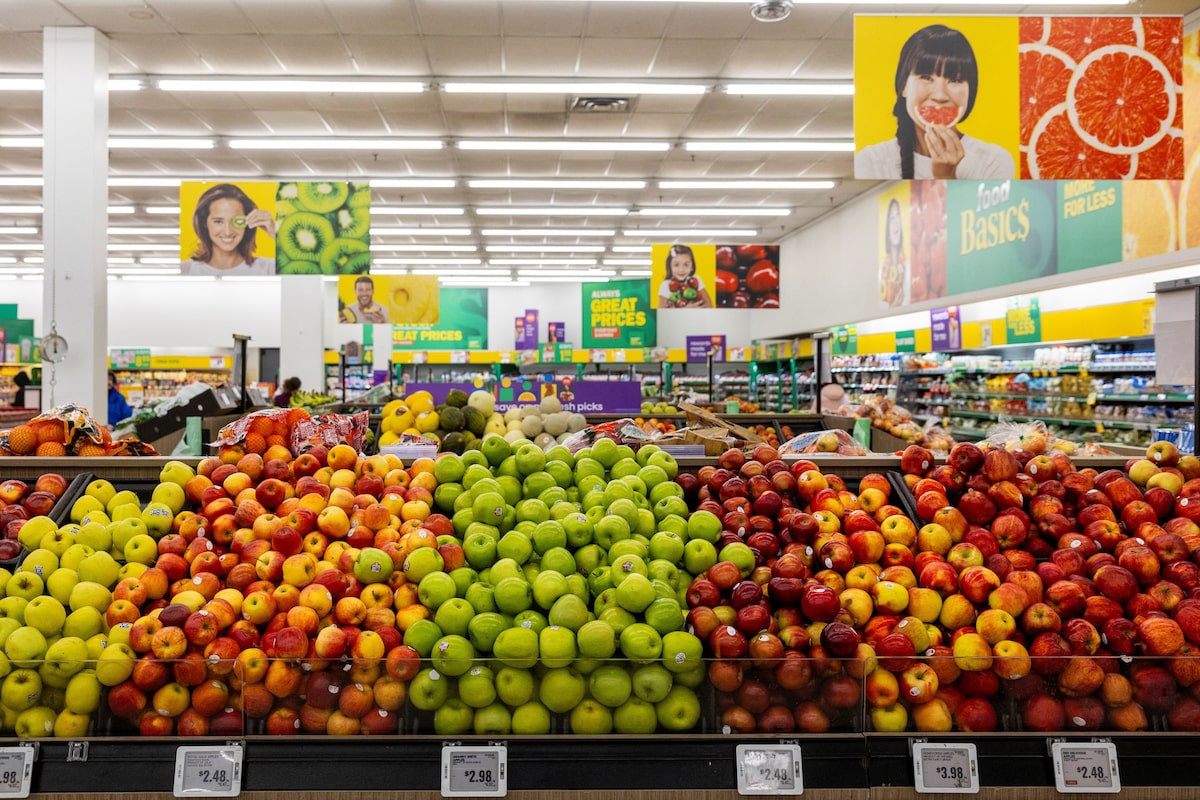
Food prices are now driving inflation, which could complicate the Bank of Canada’s rate path ahead.Carlos Osorio/Reuters
Jeremy Kronick is vice-president and director of the Centre on Financial and Monetary Policy at the C.D. Howe Institute, where Steve Ambler, a professor of economics at Université du Québec à Montréal, is the David Dodge Chair in Monetary Policy.
On Wednesday, to the surprise of few, the Bank of Canada held its policy interest rate at 2.25 per cent. We agree with the decision, though believe food price increases are likely to pose an ongoing challenge for the bank. It could test the limits of monetary policy.
When the bank leaves its policy rate unchanged and the rate sits in the so-called neutral rate range – where the bank is neither trying to stimulate nor slow the economy – the data are often conflicting. This time was no different.
Headline inflation (the change in the consumer price index over the preceding 12 months) nudged up to 2.4 per cent in December from 2.2 per cent in November, but it was 0.4 percentage points above the bank’s 2 per cent target.
On the other hand, fourth-quarter GDP growth appears sluggish, with the likely best-case outcome seeing the Canadian economy eke out a weakly positive gain when Statistics Canada releases the data at the end of February. Moreover, labour growth stagnated in December and the unemployment rate increased to 6.8 per cent, up from from 6.6 per cent.
This kind of conflicting data makes a strong case for a hold.
That said, after the recent inflation surge, it is important to understand what is now driving headline inflation’s uptick, which has remained stubbornly above 2 per cent since September.
Analysis: This is why you’re feeling much poorer than the economic numbers suggest
The rate of food price growth has replaced the rate of shelter price growth as the primary contributor. Food prices grew by 6.2 per cent in December, while inflation excluding food was below target at 1.6 per cent. This is the highest rate of food price growth since August, 2023, when headline inflation was 4 per cent. Canada now has the highest rate of food price growth of the G7 countries.
Some of what is driving higher food prices the bank can look through. Such factors are temporary.
Drought in Western Canada has been a major contributing factor. This has caused national cattle herds to fall to their lowest level since the late 1980s. Beef prices rose by 16.8 per cent year-over-year in December. Drought has also led to lower yields (and higher prices) for Canadian wheat, canola, and pulses.
In addition, some Canadian consumers have reduced purchases of food imported from the United States. To the extent that they have substituted more expensive goods from other foreign markets, this will have contributed to an increase in the level of food prices.
Should these factors reverse themselves, or generate only a one-time jump in the price level with average inflation falling back to target, the bank can safely ignore them.
However, some factors of food inflation might be longer-lasting supply-side concerns. The bank can ignore them for only so long before inflation expectations become unanchored.
The industrial carbon price will increase to $110 in 2026 from $95 per tonne in 2025, on a path to $170 by 2030. This will affect costs at all stages of the production process, from sowing and harvesting to transportation, storage and retail. Additionally, cutbacks to Canada’s temporary foreign workers program will drive up agricultural production costs.
Dalhousie University Professor Sylvain Charlebois adds more: “Yes, some of Canada’s food inflation reflects global factors – climate volatility, energy costs, and supply disruptions. But most of it is now policy-induced. Regulatory drag, interprovincial trade barriers, poor logistics, rising compliance costs, carbon pricing embedded throughout the supply chain, and a sluggish macroeconomic environment all compound one another. These are not temporary shocks; they are structural weaknesses.”
The danger with more permanent shocks that keep inflation elevated is that the Bank of Canada would have to aim to reduce inflation excluding food to well below target to achieve an overall 2 per cent inflation rate. To do so would mean raising the policy interest rate and driving down aggregate demand and output – in other words, creating a smaller Canadian economy.
However, to the extent some of what we have discussed are candidates for policy changes – here’s looking at you, interprovincial trade barriers – they may not be so long-lasting.
Should these policy changes occur, it will make it a lot easier for the bank to tolerate higher food price growth. That would help avoid the difficult task of justifying rate hikes and shrinking the economy to counter higher food prices – a situation that would fall most heavily on lower-income households. This is yet another reminder that monetary policy cannot do it all.