Hyundai briefly operated a stamping and assembly plant in Quebec in the late 1980s.Kim Hong-Ji/Reuters
Ottawa and Seoul have signed a memorandum of understanding intended to bring South Korean auto sector manufacturing and investment to Canada, according to a document reviewed by The Globe and Mail.
The MOU stems from the Asian country’s campaign to win a multibillion-dollar contract to build up to 12 submarines for the Royal Canadian Navy.
Industry Minister Mélanie Joly and her counterpart, Kim Jung-kwan, Minister of Trade, Industry and Resources, signed the MOU this week as a government delegation from South Korea visits Ottawa to talk about the submarine bid. The ceremony took place Tuesday, a government official said.
The Globe and Mail is not naming the official because they were not authorized to speak on the matter.
South Korean delegation heads to Canada to lobby for submarine project amid competition with Germany
The MOU on Korea-Canada Industrial Collaboration on Future Mobility and the Establishment of the Korea-Canada Industrial Cooperation Committee is non-binding but pledges both sides to working together to promote the manufacturing of autos, electric vehicles, battery manufacturing and hydrogen-powered vehicles.
The agreement says Ottawa and Seoul will work on “advancing a Korean automotive industrial footprint in Canada” as well as “electric vehicle (EV) manufacturing opportunities.”
It also says the two countries will co-operate on “growing Korea’s battery manufacturing presence in Canada” as well as the battery supply chain including “manufacturing, critical mineral extraction and refinement, research, development and extraction.”
The MOU says this accord recognizes the “complementarity of the two economies and their significant potential for cooperation in the industrial sector.”
It also talks of co-operation on hydrogen-powered commercial vehicles and a stable hydrogen production and supply chain.
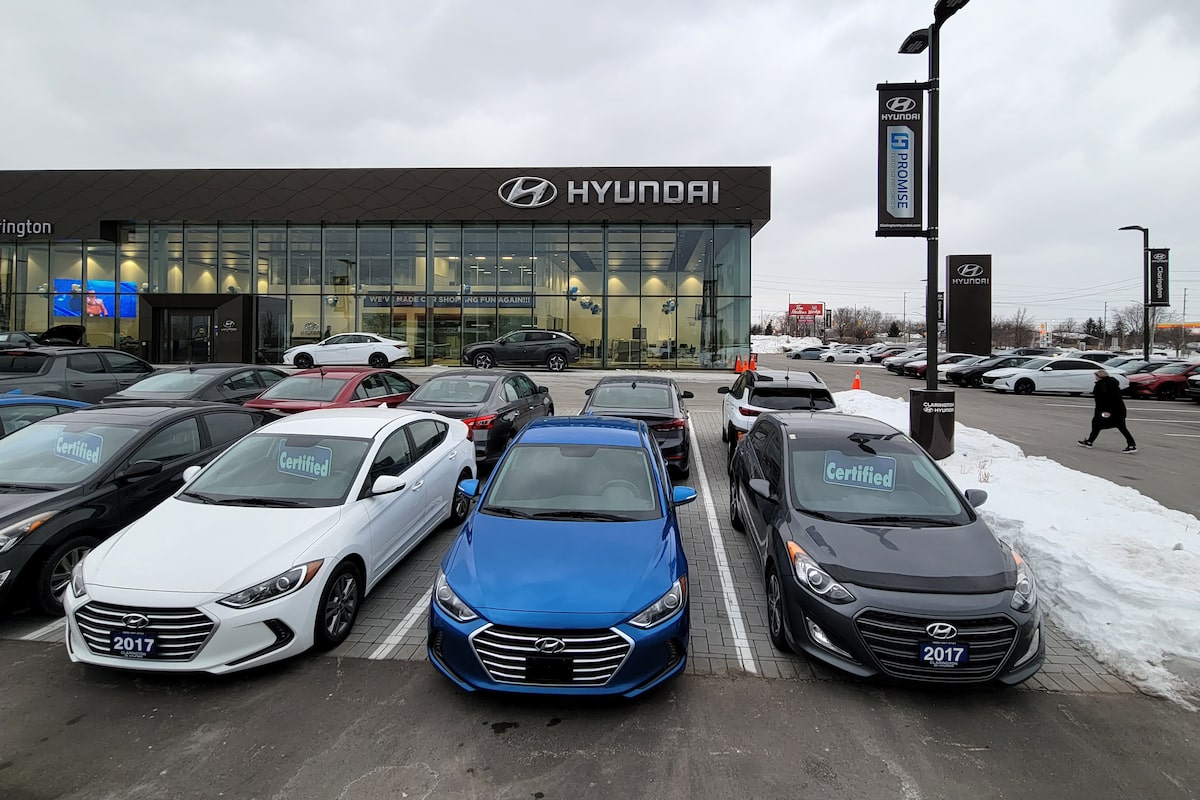
A Hyundai car dealership in Bowmanville on Jan. 22, 2022.Doug Ives/The Canadian Press
As The Globe and Mail reported earlier this month, Ottawa has asked the governments of South Korea and Germany, two countries with companies bidding to build the Canadian navy’s next submarine, to facilitate auto industry production pledges in Canada as part of the pitches.
The MOU further talks of co-operation in artificial intelligence, steel and cement industries as well as nuclear power and liquefied natural gas.
Along with trade minister Mr. Kim, the Seoul government delegation in Ottawa this week includes Kang Hoon-sik, South Korea’s presidential chief of staff, as well as Minister of Defense Acquisition Program Administration Lee Yong-cheol.
Hyundai Motor Group executive chair Euisun Chung, although not part of the government delegation, is also part of the visit.
In the late 1980s, Hyundai briefly operated a stamping and assembly plant in Bromont, Que., with substantial support from the federal and Quebec governments, before closing it several years later.
Korea’s LG Corp. has already made EV supply chain investments in Canada.
Last year, Canada narrowed its search for new submarines to two contenders: South Korea’s conglomerate Hanwha Group and the German-Norwegian bid that includes defence contractor ThyssenKrupp Marine Systems, or TKMS.
Carney faces historic choice between South Korea and Europe for submarine fleet
As The Globe reported earlier, any submarine deal will be a government-to-government arrangement. Canada has asked the South Koreans to arrange a commitment for Hyundai to establish production in Canada and for Germans to beef up Volkswagen-related auto industry production here.
The contract for up to 12 submarines could be worth tens of billions of dollars. Either submarine option would lead to a deep international partnership with the winning bidder – a de facto alliance – that would last more than 50 years on a contract worth upward of $100-billion, including acquisition, maintenance and upkeep.
Hyundai does not have auto production facilities in Canada. Volkswagen has committed to building an electric vehicle battery factory in St. Thomas, Ont., through its PowerCo subsidiary.
Hanwha’s offer to Canada is the KSS-III Batch-II submarine, while TKMS, as part of a joint German-Norwegian project, is offering the 212CD. Both are diesel-electric submarines because Canada has ruled out purchasing nuclear-powered vessels.