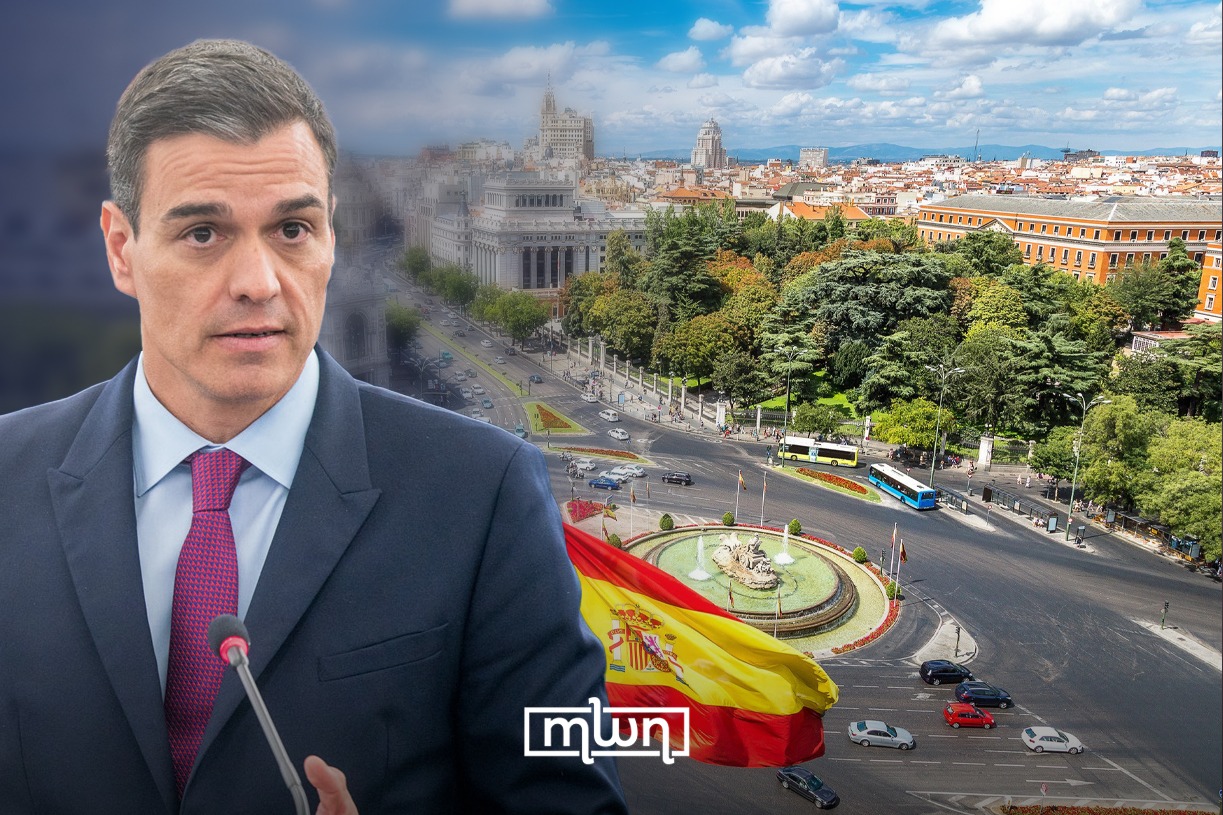
The Spanish government’s announcement on Monday that it was moving ahead with a plan to regularize the immigration status of roughly five-hundred thousand undocumented migrants represented a sharp departure from the current mood in many EU member capitals concerning migration.
The measure (by decree) was adopted yesterday by Prime Minister Pedro Sanchez’s cabinet, affecting those living in Spain for at least five months, with no criminal record, and who arrived before December 31, 2025.
Following a news conference held after the decision, Migration Minister Elma Saiz, a former city councilor in Pamplona, affirmed that the new measures are meant to establish a “migration model based on human rights, integration, coexistence and compatible with economic growth and social cohesion.”
She said beneficiaries of the new policy would be able to work “in any sector, in any part of the country.” The updated regulations provide one-year initial work permits, which may be extended to four years, as well as streamlined processes for long-term residency permits for those over 30.
Though the announcement drew skepticism from Sanchez’s political opponents in Spain, the policy represents a shift to a long view on migration and demographics.
Morocco’s unique regularization in 2014 & 2017
As a gateway between Europe and Africa, Morocco has often been an innovator in migration policy. The process of constitutional reform that began in 2011 included an embrace of inclusion and continental solidarity, even as irregular migration by sea began to accelerate across the Mediterranean region.
The nation began a regularization campaign for undocumented migrants in 2014, eventually approving about 20,000 migrant applications for one-year residence permits. The permit could be renewed and the updated processes gave priority to all women and children who applied.
A second phase in 2017 allowed at least 23,000 foreign-born migrants to be granted registration cards. Like Spain today, Morocco a decade ago appreciated the importance of creating durable administrative and policy structures that support humanitarian goals and migration management.
Spain 2.0: Diverse and aging
Data from Spain’s National Statistics Institute indicate there are over seven million foreign residents living in Spain out of a total population of 49 million people. Moroccans constitute the largest group of foreign-born residents, about 900,000.
The Spanish Catholic Church was among the national organizations that praised the new policy. The reality, too, of declining birth rates in many EU nations also plays a role in the wider migration policy debate. Last year, Spain’s National Statistics Institute projected that by 2050, for every retiree on a pension there will be just 1.6 working-age citizens. Migration, it is believed, can mitigate some but not all of this fiscal challenge.
Sánchez has said repeatedly that Spain needs migration to fill workforce gaps in agriculture, service and light manufacturing.
As reported last week, France, for the first time in its modern history, recorded more deaths than births in 2025. A key demographic benchmark, fertility rate, was the lowest (1.56) in France since the end of the 1st World War.
Germany, whose population grew by a fraction of one percent last year, saw its economy stagnate in 2025, with very modest growth of 1.2% projected in 2026 and 2027. Competitive advantages have shifted or disappeared, and the population continues to age.
A 2024 Bertelsmann Foundation study found Germany’s workforce could shrink by ten percent by 2040 without substantial immigration. The retirement of the baby boomers from major Western labor markets presents a significant challenge – and an opportunity.
The good news: In the last quarter of 2025, Spain’s stubborn unemployment rate dropped below 10 percent for the first time since the 2008 housing crisis. Spain ended the year, too, with a record number of foreign employees – 3.1 million workers of foreign origin – who were registered with the nation’s social security system.
As CNBC noted last August, “Spain’s booming economy is outpacing its European neighbors as tourism, foreign investment and immigration helps fuel growth. The southern European country is still leading growth in the euro zone with annual gross domestic product forecasted to rise 2.5% this year.”
The Mediterranean neighborhood
Spain has found success in attracting migrants with in-demand skill sets while combatting irregular arrivals, which are primarily via dangerous sea routes. Data from Spain’s Interior Ministry indicate irregular arrivals to Spain fell by more than 40% (to 36,000) in 2025 compared to 2024. Sadly, one Spanish NGO, Caminando Fronteras, calculates that eight people died each day last year attempting to cross from Africa to Spain.
Spain’s southern neighbor Morocco plays a significant role on many levels. From enhanced border security to migration management to maritime surveillance, security cooperation is a cornerstone of the relationship. That cooperation will only deepen as the two nations, along with Portugal, host the 2030 FIFA World Cup and perhaps three million fans.
Two-way Morocco-Spain trade is valued at over €22 billion. Thousands of Moroccan seasonal agricultural workers in Spain earn income which is sent back to Morocco to help bolster local economies and families, who then develop business contacts, from tourism to financial services to micro enterprises, with Spanish businesses. A productive cycle of investment and relocation.
As defense spending rises in Europe over the next few years, expect increased collaboration between Spanish industrial giants like Airbus and Morocco-based aerospace enterprises that have partnered with international firms like Lockheed Martin and Safran.
Challenges & growth
The challenges of creating an inclusive welcoming nation are many. Last year, the Moroccan Association for Immigrant Integration in Spain published a study revealing that 47.5% of Muslims in the country had been victims of racist attacks in Spain, though only 6% dared to file a formal complaint.
Spain has undergone dramatic change in the forty years that it has been a member of the European Union. When Spain joined the EU in 1986, a steady phase of liberalization and modernization would lay the groundwork for the successes of the 21st Century, mirroring similar efforts by Moroccan King Hassan II during the same general timeframe. Spain now has one of Europe’s longest average life expectancies (84), a nod perhaps to the blending of Andalusian, Castilian, Moorish and Iberian culture.
Spain’s bold move on migrant regularization can be visualized, perhaps, in Barca football superstar Amine Yamal’s signature post-goal salute to the postal code (304) of his gritty yet vibrant Spanish childhood neighborhood, Rocafonda. Challenges, and constant change.