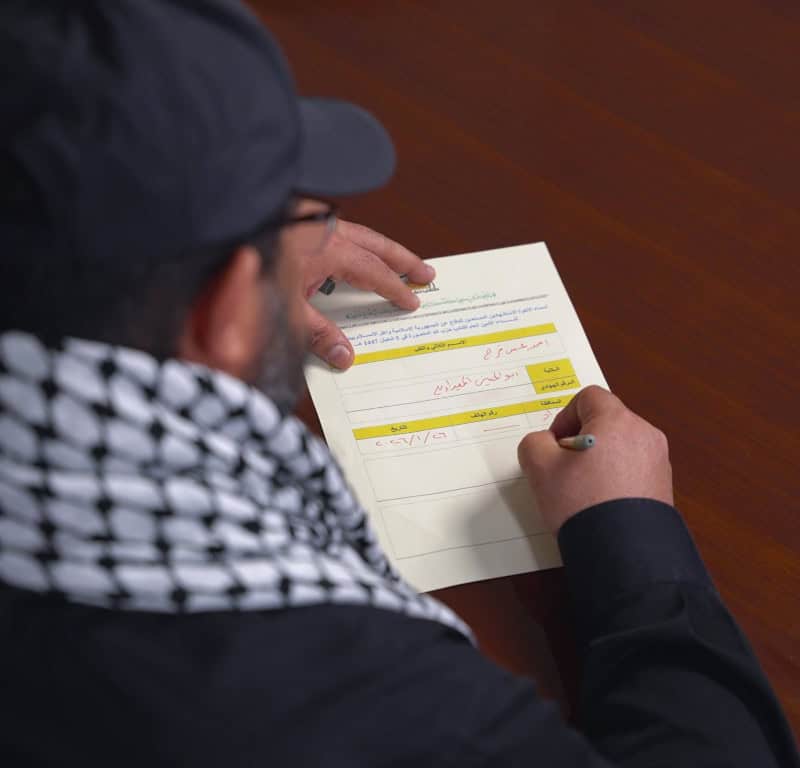
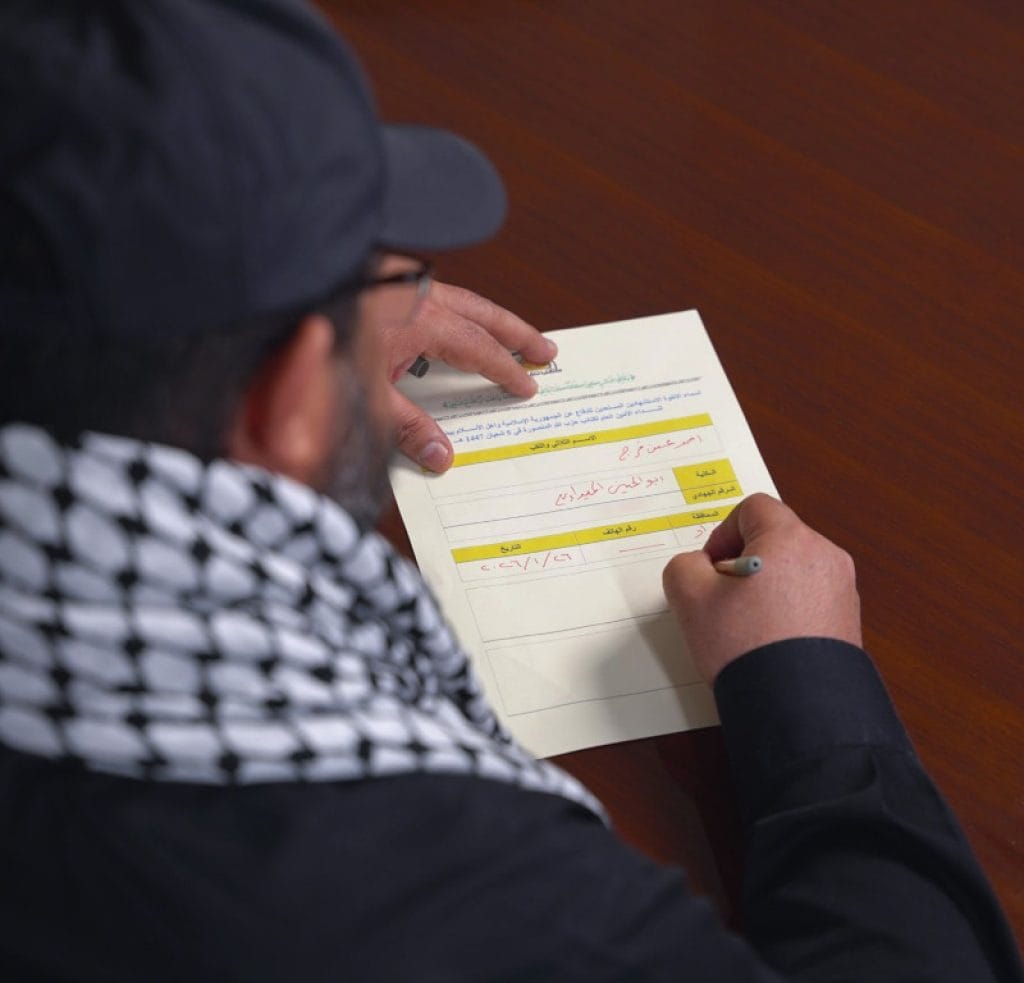
 Hajj Abu Husayn al Hamidawi, the secretary-general of the pro-Iranian Iraqi militia Kataib Hezbollah, fills out a “martyr volunteer” form. (Sabereen, an Iraqi militia-affiliated X account)
Tehran and its regional proxies are escalating threats against the United States and Israel as Washington moves additional naval forces into the Middle East. The US military buildup follows US President Donald Trump’s warnings over the Iranian regime’s lethal crackdown on protesters. Regime-affiliated outlets and militia leaders have outlined retaliation scenarios ranging from missile and drone strikes on US facilities and maritime disruptions in the Persian Gulf to direct proxy-led ground attacks.
The Pentagon is moving the USS Abraham Lincoln carrier strike group from the South China Sea through the Indian Ocean toward the Middle East, adding a carrier, three destroyers, and roughly 5,700 personnel to the theater. Once in the region, the group will link up with three littoral combat ships based in Bahrain and two US destroyers already operating in the Persian Gulf, reinforcing existing US forces and command elements centered at Al Udeid Air Base in Qatar.
The buildup follows a series of threats from Trump directed at the Islamic Republic over its killing of unarmed protesters. Trump wrote on January 2 that should the regime kill Iranian protestors, “the United States of America will come to their rescue. We are locked and loaded and ready to go.” He later escalated his remarks on January 13, calling on protestors to take over regime institutions and adding that “HELP IS ON ITS WAY.”
Regime forces, supplemented by terrorists deployed from Tehran’s network of regional militias, have killed over 36,000 unarmed protestors with heavy military equipment. An Iraqi security source reported to CNN that nearly 5,000 Iraqi militia fighters from Kataib Hezbollah, Harakat Hezbollah al Nujaba, Kataib Sayyid al Shuhada, and the Badr Organization “entered Iran from two border crossings in southern Iraq” to suppress protests. All of these groups, except the Badr Organization, are US-designated Foreign Terrorist Organizations that have killed American servicemembers.
Tehran is on high alert
On January 25, regime authorities unveiled a new mural in central Tehran warning the United States. Displayed on a massive billboard, it depicts an aircraft carrier from above with burning and wrecked fighter jets on the deck, bodies scattered across the surface, and blood streaming into the sea in a pattern resembling the stripes of the US flag. A caption reads, “If you sow the wind, you will reap the whirlwind.”
Defa Press, an outlet controlled by the regime’s General Staff of the Armed Forces, published an article on January 20 outlining Tehran’s “four options” for retaliation against a potential US attack:
1. A missile and drone barrage against US facilities in the Middle East
The publication argued that “the Islamic Revolutionary Guard Corps (IRGC) Aerospace Force and the Islamic Republic of Iran Army’s (Artesh) drone units” can strike US military installations in the region, including Al Udeid Air Base in Qatar, Incirlik Air Base in Turkey, Sheikh Isa Air Base, and Al Dhafra Air Base in the United Arab Emirates.
Similarly, regime-affiliated social media channels circulated a video on January 22 titled “U.S. bases that are within Iran’s firing range.” The video shows pins being placed on American military sites in Iraq, Syria, Turkey, Qatar, the UAE, Kuwait, Bahrain, Oman, and Saudi Arabia.
2. Attacking Israel with missiles and drones
The Defa Press article also pointed to the 12-Day War between Iran and Israel as a model for how a response could unfold. It listed missile and drone strikes against Israel as another potential retaliatory option, suggesting that the regime either expects Israel to join US operations or intends to draw it into a broader conflict.
3. Attacking US naval assets and ‘closing the Strait of Hormuz’
Another retaliatory option for Iran centers on “closing the Strait of Hormuz” in the Persian Gulf, according to Defa Press. If Iran’s trade routes are “disrupted,” the regime will retaliate by “impeding global trade” and warns that it could target the US naval fleet using “thousands of coastal anti-ship missiles” alongside a three-part approach involving “anti-ship missiles, naval mines, and patrol craft.”
The regime-affiliated Javan Online wrote on January 26 that the IRGC is concentrating on Iran’s Persian Gulf coastline and has deployed military equipment and fortifications on Greater Tunb, Lesser Tunb, and Abu Musa, conducted mine-laying operations in the Strait of Hormuz, and installed the Belarusian Vostok-1 radar to increase visibility of aerial threats.
An analysis posted on Fox News on January 25 said that Iran’s use of low-cost drones poses a credible asymmetric threat to high-value US naval assets, including the USS Abraham Lincoln carrier strike group. The analysis noted that mass drone launches could overwhelm ship defenses through saturation attacks and make US surface vessels operating near Iran prime targets.
4. Escalation through regional proxies
A final retaliation scenario involves Tehran leveraging its terror proxies, which it refers to as “resistance” forces, to strike US targets and form a “coalition” against Israel that could include “ground combat.” Tehran’s militias within the “Axis of Resistance” are already issuing threats across the region.
On January 16, Kataib Hezbollah threatened to strike US bases in the region if the United States attacks the Islamic Republic. Kataib Hezbollah is also part of the Popular Mobilization Forces (PMF), an official Iraqi security institution comprised largely of Iran-backed militias. On January 26, the Badr Organization, another Iran-backed militia in the PMF, echoed Kataib Hezbollah’s support for the regime in Tehran.
American forces are present in Syria and the Kurdistan Region of Iraq, but on January 18, the Iraqi government announced that US personnel had withdrawn from military facilities within the federal territory it controls in Iraq. US Central Command (CENTCOM) described the Iraqi statement on the handover of bases as “factual” but did not elaborate on current troop dispositions.
Hajj Abu Husayn al Hamidawi, the secretary-general of Kataib Hezbollah, reiterated the group’s threat against the US on January 25. In his statement, he urged fighters to “prepare for a comprehensive war in support and backing of the Islamic Republic in Iran” and included the possibility of suicide operations. On January 26, Sabereen News, a militia-aligned X account, shared photos of Hamidawi filling out a form to volunteer for suicide attacks. The account has also published photos and footage of crowds gathering to register in what they describe as an “influx of volunteer martyrs.” Harakat Hezbollah al Nujaba has publicized recruitment efforts for suicide operations in defense of the Islamic Republic.
Alwiya Waad al Haq, a front group for Kataib Hezbollah, also issued a threat to American embassies and interests in the Arabian Peninsula and surrounding waters.
The Islamic Republic reportedly transferred long-range ballistic missiles to its proxies in Iraq in April 2025, according to The Times. Israeli media reported in November 2025 that the regime in Tehran was increasing arms supplies to Iraqi militias in anticipation of future conflict.
Trump may choose to strike Iran-backed militias in Iraq as part of any military activity against the Islamic Republic and its adversaries. Both Trump in his first term and former President Joe Biden in his term have struck Tehran’s proxies in Iraq.
In Lebanon, Hezbollah Secretary General Naim Qassem delivered a speech on January 26 in support of the Islamic Republic and Iranian Supreme Leader Ali Khamenei. Qassem said that while Hezbollah will determine the manner of its response to any conflict between the Islamic Republic and Israel/America, the group is “not neutral.”
On January 26, Yemen’s Houthis shared new footage of their attack on the Marlin Luada fuel tanker, which they struck in the Gulf of Aden at the end of January 2024. On January 25, the group shared a short excerpt from the video with the caption “soon,” as a teaser for the full video. The Houthis and the United States have had a ceasefire in place since May 6, which followed a roughly seven-week air campaign conducted by American forces against the Iran-backed terror group. However, the Houthis continued to attack commercial ships and Israel until a ceasefire went into effect in Gaza in October 2025.