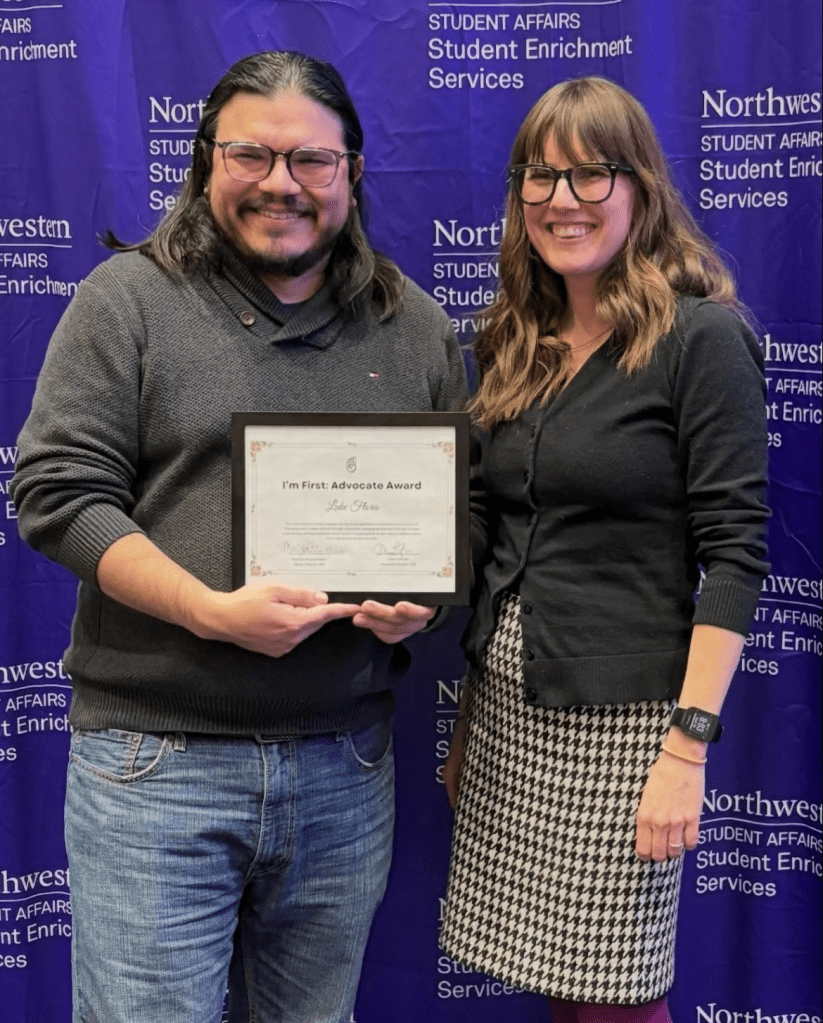
 Luke Flores (left) poses with Rebecca Siroky (right) after receiving the Student Enrichment Services (SES) Advocate Award. Photo courtesy of @northwesternarchscholars on Instagram.
Visitors know the “doctor” – or rather, the Ph.D. neurobiologist – is in when they see a Johnny Bravo magnet placed underneath the word “available” on a whiteboard outside Luke Flores’ office door.
As the director of the Arch Scholars programs for first-generation, low-income (FGLI) students at Northwestern, he connects with students in his office every day. A brand-new cohort of first-years come in every year to take advantage of the programs and meet Flores.
A low-income background can contribute to feelings of imposter syndrome, exclusion, anxiety and depression, and a lack of perseverance toward academic work, according to a 2024 American Sociological Association study. FirstGen Forward also reports that the six-year graduation rate for first-generation students is 24%, compared to 59% for those from continuing generations. Flores’s work with Arch Scholars offers a supportive environment to these students.
Before he was director, though, he sat in a similar seat as the students he now mentors. In 1999, Flores was an undergraduate at the University of San Antonio majoring in biology on the pre-med track. He said he was simply following along with the pre-med curriculum without much thought.
Then, his grandmother was diagnosed with Alzheimer’s disease.
“She could remember some things from when she was young, when she was in high school, when she and my grandfather had first gotten married, but she couldn’t remember what she had done an hour ago,” Flores said. “That got me interested in this idea of: Why are some memories stronger than others? Why do some things stick with me, and some things I’m going to immediately forget? What is going on up here that’s making those things happen?”
During the same time as his grandmother’s diagnosis, Flores was doing research and lab work with his biology professor, who studied the brain. The two events spurred on a passion and lifelong interest.
“I realized that every thought I’ve had, every emotion I’ve had, every aspiration I’ve had, every word I’ve said, and every word I thought about saying but held back – it’s all been these cells in my brain that have been communicating with each other and doing this every moment of every day of my entire life,” Flores said. “Once I started thinking about the world from a standpoint of how my brain was working, I could not move off of it.”
He came to Northwestern on a recruiting trip and maintained close contact with John Disterhoft, a neuroscience professor at the Feinberg School of Medicine. That coupled with his eagerness to escape the sweltering summers of his hometown of Corpus Christi, Texas made him choose Northwestern in 2004 to pursue his Ph.D. in neurobiology.
“When I finished my Ph.D., I didn’t want to run a lab,” Flores said. “I wanted to teach, I wanted to mentor, I wanted to advise, I wanted more student time.”
In 2010, Northwestern received a $2 million grant from the Howard Hughes Medical Institute to promote undergraduate success in science. This led to the development of two summer programs: NU Bioscientist and Bio&ChemEXCEL, which aim to prepare first-year students for science courses and science-based research at Northwestern. After graduating with his doctorate in 2011, Flores got hired to design the curriculum and led classes for both programs.
The grant funding ended in 2014, but the University decided to keep the summer opportunities and integrate them into the Weinberg College of Arts and Sciences. Flores met with Lane Fenrich, the Weinberg assistant dean for first-year students and programs. At the time, Fenrich ran the Warren Summer Bridge program.
Combining Flores’ science programs and Fenrich’s Bridge program, the two developed Arch Scholars. Later, the Posner Research Fellowship Program and the Peer Mentoring program came to fall under this umbrella. As director, Flores meets and works with students from all of these programs.
“He invites students to come in, engage with him and stay connected, even after they’re not participating in a specific program anymore,” said Rebecca Siroky, assistant director of undergraduate affairs for Weinberg, who works closely with Flores for Arch Scholars.
Feedback from Arch Scholars students always mentions Flores’s impact somewhere in their response, Siroky said.
His impact has been felt by Weinberg fourth-year Sarah Opoku, who participated in Bio&ChemEXCEL the summer before her first year in 2022 and has returned as a counselor every year since then.
Opoku, a chemistry major, often visits Flores during his office hours. He helped her learn to better advocate for herself “as a minority in a predominantly white institution and going into a predominantly white field,” she said. “Finding ways to speak up for yourself and making sure you have access to resources is something I’ve carried a lot in my life, both academically and socially.”
In her three years of knowing him, Opoku says that Flores isn’t the loudest or most extroverted leader, and she feels like he goes underappreciated or overlooked by others. “Almost every successful aspect I’ve had in my academic career, and my personal life, I can definitely track it back to things he’s taught me,” Opoku said. “He touches so many people on this campus’ hearts and minds.”
Northwestern alum Ken Li (Weinberg ‘24) has known Flores since 2020, when he started the Warren Summer Bridge program. Li said he struggled in his first two years at Northwestern. Despite being a biology major on the pre-med track, he consistently failed STEM-related exams. He’d visit Flores for study tips, but nothing seemed to worked.
“I remember telling him that my mind was in the washing machine, and it was just sloshing around,” Li said. “And there’s no end, this wash cycle will not end.”
Flores encouraged Li to visit a professional doctor, who diagnosed him with ADHD and prescribed medication. His academic performance improved, and Li said he’s thankful to Flores for pushing him to make that step.
“Luke is like my dad at Northwestern,” Li said. “He’s genuinely like a father figure to me.”
Arch Scholars took precedence for the first 8 years of his career, but Flores became a neurobiology professor in 2019.
“I’m a neurobiologist,” Flores said. “I love these programs, and I love what I’m doing, but I really missed the brain, and I wanted to teach some neurobiology classes.”
Flores’s most popular course, “College and the Brain,” combines his work advising students and his love for neurobiology. Offered in Spring Quarter, it focuses on how the brain processes information. He also covers the importance of sleep, diet, stress relief and healthy study practices.
He calls his career path “atypical” but rewarding. Flores said he knows how easy it is to constantly ask yourself, “Can I do this?” especially with Northwestern’s rigor and high expectations. He wants to ensure students can always have a supportive community, he said.
“Some of your study habits might not be ideal, but there’s something we can do about it,” Flores said. “That’s what I always want students to know after they’ve had a meeting or a class with me – the knowledge that there’s something else we can try, there’s something else we can do. There’s value in this effort that you’re putting forth.”