
During the Asian session on Thursday, U.S. crude oil extended its rally, trading near $63.70 per barrel. Recently, international crude oil prices have shown significant strength, with WTI crude rising to a four-month high. The core driver has been renewed tensions in the geopolitical situation.
U.S. President Trump publicly warned Iran, stating that if related issues cannot be resolved through negotiations, more severe actions will be taken, and urged Iran to return to the negotiating table as soon as possible. This statement quickly triggered market concerns about the stability of crude oil supplies in the Middle East, reintroducing a geopolitical risk premium into oil price calculations.
Against the backdrop of heightened sensitivity in the Middle East situation, Iran, as a key oil-producing country, remains a focal point for markets regarding its exports and shipping safety. Any potential escalation of conflict could impact the stability of the crude oil supply chain, particularly near critical channels such as the Strait of Hormuz.

 As a result, even though the market had widely anticipated a potential oversupply in the second half of 2025, risk sentiment has driven crude oil futures to remain strong since the beginning of the year. This month’s cumulative increase has already exceeded 10%, with call options maintaining a relatively high premium over put options, reflecting a significant rise in investors’ demand to hedge against upward risks in oil prices.
Following Trump’s remarks, WTI futures prices quickly rose to their highest level since the end of September last year. However, oil prices subsequently retreated slightly from their peak.
Iran’s delegation to the United Nations stated that it is prepared to engage in dialogue based on mutual respect and consideration of shared interests but emphasized that under duress, it would respond to external pressures in an ‘unprecedented manner.’ This ‘soft yet firm’ statement partially alleviated market concerns about short-term conflict escalation, temporarily slowing the rise in oil prices.
Meanwhile, macro-financial conditions are constraining oil prices. U.S. Treasury Secretary Bessent reiterated that the U.S. will continue to pursue a ‘strong dollar’ policy and denied any plans to intervene in the foreign exchange market, leading to a rebound in the U.S. Dollar Index. A stronger dollar reduces the attractiveness of commodities priced in dollars, placing some downward pressure on crude oil at higher levels and limiting short-term gains.
From a fundamental perspective, the latest inventory data released by the U.S. shows notable divergence. Crude oil inventories declined, indicating a phase of improved supply-demand dynamics in the crude sector, while the sustained accumulation of refined product inventories reflects continued pressure on end-user demand.
Data shows that during the week ending January 23, U.S. crude oil inventories, including strategic petroleum reserves, saw a slight decline. Excluding strategic petroleum reserves, commercial crude oil inventories posted a more pronounced drop, exceeding market expectations.
This change provided tangible support for oil prices. However, gasoline and distillate inventories both increased, with gasoline stocks rising to their highest levels since 2020 and distillate inventories showing a relatively high year-on-year increase.
Moreover, the significant decline in refinery capacity utilization indicates that refineries are becoming more cautious amid uncertain prospects for refined oil product demand. This suggests that the current rise in oil prices is more dependent on supply-side factors and risk premiums, while improvements on the demand side have yet to form a consensus.
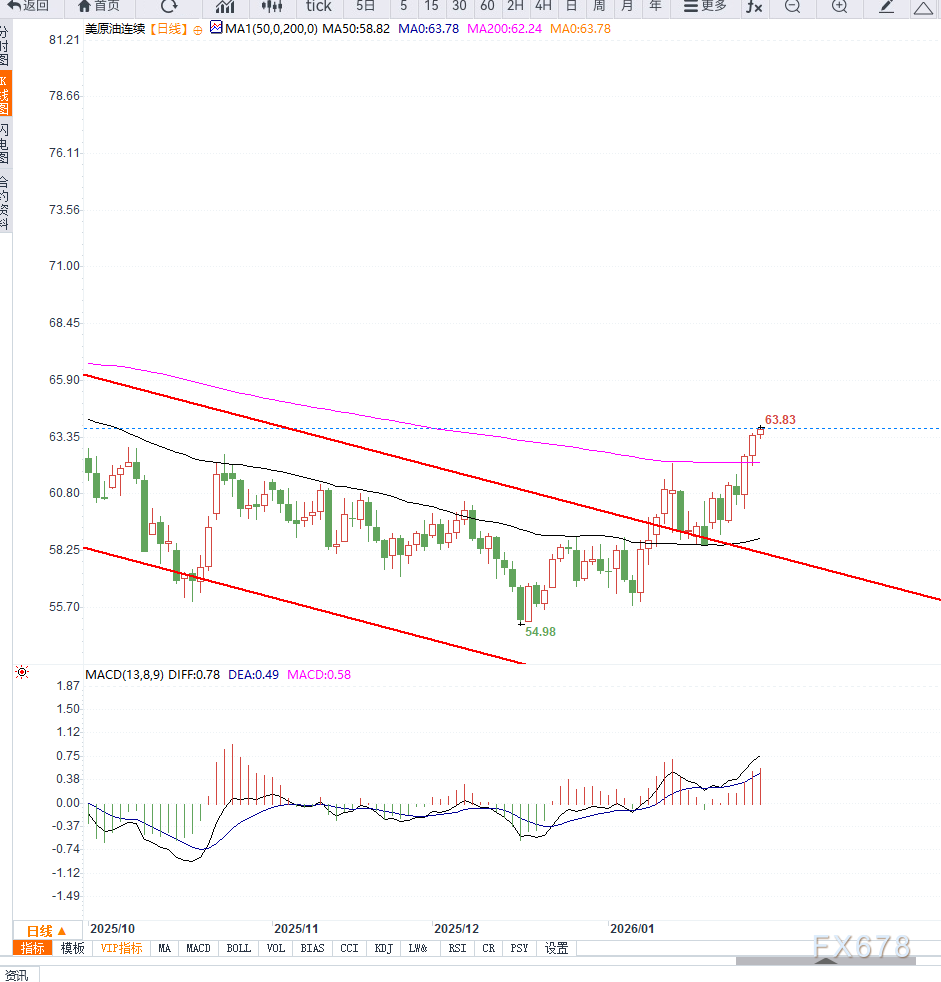
From the perspective of the daily chart, WTI crude oil remains within its medium-term upward channel, with prices breaking through the upper boundary of the previous consolidation range, reflecting a clear strengthening of bullish momentum. On the daily chart, oil prices have effectively risen above several key moving averages, with short- and medium-term moving averages forming a bullish alignment, presenting a technically favorable scenario for bulls.
In terms of momentum indicators, the RSI on the daily chart remains in the strong zone but has not yet shown extreme overbought signals, indicating that bullish momentum still dominates. However, the scope for further upside in the short term may gradually narrow, and heightened volatility at elevated levels should be monitored.
When observing the price-volume structure, the momentum following recent high-volume gains has stabilized, suggesting that the market is awaiting new driving factors. Regarding key price levels, the $63 mark has now become an important short-term support zone. If prices can consistently hold above this level, WTI is likely to continue testing the psychological threshold near $65.
Conversely, if geopolitical risks ease or the US dollar strengthens further, causing oil prices to fall below $63, there could be a retest of the previous breakout area, with attention to the technical support effectiveness near $61.50.
Overall, the WTI daily chart remains biased toward bullishness but has entered a sensitive high-level zone. Future movements will heavily depend on whether geopolitical tensions escalate further and how macro-financial conditions evolve. While the trend remains intact, bulls maintain the initiative, but chasing highs in the short term requires caution against pullback risks.
Editorial View:
From the current landscape, the rise in oil prices is primarily driven by the rapid return of geopolitical risk premiums rather than fundamental shortages. A decline in crude oil inventories provides support for prices, but rising gasoline and distillate inventories, coupled with a drop in refinery operating rates, signal lingering concerns about end-user demand.
Against the backdrop of a rebounding US dollar and expectations of oversupply yet to fully dissipate, oil prices may remain volatile at high levels in the short term. The direction going forward will largely depend on developments in the Middle East situation and changes in the macro-financial environment.