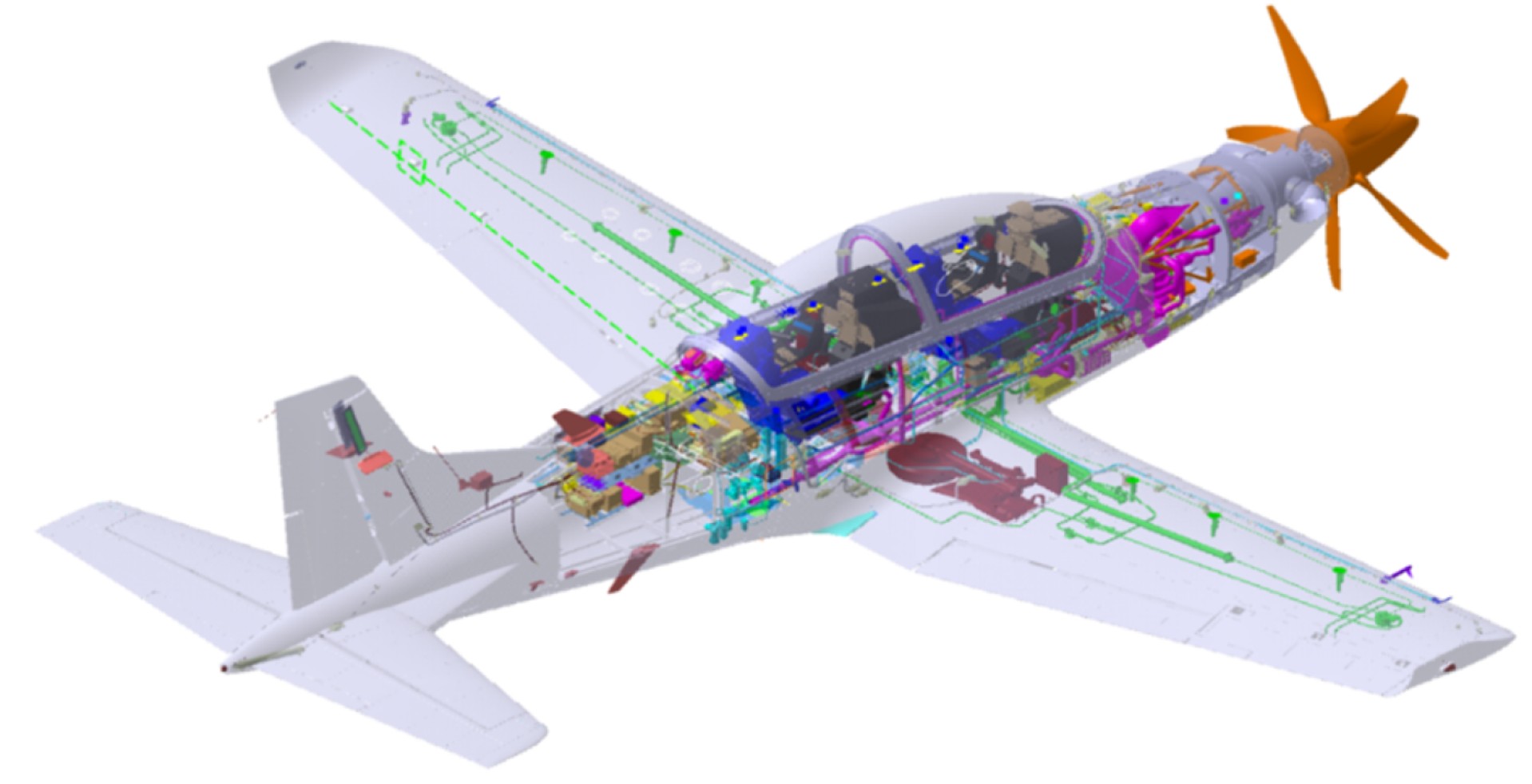
 AIDC announced in 2024 that it had completed the first-stage design of a basic trainer. (AIDC)
Taiwan is seeking to recapitalise its basic trainer aircraft fleet, but it has not yet decided whether replacements will be procured from overseas or developed domestically.
Around three dozen of the 44 Beechcraft T-34C Turbo Mentor aircraft purchased by the Republic of China Air Force (ROCAF) in 1985 remain in service. These are assigned to the ROCAF Academy at Kangshan, where prospective pilots take their first step in flight training.
A spares and accessories package funded last year will allow the T-34 fleet to remain in service through till 2028 at this stage. The aircraft are expected to reach the end of their service lives in 2033.
As such, plans to replace the T-34 need to be set in motion, and President Lai Ching-te’s commitment to raising defence spending to 5% of GDP by 2030 has injected new momentum into discussions about a replacement.
Taiwan’s Aerospace Industrial Development Corporation (AIDC) has been pitching a locally designed trainer for a number of years, and it announced in 2024 that it had completed the first-stage design of an aircraft.
AIDC said at the time, “If the government supports the project, AIDC will be able to commence the second phase of detailed design, achieve a first flight within three years and begin mass production within six years, meeting the ROCAF’s requirement for a basic trainer replacement by 2033.”
AIDC said producing 45 of the new basic trainers would cost NT$21.4 billion (US$682 million).
The development of associated ground-based training systems – including simulators, as well as mission planning and debriefing tools – would fall under the responsibility of the National Chung-Shan Institute of Science and Technology (NCSIST), which would also serve as the government’s overall programme manager.
The programme aligns with Taiwan’s ongoing efforts to strengthen its domestic defence industry, an initiative launched under the preceding Tsai Ing-wen administration, and which Lai has also committed to.
That indigenous drive produced the AIDC T-BE-5 Brave Eagle advanced trainer, with production of the 66 aircraft on order scheduled to be completed late this year, barring delays.
For a country that had not developed an aircraft for three decades, the project was envisaged as a stepping stone toward Taiwan’s next-generation fighter programme, the Advanced Defence Fighter (ADF).
However, the programme was shelved in late 2024 due to insufficiently mature technologies and a lack of technical know-how. Should Taiwan pursue a basic trainer, this would represent a step backward in its aircraft development trajectory.
Some analysts also caution against such a programme, noting that numerous, mature, basic trainer aircraft already exist on the market. Should Taiwan choose to develop its own aircraft and remain the sole operator of only three dozen or so airframes, poor economies of scale would likely result in high lifecycle costs.
Analysts have suggested choosing a widely used, proven trainer aircraft from overseas for local production. This approach would allow Taiwan to leverage a proven design and support network, while enabling its industry to participate in producing spares and providing maintenance services for the broader international fleet.
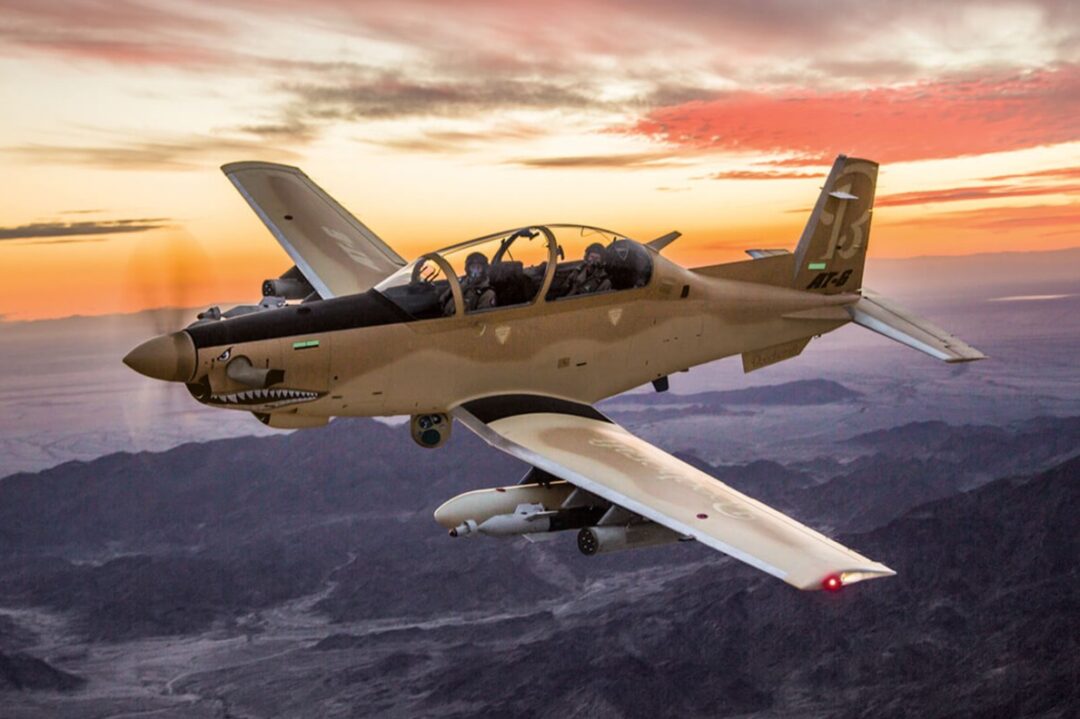 The purchase of a trainer aircraft and light-attack variant, such as T-6/AT-6 aircraft, could help fulfil both basic pilot training and support lower-intensity operations. (Beechcraft)
Purchasing trainer aircraft from overseas would likely be less politically sensitive than acquiring fighters, and it would probably not trigger protests from China.
Taiwan could also procure an armed light-attack variant of the aircraft to support lower-end missions that do not always require a fighter, thereby helping to relieve the workload on the ROCAF’s fighter squadrons.
Huang Yang-te, a Taiwan defence analyst and retired ROCAF officer who once served as an F-16 squadron commander, said an armed variant of a trainer could help in countering loitering munitions or one-way attack drones.
Although the People’s Liberation Army (PLA) has not confirmed the deployment of such systems beyond legacy platforms like the Harpy, Chinese defence firms have promoted similar capabilities, whose low-cost and disruptive potential make their use likely in a cross-strait conflict.
Huang suggested acquiring around 20 Beechcraft T-6 Texan II aircraft as basic trainers, along with 15 AT-6s, the armed variant of the T-6. A common pool of flight crew could rotate between serving as instructors on the T-6 and pilots on the AT-6 as required.
Armed with AGR‑20 Advanced Precision Kill Weapon System (APKWS) rockets and gun pods, and equipped with an electro‑optical/infrared sensor, the AT‑6 – coupled with its slow speed –would be well suited to a counter‑drone role.
Such armed aircraft could also play a role in defending against PLA grey‑zone operations, intercepting slower‑moving Chinese aircraft, including helicopters and drones.
by Roy Choo