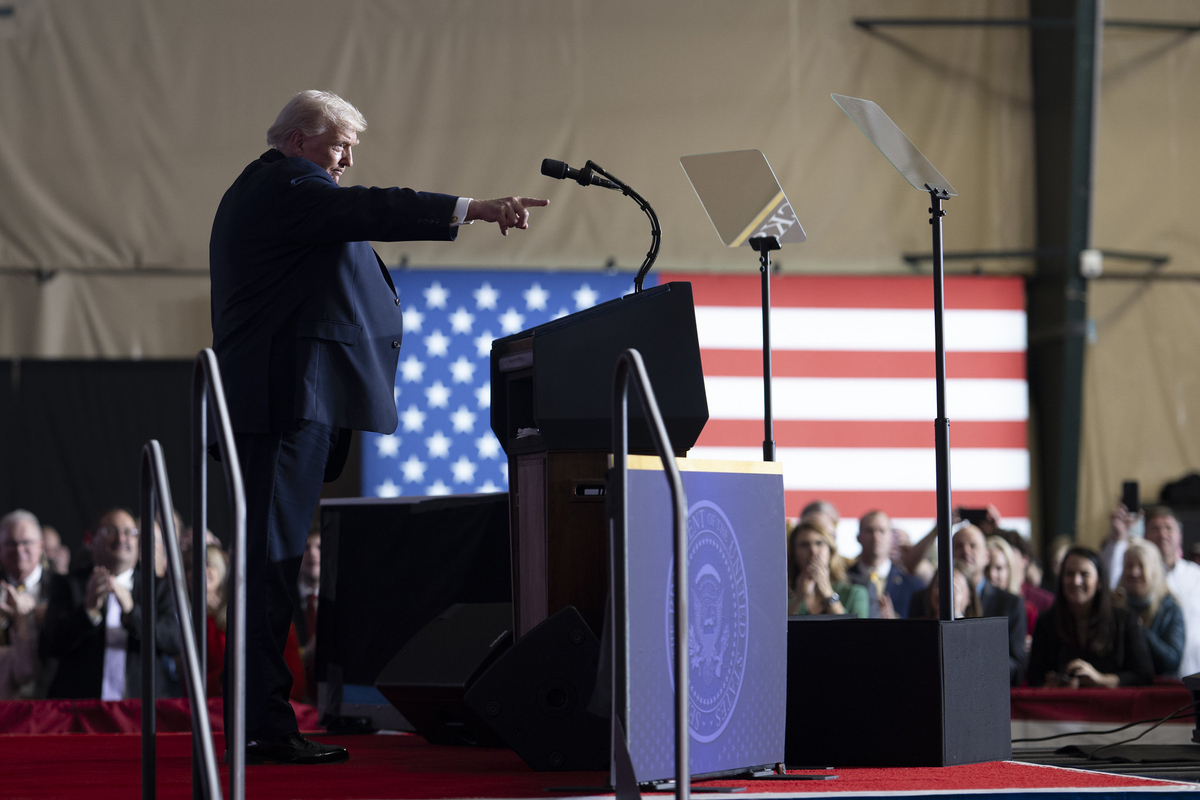
WASHINGTON DC – The drumbeat toward confrontation between the US and Iran is growing louder, sharper – and increasingly difficult to ignore.
President Donald Trump on Wednesday escalated his warnings, threatening military action “far worse” than last summer’s strikes unless Tehran returns to the negotiating table to agree to a sweeping nuclear deal.
JOIN US ON TELEGRAM
Follow our coverage of the war on the @Kyivpost_official.
Tehran responded swiftly, issuing a defiant statement via its UN mission: it would respond “like never before” if provoked, while still signaling willingness to engage in principle under conditions of mutual respect.
Yet the starkest indication of how close the US is to open conflict came during testimony before the Senate by Secretary of State Marco Rubio.
Speaking to lawmakers, Rubio framed potential war as a defensive necessity, emphasizing the administration’s readiness to act preemptively to protect US forces and allies.
“This is no longer messaging for leverage,” said one senior Western official, speaking on condition of anonymity. “This is positioning – militarily and politically – for a decision point.”
US military posture shifts dramatically
Behind the scenes, Washington has bolstered its presence across the Middle East.
Open-source intelligence cited by the Middle East Forum shows a surge of tanker aircraft to Qatar’s Al Udeid Air Base, the deployment of roughly 35 F-15E Strike Eagles to Jordan, and reinforced missile defense batteries throughout the Gulf.
Other Topics of Interest
Why I’m Running for the US Senate
An American hero whistleblower explains why he wants to fight on for democracy in the Senate.
Analysts describe the build-up as a “multi-domain strike package” capable of sustained operations against Iran.
Rubio underscored the urgency in his Senate testimony, describing Iran’s regime as “probably weaker than it has ever been” since the 1979 revolution – but still dangerously capable.
“About 30,000 US personnel are within reach of thousands of Iranian drones and short-range ballistic missiles,” Rubio said. “We have to be prepared – including preemptively – to protect our forces and our allies.”
A regime under siege at home
The escalating showdown unfolds against the backdrop of Iran’s gravest internal crisis in decades.
Following a currency collapse in late December, Iranian security forces reportedly killed as many as 30,000 people in just 48 hours, according to figures cited by Time.
“The Islamic Republic is weaker than at any point since 1979,” said Gregg Roman, executive director of the Middle East Forum. “Its military has been humiliated, its proxies decimated, its economy collapsing – and its people have risen.”
Roman argues that Washington faces a once-in-a-generation opportunity to support Iranian protesters through a combination of military deterrence, sanctions, information warfare, and opposition backing – a strategy he likens to the Reagan administration’s support for Poland’s Solidarity movement.
US officials remain cautious publicly but privately acknowledge the regime’s vulnerability. “This is a brittle system under enormous stress,” a Western diplomat told Kyiv Post. “The question is whether pressure accelerates collapse – or rallies the elites.”
Strike or strategy? Divisions among experts
The dilemma is splitting analysts. Jason Brodsky, policy director at United Against Nuclear Iran (UANI), contends that Trump’s mix of threats and diplomacy could be a psychological operation culminating in “quick, surgical, decisive” strikes targeting Iran’s leadership and security apparatus.
But former Israeli intelligence officer Danny Citrinowicz cautions that military action could consolidate the regime, marginalize protesters, and trigger wider regional escalation without producing credible regime change.
“Externally imposed change would more likely yield IRGC rule or civil war,” he told the Atlantic Council.
Even proponents of tougher action recognize the risks. Gulf states have quietly told Washington they will not permit airspace or base access for an attack, fearing Iranian retaliation. European diplomats report mounting Israeli anxiety over potential reprisals.
The stakes extend far beyond the Gulf. “Anything that disrupts energy flows directly impacts Ukraine,” said a senior European diplomat. “At the very least, it diverts attention from Putin and his daily crimes.”
There is also concern Moscow and Beijing could exploit a US-Iran confrontation to stretch American resources and diplomatic focus – even as Trump demands Iran hand over its enriched uranium to a third party, possibly Russia.
“This crisis intersects with every major geopolitical fault line,” the official added. “It’s not a side show.”
Region holding its breath
For now, diplomats in Saudi Arabia, Qatar, Turkey, and Egypt are scrambling to reopen channels to avert a spiral neither side may fully control. But Trump has signaled that his patience is thinning.
Some in Washington see the escalation as a calculated distraction from domestic pressures.
Others argue it reflects a genuine belief that the moment for decisive action has arrived.
Either way, the Middle East is once again holding its breath, watching a familiar confrontation edge toward unfamiliar consequences.
As one senior Western diplomat put it: “This feels like the last off-ramp. Whether either side takes it is the question that now defines the region.”