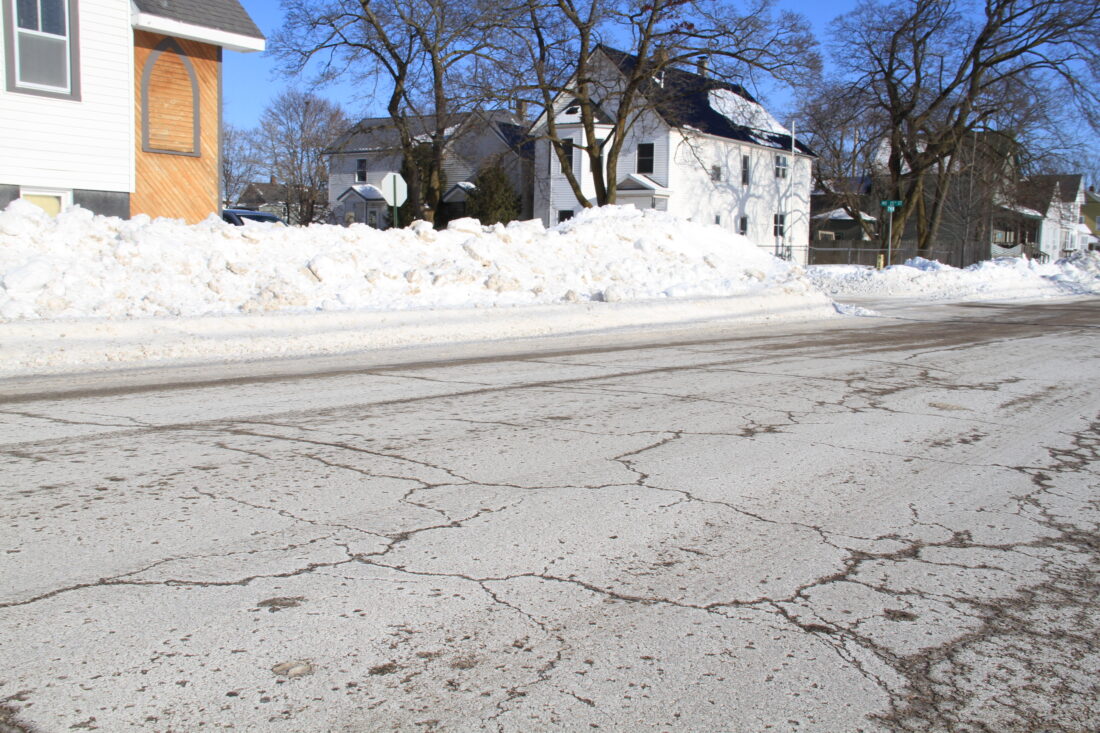
A local street is stained white from salt residue, which is why some agencies don’t salt before each storm in the middle of winter. Certain road commissions have different approaches, and strategies taken always depend on circumstances around each storm. (R. R. Branstrom | Daily Press)
ESCANABA — Maintaining Upper Peninsula roads in the winter is no mean feat.
Presently, with a lull after several successive snowstorms that threatened overburdening, local road commissions are able to use the breathing time to maintain their fleet of equipment.
“The biggest challenges would be keeping up with the fleet,” said Menominee County Road Commission Engineer-Manager Darrell Cass. “When these trucks are being used so heavily, you know, it’s inevitable — you’re going to have breakdowns, and you got to repair a lot of these trucks.”
In addition to keeping the physical machines in working order, keeping the drivers “fresh” is also a challenge.
“These guys are working really long shifts for the duration of the storm, so you hope that they can go get well rested before the next storm hits. So that’s been taking a toll on ’em, too, but they’ve definitely been keeping up with the task,” Cass said.
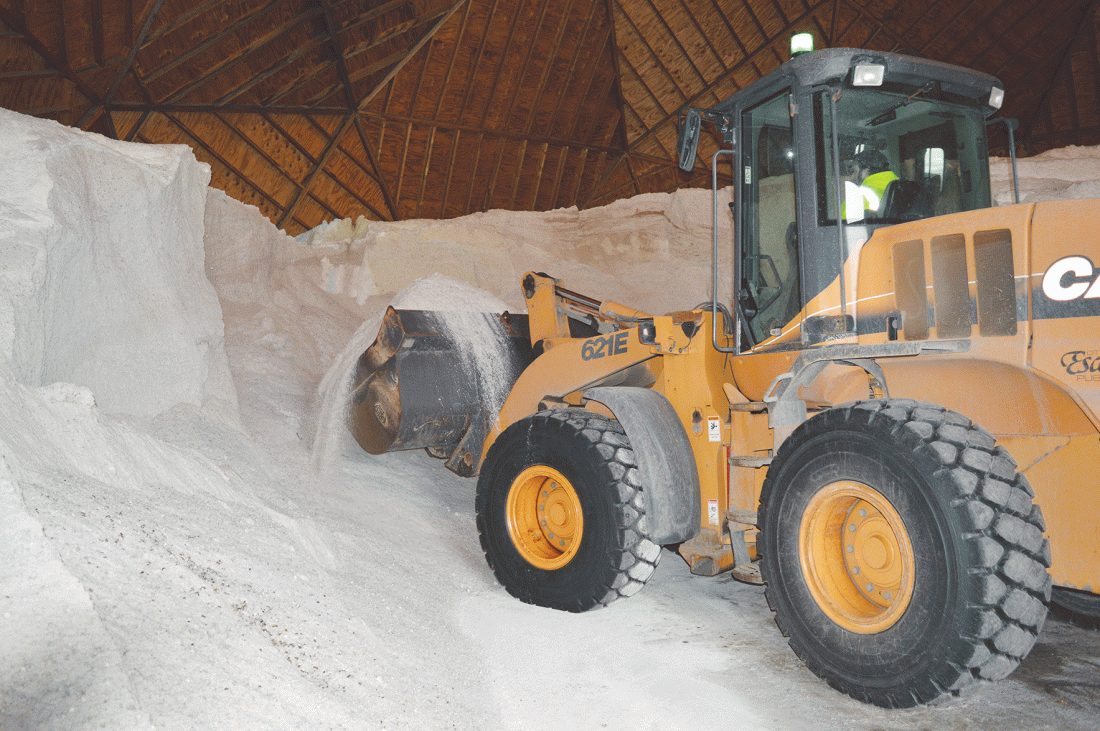
Rock salt is restocked in this 2021 Daily Press file photo by Caroline Carlson. Straight rock salt is used on Michigan highways, while counties often use a mixture with sand to treat their roads.
In Delta County, Road Commission Manager Jody Norman said that shifts overlap. During an average storm that drops about six inches of snow, for example, five people will work from 6 p.m. to 6 a.m., and then a day shift comes in at 4 a.m., Norman explained.
As in Menominee County, Delta is also finding the temporarily blizzard-free spell useful for fleet maintenance.
“Let’s just say we are happy it finally quit snowing for now,” Norman said, noting that equipment needed some work. He also mentioned that staffing can sometimes be an issue due to sickness, injuries and vacations.
Both road commissions, in addition to plowing their respective county roads, are also contracted through the Michigan Department of Transportation (MDOT) to clear the state trunklines. The way that these routes are tackled is different from the approach taken on local streets.
“MDOT has a standard on how we treat the highways, and then each individual transportation agency or road commission has a guidance on how they handle their county roads,” Cass explained.
As per the MDOT maintenance contract, Cass shared, rock salt is used on the state highways. Both Delta and Menominee Counties often use a sand-salt mixture to treat roads. The sand is particularly useful when temperatures are especially low.
“Salt loses its effectiveness at 16 degrees, so it doesn’t pay to put salt on the roads if it isn’t going to work well,” relayed Norman. “In the case of temps below 16 degrees, we will use sand with chloride in it on the roads. Also, the cost of salt is starting to get out of control; this year it’s $71 per ton, (while) two years ago it was $58 per ton.”
Since the current winter has been far snowier than the last couple years, agencies have had to work harder and use more resources than in immediately prior winters.
“To date on our local system we have spent over $573,778 clearing roads, and we are half way through the year. In comparison, the total for 2024-2025 winter we spent $450,000 total, on the 2023-2024 winter we spent $525,000 total, the 2022-2023 winter was $885,000,” Norman shared. “We have already ordered our backup salt for the Escanaba garage, which is a little disturbing for that to happen this time of year.”
Slightly different topography can affect the state of certain roads. Wide-open field-adjacent areas are prone to accumulating drifts, while more wooded areas carry the danger of trees coming down across roadways or power lines. And with the size of existing snowbanks, even two inches of fresh snowfall with a high wind can create surprising drifting issues, Norman said.
The strategy for tackling road care can be tricky and is different for every storm, Cass said. Decisions are made by monitoring predicted storms and taking steps based on calculated estimations.
“Every storm is different. The temperatures are different, the type of precipitation is different, right? Whether it’s sleet and ice or if it’s fluffy snow … it’s a judgment call that our district foreman (makes),” Cass explained. “They look at the temperatures, they look at the immediate forecast, they look at, you know, how much we’re expecting in terms of snow accumulation, things like that. And they time out how they think the winter operations should go — and they do a heck of a job at it.”
Different agencies may formulate various plans, which is why there sometimes is a noticeable difference in the state of roads at county lines.
During the last big storm, Cass explained, Menominee County Road Commission presalted a little before the snow hit, which prevented it from sticking to the road surface, while other counties were dealing with snow pack on the roads.
Yet different techniques are employed elsewhere. There are places that use a brine to treat their roads, and others that use a system called “pre-wetting,” in which a nozzle sprays liquid onto rock salt or sand right before the solid granules hit the ground, to help them adhere to road surfaces better.
Delta County Road Commission tends to clear roads during and after a snow event, but deems pre-salting before mid-winter storms unnecessary: “Typically there is a fair amount of salt residue on blacktop roads from past storms; that is the white film you see on blacktop roads when they dry after an event,” Norman said.
As much as possible, highways are the highest-priority routes, followed by primary roads and then smaller local roads. Succeeding the storm that hit the area shortly after Christmas, many residents were frustrated and blamed the municipalities for not plowing their roads soon enough, prompting the City of Escanaba to release a statement clarifying the order and asking citizens to be patient.
While city public works departments handle road plowing within their limits, the county road commissions are responsible for a much larger area. MDOT’s system within Delta County is 340 miles, and the Delta County Road Commission plows roughly 730 miles in their whole system, Norman reported.
“With a six-inch storm, we will try to get in every road with a full-time resident that day,” he said. “That doesn’t mean we can always make that happen; with high winds, there can be trees down or power lines that won’t allow us to come down some roads.”
As far as specific challenges encountered this season:
“This winter has been very difficult — warm weather, then getting a bunch of snow, then it freezes, makes it very difficult to deal with,” Norman said. “By the time we get to most side roads it’s been packed on and frozen, and that takes much longer to get it off.”