America’s major trading partners no longer feel confident in the country’s stability and are looking elsewhere for alternative global markets. That includes moving towards China despite some serious concerns about leadership in that country as well.
So, how does all this global trade turmoil actually impact you?
Recent concerns over the US
Major trade allies continue to investigate other options one year into the Trump administration.
“If you look at the president’s trade policy, the message he’s sending other countries with the tariffs and these agreements is that the United States is no longer a reliable trading partner,” Bill Reinsch, senior adviser at the Center for Strategic and International Studies, told Straight Arrow News. “And so, the obvious conclusion to draw, if you’re in another country, is find other partners. And that’s exactly what they’re doing.”
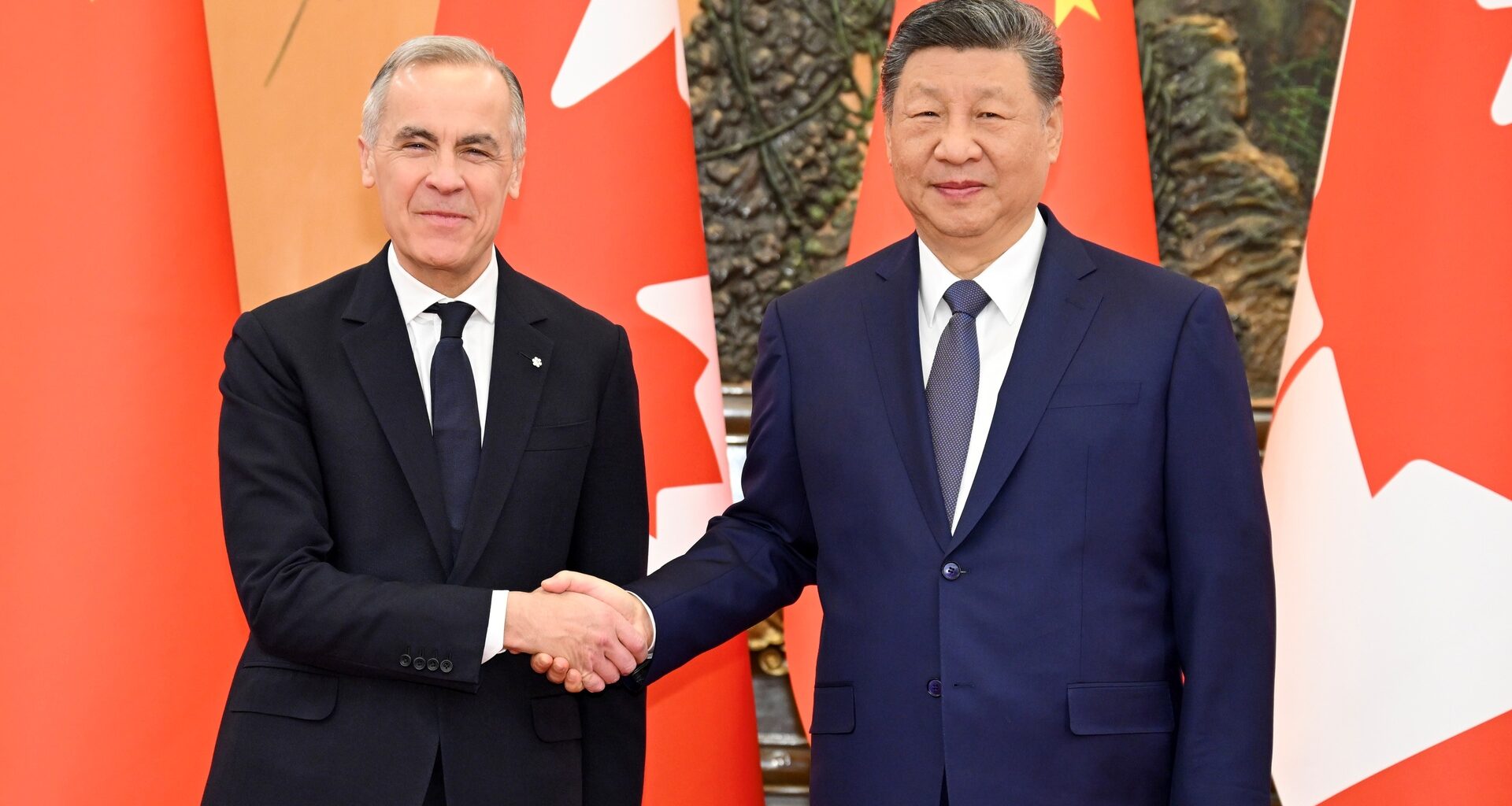
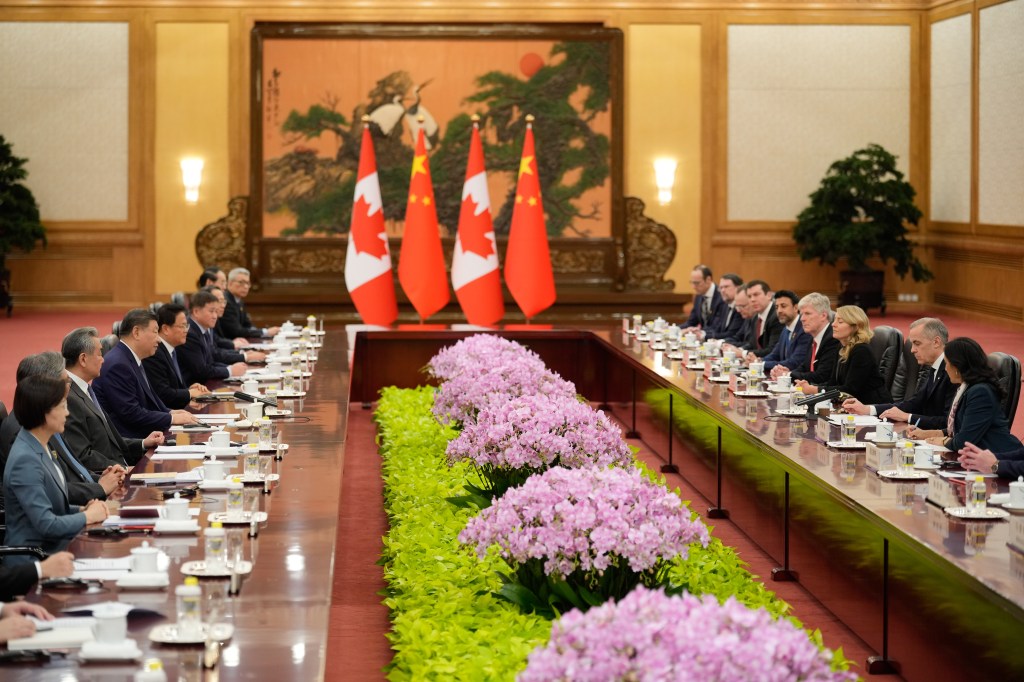 BEIJING, CHINA – JANUARY 16: Chinese President Xi Jinping (3rd-L) and Canada’s Prime Minister Mark Carney (2nd-R) meet at the Great Hall of the People on January 16, 2026 in Beijing, China. (Vincent Thian – Pool/Getty Images)
Canada is America’s top commercial trade partner other than the European Union. Trade war tensions increased between the U.S. and Canada recently after Canadian Prime Minister Mark Carney met with Chinese President Xi Jinping and announced a “new strategic partnership.”
President Donald Trump later threatened 100% tariffs on Canada if a trade deal is made with China. Carney later ruled out a free trade deal with China over concerns of causing even more rifts in his country’s relationship with the U.S.
“Canada, the most dependent nation on United States, is actively looking for alternatives, and the recent agreement that they’ve had with China on agricultural goods going to China and electric vehicles coming in from China is just a beginning step for them being forced to find alternatives,” Robert Rogowsky, professor of trade and economic diplomacy at the Middlebury Institute of International Studies, told SAN.

Download the SAN app today to stay up-to-date with Unbiased. Straight Facts™.
Point phone camera here
Trade tensions between the U.S. and the U.K. have also escalated under the Trump administration. Now British Prime Minister Keir Starmer will become the first British head of state to head to Beijing in eight years along with Starmer’s Business Secretary Peter Kyle.
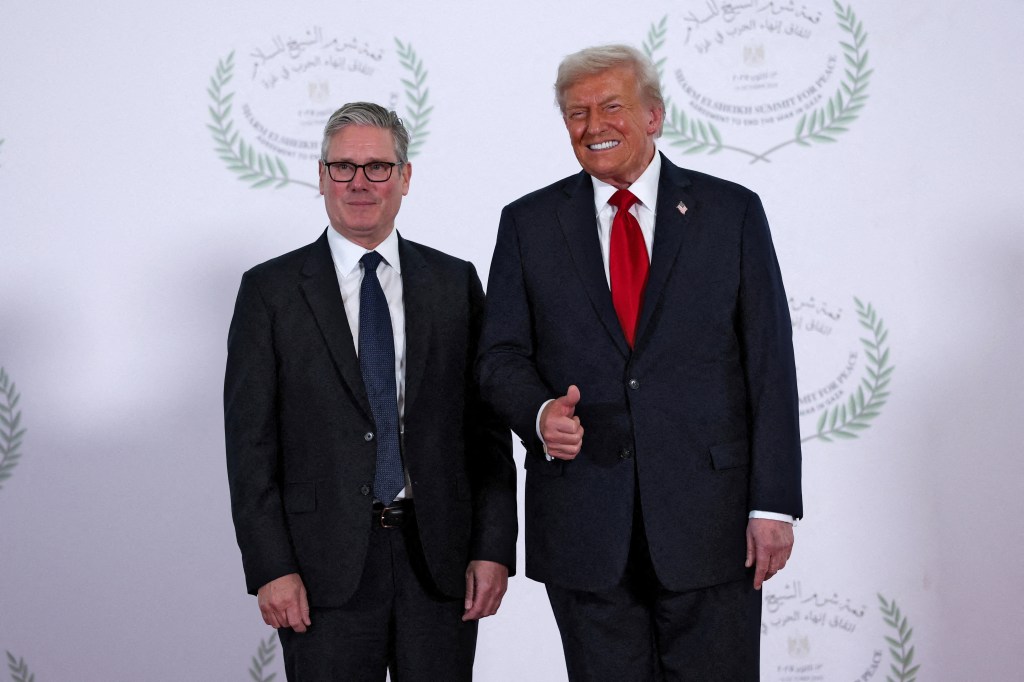 U.S. President Donald Trump (R) and British Prime Minister Keir Starmer pose for a photo at the Gaza summit in Sharm El-Sheikh on October 13, 2025. (SUZANNE PLUNKETT/POOL/AFP via Getty Images)
Trump’s relationship with Starmer has been further strained over Trump’s threats of America taking over Greenland.
“They don’t think strategically,” Susan Aaronson, PhD, research professor at the George Washington University Elliott School of International Affairs, told SAN. “You need friends and alliances and trust to sustain foreign investment in the United States. You need foreigners to keep buying our treasury bills.”
China is, of course, another major trading partner with the U.S. and the two sides have traded tariffs and engaged in talks for the better part of a year.
Historical precedent
The concerns over U.S. stability in the global trade market are unprecedented since the end of World War II, according to experts SAN spoke with.
“The world has been working steadily to create a rules-based trading system that was supportive of liberal democracy and free market capitalism, with the idea that a free-market trading system encapsulating most of the world,” Rogowsky said.
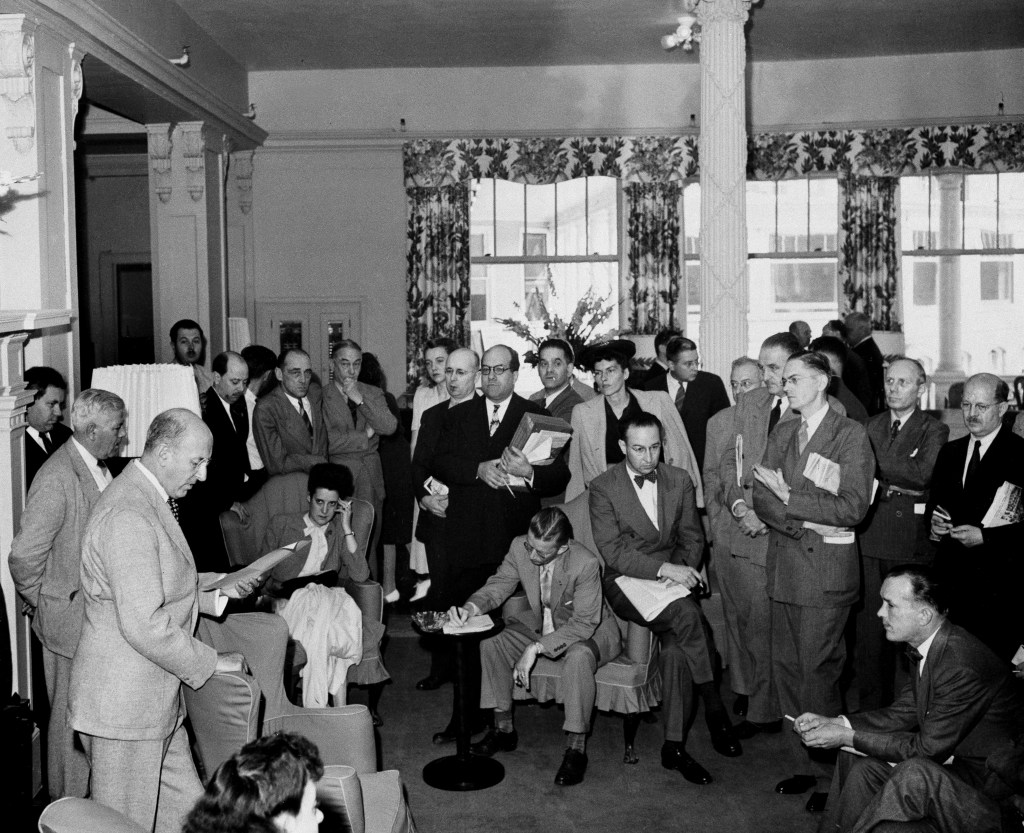 Henry Morganthau, left, conference president, reads a statement to the press representatives of most of the 44 nations represented at the United Nations Monetary and Financial Conference session at the Mt. Washington Hotel, in Bretton Woods, N.H., July 1, 1944. (AP Photo/Abe Fox)
Nearly 50 allied nations came together in New Hampshire in July 1944 for the United Nations Monetary and Financial Conference where, among other things, they helped construct the global trade system we see today.
“Every president until Trump – every president of either party has pursued a policy that was intended to liberalize trade, cement multilateral alliances and support an open rules-based trading system,” Reinsch said.
In the 82 years since, there’s been some moments of global tension but nothing to this magnitude.
“Nixon’s return to the gold standard, his taking the dollar off the gold standard was pretty scary,” Aaronson said.
China concerns
The U.S. and China are the two largest economies in the world. Naturally, if America’s trade allies want to look for another partner, China would be near the top of the list.
However, there are numerous concerns about China as well.
“Neither one of them are reliable,” Rogowski said.
Aaronson agreed that other nations are looking for other markets, but China has its drawbacks.
“They’re turning towards stability and the rule of law,” she said. “Although China is a mixed bag on that. I wouldn’t say they’re turning towards China. They totally distrust China.”
Despite concerns over China, the country posted a record trade surplus last year and stands to benefit from mistrust of U.S. leadership.
“China will most significantly benefit,” Rogowski said.
Other global markets
At the recent World Economic Forum in Switzerland, Canada’s Carney said it’s time for the middle powers of the world to step up.
“The middle powers must act together, because if we’re not at the table, we’re on the menu,” Carney said.
 BRUSSELS, BELGIUM – SEPTEMBER 17 : EU Commission vice-president, High Representative for Foreign Affairs and Security Policy Kaja Kallas (L) and the EU Commissioner for Interinstitutional Relations and Transparency Maros Sefcovic (R) talk to media in the Berlaymont building on September 17, 2025 in Brussels, Belgium. (Thierry Monasse/Getty Images)
That opens the door for countries like India, which has recently reached a free trade deal with the European Union, representing a third of global trade.
“India is the more attractive partner,” Aaronson said. “It’s got greater potential for growth.”
The EU’s trade relationship with China is icy to say the least over human rights issues and more, but that could change if things get more complicated with the U.S.
“The EU must now be thinking, perhaps we need to make concessions on that, or agreements on that, and reestablish and rebuild our relationship with China,” Rogowski said.
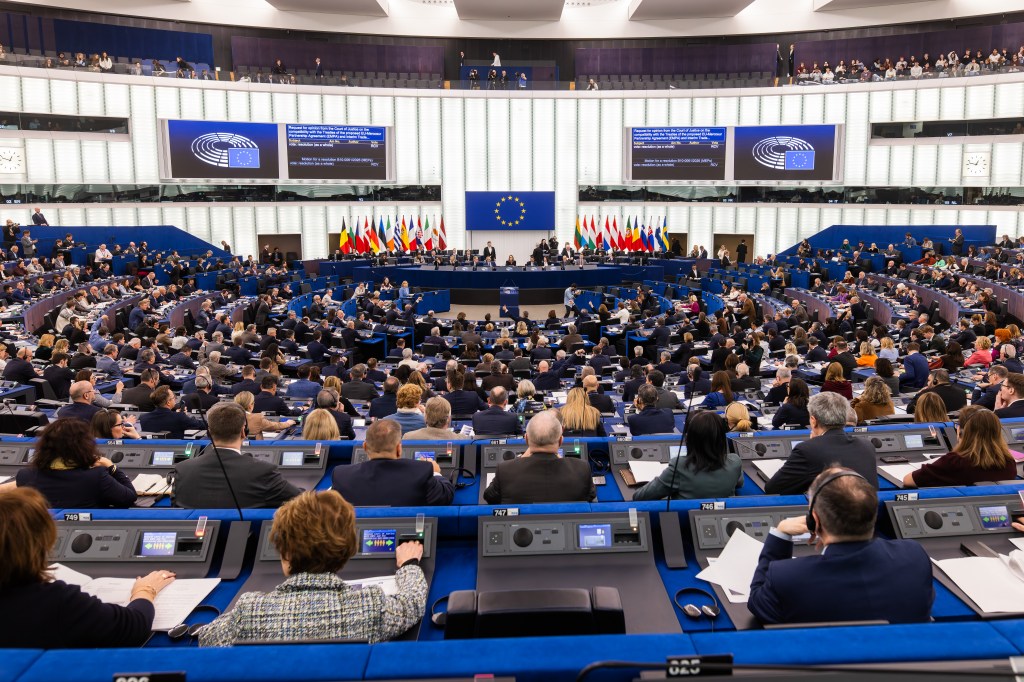 21 January 2026, France, Estrasburgo: Members of the European Parliament vote on the review of the agreement with Mercosur by the Court of Justice of the European Union. Photo: Philipp von Ditfurth/dpa (Philipp von Ditfurth/picture alliance via Getty Images)
The EU has also finalized a partnership with Mercosur, which includes Argentina, Brazil, Paraguay and Uruguay.
Meanwhile, India has made five new trade deals in just the last year and a half.
“There’s a lot going on without us,” Reinsch said.
When it comes to the relationship between India and the United States, India has cut its U.S. Treasury holdings to a five-year low.
“I think you’re going to find other countries, very quietly, other investors very quietly, not coming to the United States,” Reinsch said. “I don’t think you’re going to see a lot of people leaving, but you’re not going to see them coming here. They’re not going to say that because they don’t want to irritate Trump, because irritation usually is followed by retaliation, so it’ll be quiet.”
How it impacts you
While all of this is clearly having an impact on the global stage, how is it impacting you?
Experts SAN spoke with don’t expect major immediate impacts.
“It’s turning out to be a long-term issue,” Reinsch said. “The people that predicted doom in April have turned out to be not right so far.”
Reinsch added there are several reasons for that, including companies stockpiling inventory in anticipation of what Trump did, the tariffs that ultimately did go into effect were lower than what Trump originally said, and they went into effect later than expected.
“If you add all that stuff up, the impact has been less than what people predicted,” he said. “Whether that will change, I think, depends a little bit on what Trump does with the tariffs, what the Supreme Court does with the tariffs, and on what retailers do about the tariffs?”
There has not been much data on the cost of the tariffs to Americans, except for one recent study from the Kiel Institute that showed Americans paid most of the tariffs. Researchers found Americans paid 96% of the cost.
“You have to be a little careful on saying that because what they measured is shipping prices, so that doesn’t measure what the U.S. consumer ends up paying,” Reinsch said. “If Walmart decides to absorb the entire tariff and not raise prices, U.S. consumers are no worse off.”
Walmart has raised some prices in the last year but has said it’s attempting to mitigate costs.
The other thing to consider when it comes to the impact on you is a trade war’s impact on inflation.
“It’s surprising how little it hasn’t raised prices yet, but I think over time, it will be felt in the inflation figures,” Rogowski said.
Trump and his administration have proven to be unpredictable during this second term, especially when it comes to trade, which makes it hard to know what’s coming.
“As Yogi Berra says, it’s hard to make predictions, especially about the future,” Rogowski said.