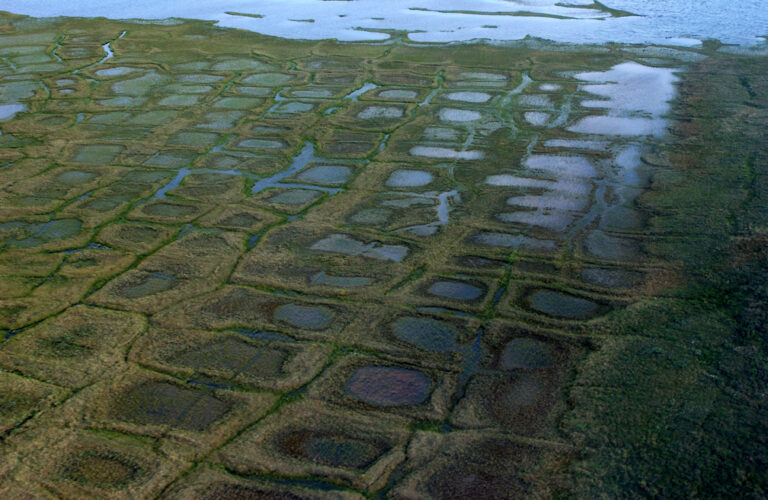
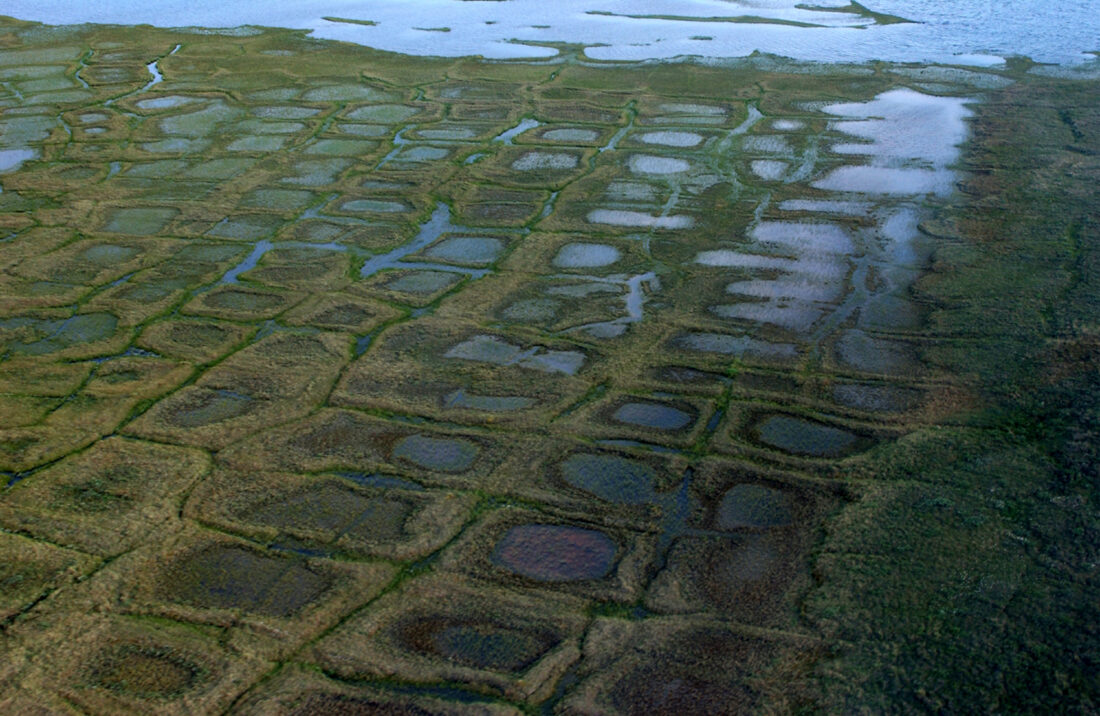
FILE – In this undated photo provided by the United States Geological Survey, permafrost forms a grid-like pattern in the National Petroleum Reserve-Alaska managed by the Bureau of Land Management on Alaska’s North Slope. (David W. Houseknecht/United States Geological Survey via AP, File)
JUNEAU, Alaska (AP) — ConocoPhillips Alaska can proceed with an oil and gas exploration program in a portion of a vast petroleum reserve in the state after a federal judge refused to block the project, denying a request by opponents who said it was improperly analyzed by the U.S. government but that the company said was imperative to preserving its leases.
U.S. District Court Judge Sharon Gleason, in an order dated Tuesday, rejected a request by conservation groups and an Inupiat-aligned group that sought to halt the company’s planned exploration program in the National Petroleum Reserve-Alaska until the groups’ legal challenge to the program’s authorization by the U.S. Bureau of Land Management was resolved.
Gleason said the groups had not shown that they have a “fair chance of success” on the merits of their claims.
The decision comes after a mobile drilling rig the company planned to use as part of its program toppled onto snow-covered tundra near existing oil and gas infrastructure while being transported last week. Attorneys for the company in a court filing said the incident would not deter ConocoPhillips Alaska’s overall plans and that a substitute drill rig would be used.
The company is the top oil producer in the state and its pursuits in the petroleum reserve include the large Willow oil project, approved in 2023 and currently under development.
The Bureau of Land Management in late November approved a program proposed by ConocoPhillips Alaska that included seismic surveys aimed at helping identify oil and gas reserves and plans to drill four exploration wells. The lawsuit, brought by Sovereign Inupiat for a Living Arctic, the Center for Biological Diversity and The Wilderness Society, alleges the process around the company’s application and its subsequent approval lacked transparency and was rushed. The groups say the planned program could harm caribou and bird habitat areas.
In December, the federal agency issued a revised approval that it said took into account recent changes, including the Trump administration’s adoption of a plan that would reopen most of the reserve to leasing. The groups that sued said in a court filing that the revised approval did not address their concerns.
The lawsuit names as defendants the Department of Interior and Bureau of Land Management and top agency officials, including Interior Secretary Doug Burgum. ConocoPhillips Alaska filed as an intervenor in the case, in support of the government’s actions.