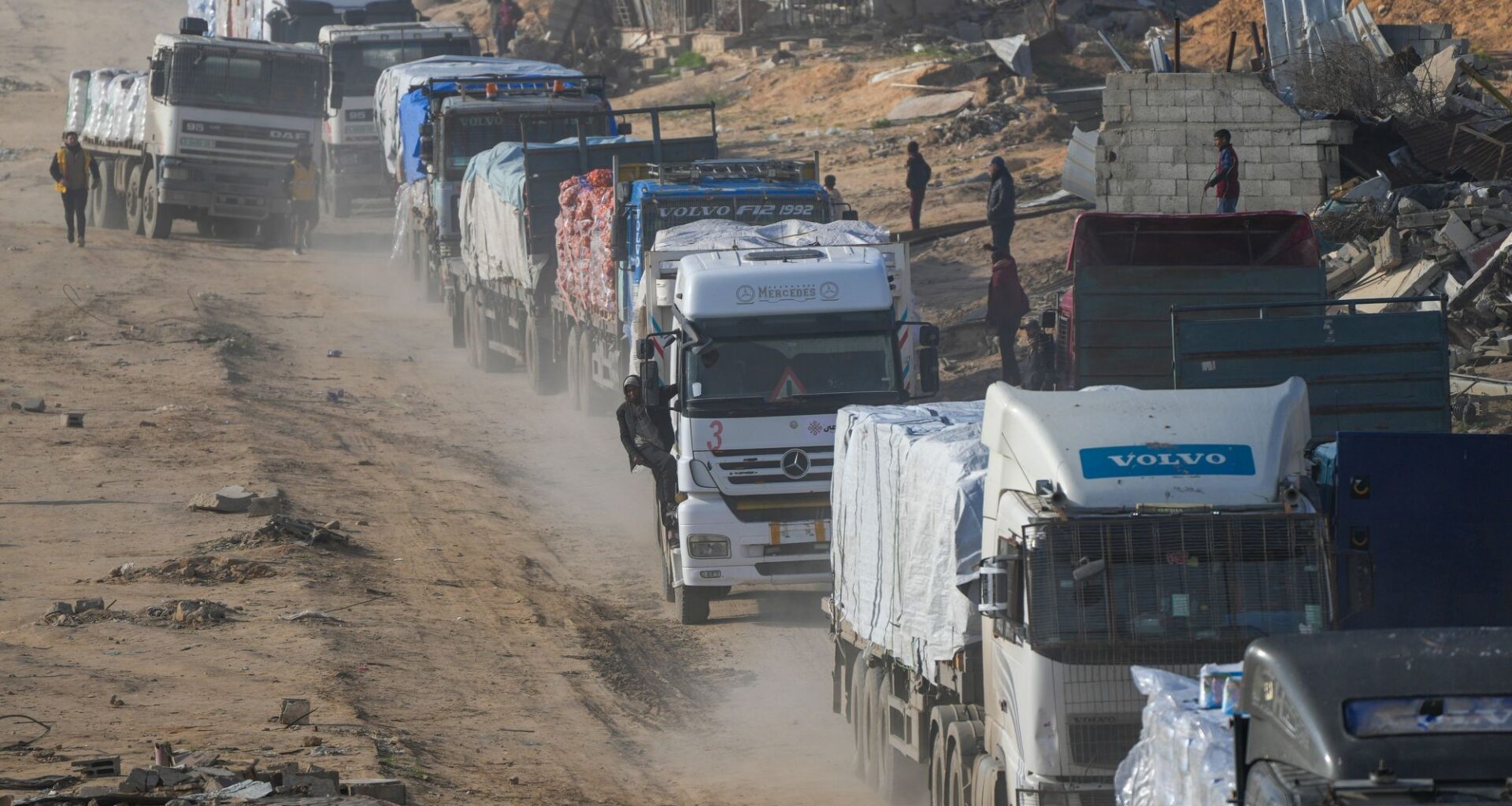
Following the return of Ran Gvili, the final Israeli hostage held in Gaza, and the conclusion of the first phase of the ceasefire, the Israel Defense Forces have released new figures detailing the scale of humanitarian aid delivered to the Gaza Strip since October 7, data that Israeli security officials say raises serious concerns.
According to military officials, roughly 4,200 aid trucks are currently entering Gaza each week, averaging about 600 trucks per day.
Israeli security assessments, however, estimate that approximately 200 trucks per day would be sufficient to meet the population’s essential humanitarian needs. Defense officials warn that the excess aid is inadvertently benefiting Hamas, arguing that “every additional truck creates an economic advantage for Hamas.”
Israel acknowledges that it agreed to the elevated aid volumes as part of the ceasefire framework, aiming to facilitate the release of hostages.
But as discussions over a potential second phase continue, security officials are increasingly calling for a significant reduction in aid flows, in coordination with the United States. They argue that humanitarian deliveries should be recalibrated to strictly defined needs for food and medicine, warning that surplus supplies risk reinforcing Hamas’s control over Gaza.
United Nations assessments are also central to the debate. The UN estimates Gaza’s needs at 134 trucks per day, equivalent to about 80,000 tons of food per month. Israeli data, however, shows that nearly 425 food trucks are entering Gaza daily, amounting to roughly 840,000 tons per month, more than four times the UN’s estimated requirement.
According to the Coordinator of Government Activities in the Territories (COGAT), around 112,000 aid trucks have entered Gaza through six Israeli-operated crossings since the war began. These shipments included approximately 1.7 million tons of food and about 55,000 tons of medical supplies and medicines.
Israeli officials also highlighted the broader humanitarian measures implemented during the war. Nearly 5,000 international aid workers have entered Gaza, while 42,000 Gazans were permitted to leave the territory to receive medical treatment abroad. In addition, some 600,000 children were vaccinated against polio in three coordinated vaccination campaigns.
Gaza ceasefire phase two: Hamas spokesperson ready for ‘complete transfer of governance’
An IDF spokesperson emphasized that the humanitarian effort has been carried out over two years under complex wartime conditions, with support from international partners, including the United Arab Emirates, and through new aid distribution mechanisms designed to replace UNRWA. According to the military, specific safeguards were established to prevent Hamas from interfering with aid distribution.
The report also referenced Israel’s humanitarian activities beyond Gaza. COGAT said Israel delivered aid to Syria, including food, clothing, shelter materials, hygiene products, medical equipment, infant supplies, fuel, and water tanks. Nearly 300 Syrians received medical treatment in Israel, while health centers were established to help train Syrian doctors with support from Israel’s Health Ministry.