January 29, 2026
Taiwan’s ability to maintain maritime domain awareness (MDA) around the island to counter China’s gray zone operations is facing serious challenges, and the government needs to find a new way of doing business to mitigate the erosion of Taiwan’s deterrence and combat power, China’s exploitation of this weakness for infiltration, and Taiwan’s ability to conduct efficient maritime search and rescue (SAR). A layered, multi-modal, combined manned and unmanned ISR complex augmented by domestic COCO (contractor-owned, contractor-operated) solutions could meet Taiwan’s needs while aligning with Taiwan’s new resilience approach to national security.
Following Taiwan President Lai Ching-Te’s announcement that the government will devote an estimated US$40 billion on defense and resilience initiatives over the next 8 years, China launched a second major exercise of the year; “Justice Mission 2025” from December 29 to 30 consisted of at least 130 sorties and 32 vessels just on day one. These persistent incursions exert enormous pressure on Taiwan’s ability to maintain proper situational awareness (SA) around the island. And of the three major physical domains air, maritime, and ground; a rudimentary common operational picture (COP) for ground operations is formed through the Taiwan Tactical Network (TTN), along with ATAK blue force trackers. The newly announced T-dome will provide further integration to existing missile and air defense system, presumably with enhancement in sensor and surveillance capabilities. Maritime domain awareness alone received little adequate attention in the new defense and resilience bills.
Current lack of maritime domain awareness (MDA) and mitigation measures are raising real concerns
Taiwan’s Navy and Air Force are stretched thin responding to PLA’s constant exercises and incursions; high end ISR and operational assets are being sortied constantly to mitigate gaps in MDA, wearing down equipment, logistics, and personnel before any major action. This is asymmetrically eroding Taiwan’s combat power by pressuring Taiwan’s vulnerability in persistent stare. And while Taiwan’s military focused attention on their opposite number across the Strait, Chinese infiltrations in civilian guises are getting through. Between June 2024 to May 2025 alone, there were 4 known cases of successful Chinese infiltration by rubber dinghies just in northern Taiwan, breaching highly sensitive defense cordons guarding against Chinese decapitation strikes. Another grave implication, demonstrated through the effort to locate pilot of a crashed Taiwan F-16 last week, is the penalty this imposed on Taiwan’s maritime Search and Rescue (SAR) operations. Search for survivors of both military and civilian maritime emergencies near Taiwan routinely suffered from a lack of reliable muti-modal sensor networks that can efficiently locate survivors within the golden hours. Search assets still frequently resort to using flares to conduct visual search at night due to lack of available high-end ISR capacity, while lack of networked C3 hamper timely dissemination of surveillance pictures to responder units.
Drones are an up and coming but risky solution
Taiwan’s Coast Guard Administration (CGA), responsible for the critical 24-mile zone around Taiwan, has been trying close the MDA gap by beefing up shore-based sensors, installing Automatic Identification System (AIS) on patrol boats, while exploring aerial surveillance solutions. Of these three, airborne ISR capabilities provide the most flexible way to mitigate critical gaps and thus receive the most attention. Taiwan’s organizational infighting prevented organic long range fixed-wing solution for maritime patrol and MDA means that UAS plans took priority. This vision of a drone-dominated solution to complement shore-based and shipborne sensors has been in development since 2016, yet as Taiwan’s National Audit Office (NAO) indicated in their annual report, operations of these drones suffered from severe issues including lack of qualified personnel, inability to operate under adverse weather conditions or at night, and low operational readiness rate for the fleet. The inability to operate under severe sea state for current group 3 and smaller UAS hit particularly hard, as Taiwan routinely suffers from windspeed exceeding 28-30 m/s with 2–3-meter waves; a significant hurdle for current UAS solutions but not smugglers and PLA or Chinese Coast Guard vessels
Growing pain is unavoidable for standing up new capabilities, such as CGA’s effort on UAS ISR, but it is clear that after 10 years of experimentation, the current pace of CGA’s drone program cannot address the MDA gap adequately in a timely manner.
Ukraine War also demonstrated that current UAS operational dynamics change every 4-6 months, while electronic warfare dynamics, critical to UAS operation, changes on a 4-5 week cycle, which means acquisition of current UAS risks obsolescence before achieving operational relevance. Attempts to shorten UAS development cycle often results in sacrificing performance and reliability. This rapid pace of obsolescence further hampered sufficient understanding of the full life cycle cost for any UAS. Currently, the upfront acquisition cost of a single system of group 3 VTOL UAS consisting of ground station and 4-5 drones generally costs around 16-21 million USD, while the initial acquisition cost for an ISR aircraft based on civilian piston-engine airframe would be around 8-10 million USD.
Alternative organic capabilities require significant political will and time
For CGA to establish fixed-wing element such as those employed by Japan and the Philippines would cost an astronomical 25-billion NT (US$796 million) for the initial airframes and still require enormous commitment in time, treasure, and political will to stand up the unit. The later concerns have proven to be decisive even when the equipment is free; when US, through Presidential Drawdown Authority (PDA), offered Taiwan Navy aerostats to enhance MDA, the Navy rejected the assistance package due to lacks of manpower, authorized formation, and operations and maintenance (O&M) funding.
Domestic fixed-wing COCO ISR offers the best option
The solution to Taiwan’s MDA gap needs a layered approach combining manned and unmanned capabilities. Manned fixed wing platforms, which can get to area of interest fast, equipped with proven and mature integrated sensors and operator at the edge to mitigate risks in communication disruption, could provide broad-area, high-data rate surveillance and target tracking capability in all-weather conditions for both daytime and nighttime. The unmanned alternatives, operating from vessels at sea or smaller fixed locations on land, could work to enhance the effective range of existing maritime or land-based ISR nodes such as vessels and tracking stations, tackling lower priority missions under less challenging environments whilst continuing to develop and mature.
Taiwan recognizes its budgetary constraints and capability shortfalls facing China’s rapidly escalating threat, and the government has begun to encourage commercial-off-the-shelf (COTF) solutions spearheaded by new units such as the Defense Innovation Office (DIO). A similar approach, the commercially-owned-and-operated (COCO) model could provide instant and flexible capacity with matured capability, while building relevant national security expertise in the domestic private sector.
Both the US Air Force and Navy have routinely engaged contractors such as ATAC and Draken through the COCO model for its adversary training, allowing the services to flexibly augment and scale existing training, or to act as the critical middle step in reforming capacity and capability. The later represents a suitable use case for Taiwan’s MDA gap. Domestically, Taiwan Navy has long used COCO for target towing services, while Taiwan Coast Guard, according to senior Guard official, operates its shore-based electro-optical (EO) surveillance systems through COCO contracts.
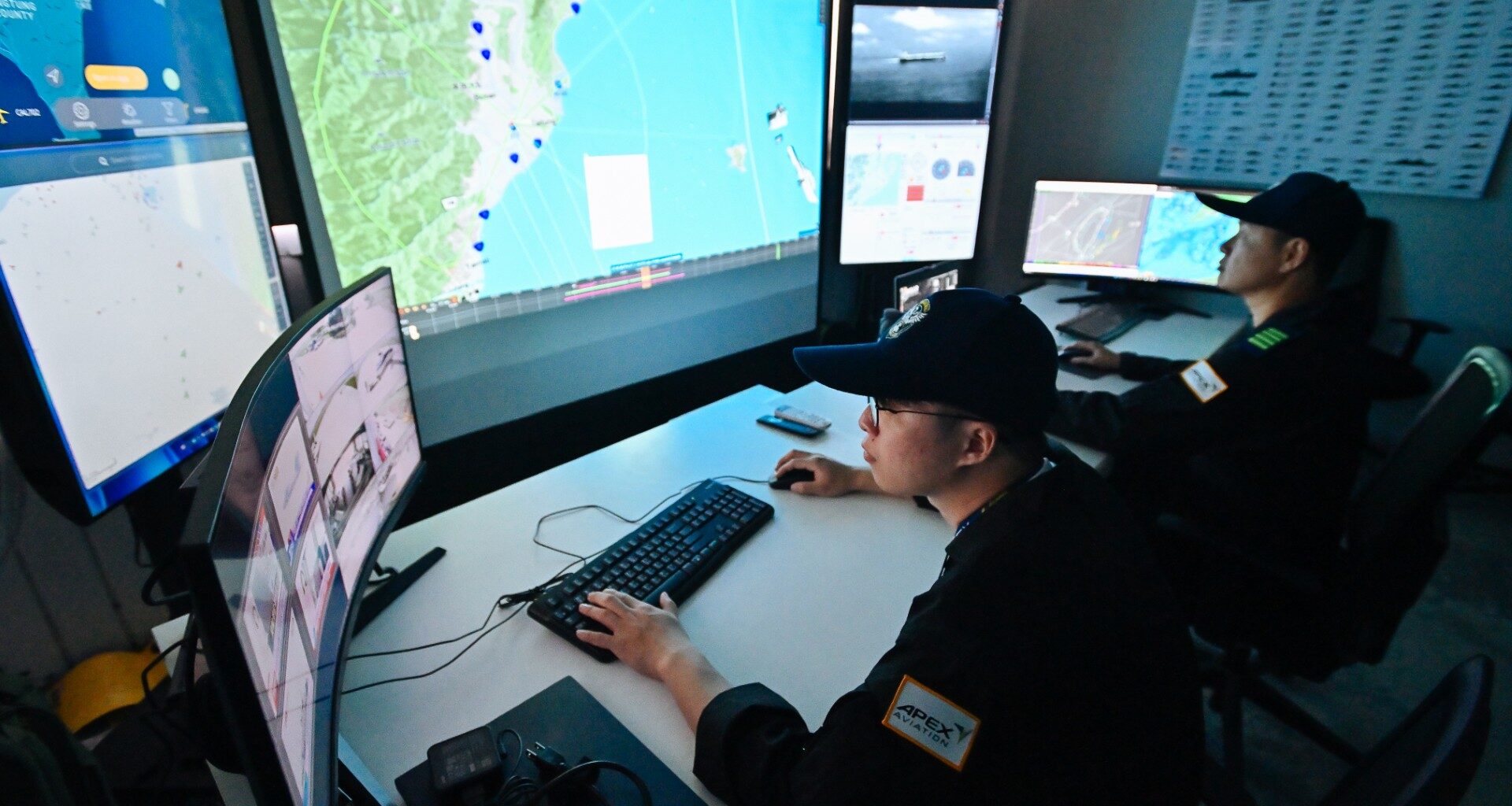
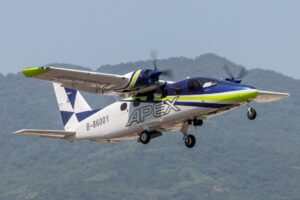
A number of Taiwan aviation firms have expressed interest in providing manned ISR services to CGA through a COCO arrangement; Daily Air is expected to propose a solution based on their existing DHC-6-400 Twin Otter airframe to be integrated with sensors. Executive Aviation (EATC) may offer a higher-end solution with mission-specific modifications to their Gulfstream G650ER. Sunrise Airlines may propose a solution based on its Raytheon Hawker 400XP business jet with mission sensor suite modifications. Apex Aviation, with its highly publicized Goshawk solution, is potentially the most technically mature. Based on the twin-engine Tecnam P2012 utility aircraft and equipped with a complete suite of EO/IR sensors, IMSAR Ku-band radar pod with moving target indication (MTI) capability, and an integrated C3 suite, the company claimed that Goshawk has already gone through extensive testing, and has been providing Taiwan Coast Guard with ISR imagery for evaluation purposes.
Risks of the COCO Model
To be sure, employing COCO to mitigate Taiwan’s capability and capacity gap in MDA introduces risks inherent to the model; an overreliance on private sector for capability, that manned platforms are on its way out and it may not make sense to encourage private sector to retain it, and that compared to organic capabilities, COCO tend to be more expensive in the long run.
However, in Taiwan’s case, the adoption of COCO for fixed-wing ISR augmenting existing MDA should not be perceived as replacing a critical capability with civilian alternative; but to provide the time and space for Taiwan to ascertain and establish a more cost-effective and long term organic ISR infrastructure for MDA. So that China will no longer asymmetrically attrite Taiwan’s exquisite, high-end ISR assets (from MS-110 carrying F-16s, to MQ-9 Sea Guardians) through grey zone incursions.
In the short run, COCO model alleviates the pressure on upfront capital expenditures, operations and maintenance, as well as depreciation and personnel costs. While these are to be reflected in the fee structure, in the near to medium-term, these are still far cheaper than any practical alternatives. Should operational dynamics change in the near future, and necessitate additional sensors, equipment, and other airframes, private companies also possess more flexibility to meet these evolving requirements more efficiently by right-sizing assets and upgrading mission capabilities. The Taiwan government would be paying a relatively low premium to hedge against changes in future operational dynamics, a trade-off that’s well worth the cost given the rapid evolution in UAS and electromagnetic spectrum operations (EMSO) dynamics.
Farming out non-kinetic national security mission capabilities to the private sector is also consistent with the third pillar of Taiwan’s whole-of-society resilience focus, that of supporting military operations during a contingency when needed. To assure the availability of such capabilities, the private sector must have a profitable way to establish and maintain such capacity; the COCO model of augmenting MDA capacity and capability provides just such a venue.
Time is of the essence
The need for enhanced MDA is clearly on the rise in East Asia, as countries such as the Philippines, also facing China’s grey zone incursions, is seeking to boast their manned maritime surveillance assets. Given Taiwan’s current MDA gap, there is an urgent need for a balanced, multi-modal, manned and unmanned ISR complex to maintain MDA, to effectively deal with the magnitude, frequency, intensity and sophistication of PRC’s grey zone operations, both in terms of incursions into Taiwan’s contiguous zones and infiltrations through exploitation of existing MDA gaps.
Both Taiwan’s Legislative Yuan and CGA are clearly aware of the problem; convener of the Defense Committee Legislator Wang Ting-yu stressed that CGA clearly lacks sufficient equipment to address the MDA gap, while Minister Kuan Bi-Ling of the Ocean Affairs Council in charge of CGA explicitly stated that the service should seek “both manned and unmanned solutions collectively.” However under the National Security Resilience Special Budget passed in October, 2025, only provisions for the UAS approach was included. Of the NT$27.98 billion (approx. US$93 million) allocated to upgrade CGA capabilities, a significant portion will be consumed by the acquisition of 20 Shield AI V-Bat VTOL UAVs for an estimated upfront cost of 60 million USD, excluding attrition replacement for individual drones valued at 3 million USD each. In addition, the O&M cost for a single UAS system flying an average of 400 hours per months (typically requiring 4-5 drones) is estimated to be around 10% of the acquisition costs. This is in stark contrast to the estimated 17-22 million cost per year for a 2-aircraft, 2-base solution under the COCO model with matured airframes that is unlikely to require attrition replacement.
To address the issue of declining readiness for combat-oriented platforms without creating a capability gap, Taiwan needs an instant capability that affords enhancement to and not substitute for organic aerial MDA capability. The solution also must not impose additional burdens on existing organization, logistics, and manpower pipelines. The COCO model provides such flexibilities while cultivating expertise relevant to Taiwan’s whole-of-society resilience effort.
Kitsch Liao is an associate director of the Atlantic Council’s Global China Hub, where he focuses on People’s Liberation Army reform and US responses, Taiwan’s military reform, China’s cyber and information operations against Taiwan, Liao has provided commentary and appeared on media outlets such as BBC, CNN, CBS 60 Minutes, New York Times, Financial Times, Deutsch Welle, and others. He received an MA in international affairs from Columbia University’s School of International and Public Affairs and a BSc from Taiwan’s National Chengchi University.
Fu Mei is the director of the Taiwan Security Analysis Center (TAISAC), a research and consulting practice with focus on Taiwan military and security issues, based in New York. He received a Political Science degree from the University of California, Los Angeles (UCLA).
The views expressed in this piece are the sole opinions of the author and do not necessarily reflect those of the Center for Maritime Strategy or other institutions listed.