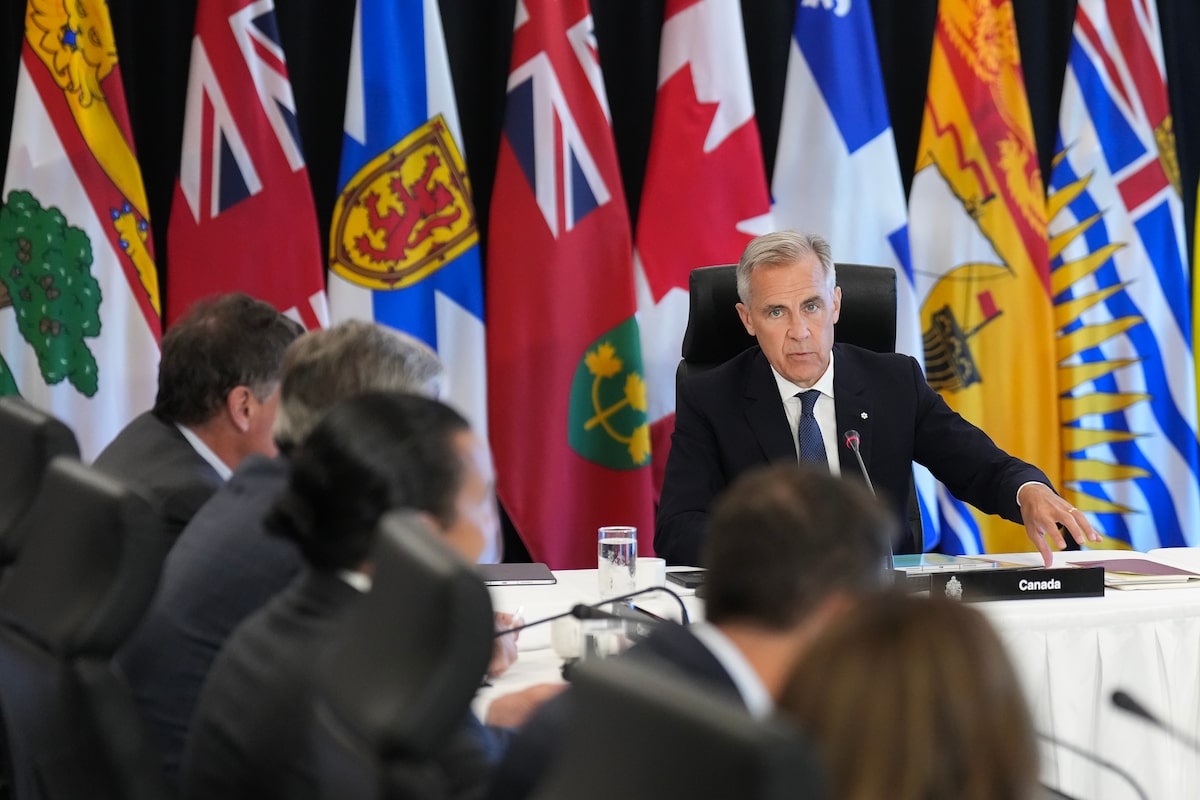
Prime Minister Mark Carney addresses provincial and territorial premiers during in Huntsville, Ont., on July 22, 2025.Nathan Denette/The Canadian Press
Donald Trump’s trade war against Canada is rightly seen as a major threat to jobs and economic growth. But it is a threat that Canada can’t do much about, other than hoping that the mercurial U.S. President doesn’t find yet another pretext for jacking up tariffs.
At the same time, however, there is a much bigger threat to the nation’s economic prosperity – one that is entirely within the power of Canadian politicians to fix. That’s the good news. The bad news is that political leaders, chiefly the provincial and territorial premiers, are unwilling to take definitive steps.
We talk, of course, about internal trade barriers, that welter of laws, regulations, rules and policies that have created 13 economic fiefdoms rather than a single national economy.
The International Monetary Fund weighed in with new research this week that underscores the magnitude of the opportunity that the premiers are wasting. According to the IMF, internal trade barriers are the equivalent of a 9 per cent tariff on goods and services.
Opinion: U.S. trade war highlights absurdity of interprovincial barriers for alcohol
By contrast, the average U.S. tariff on Canadian exports to that country is 5.9 per cent, according to the Bank of Canada.
Take the damage that Mr. Trump is inflicting on the Canadian economy, mark it up by 50 per cent, and that is the cost of the political lassitude over internal trade.
There has been progress. The Liberals have wiped out any trade barriers specific to the federal government. There have been various specific accords, including on such relatively minor things such as interprovincial alcohol sales. But the hard work of tearing down barriers protecting the service economies of each of those 13 fiefdoms has barely begun.
The IMF report lays out the stakes. Eliminating barriers would, over time, add $210-billion to Canada’s economy – the equivalent of more than $5,000 for every Canadian. That’s the money that the premiers are leaving on the table by refusing to dismantle all trade barriers.
Opinion: An unsexy fix to Canada’s growing red tape problem
The irony is that the poorer provinces would see the biggest gains, partly because they are more dependent on trade with the rest of Canada than larger provinces. Full internal free trade would increase GDP per capita by nearly 40 per cent in Prince Edward Island, the IMF forecasts. New Brunswick, Nova Scotia and Newfoundland and Labrador and the territories would also reap outsized benefits.
If the math is so compelling, why aren’t the premiers acting? To listen to them, including Ontario Premier Doug Ford on Wednesday, they are. “At the heart of our plan is the work we are doing to unlock free trade across Canada,” Mr. Ford said on the first day of the first ministers meeting in Ottawa.
But too much of that plan is lip service to the idea of free trade rather than taking the (needed) political risk of tearing down barriers.
The IMF indirectly identifies the political problem: the costs of trade barriers are “mainly concentrated” in services, it says. In the education and health care sectors, the thicket of provincial rules equate to a tariff exceeding 40 per cent.
Any serious discussion about boosting Canada’s productivity (not to mention reining in the surging cost of health care and education) must address those barriers.
Editorial: The push and pullback of internal trade
Obvious as the math is, the politics are even more so. The economic costs are huge, but diffused. The benefit of the barriers, however, is much more narrowly focused. There is always a call for an exemption, a carveout, a nod to some sort of local exceptionality.
Politics has trumped economics so far, in the nearly 159 years since Confederation. Even Mr. Trump’s trade war has shaken the status quo somewhat, but not enough to move the premiers off their protectionist stance on services.
As this space has argued before, Ottawa needs to act, beyond its own move to do away with the limited federal trade barriers. That $211-billion in increased economic activity would, roughly speaking, generate upward of $30-billion in revenue for Ottawa, based on current federal revenue as a percentage of GDP.
Ottawa has the motive, and the means, to simply bribe the provinces into doing the right thing. The initial funds could come from stripping out the billion or so superfluous dollars from the equalization program, and paying those out to any province that unilaterally drops its internal trade barriers.
So we ask the question: Which premier is willing to take a modest political risk for Canada’s prosperity – and a cheque from Ottawa?