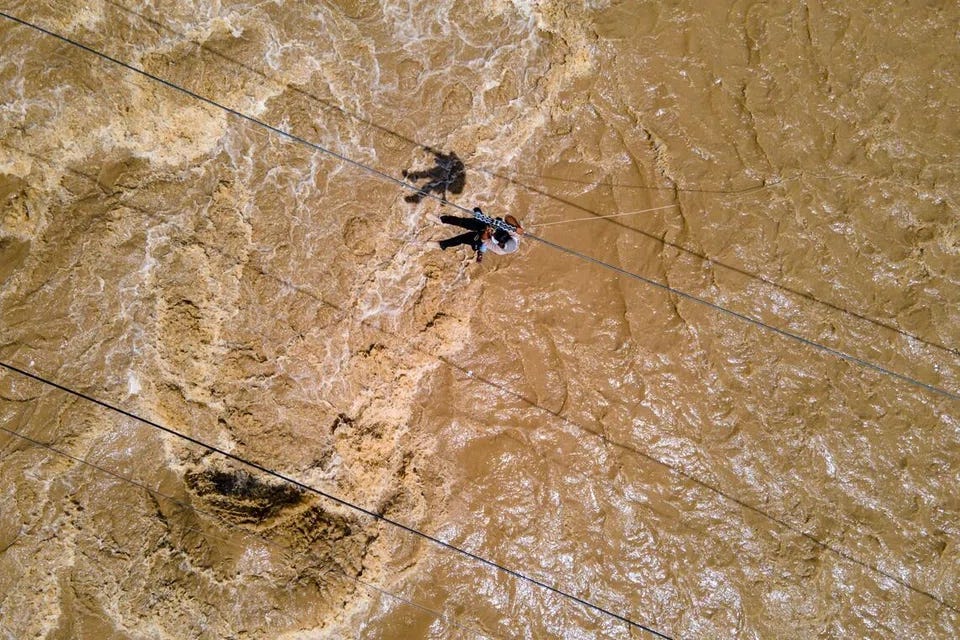
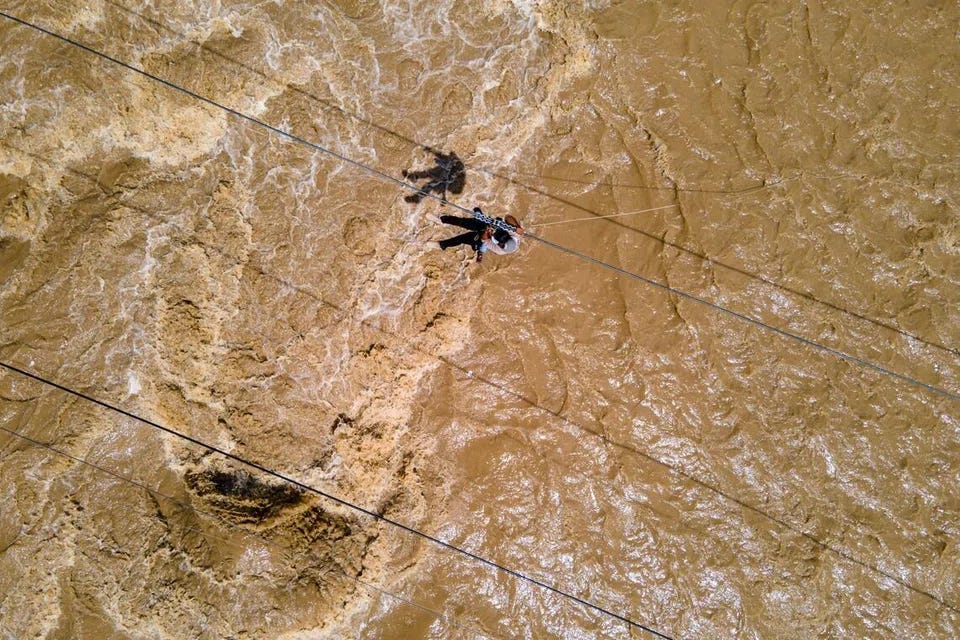
What swept through Sumatra in late 2025 was not just water. It was history returning with force.
Across Aceh, North Sumatra and West Sumatra, rivers rose with terrifying speed, hillsides collapsed, and entire communities were erased from maps. More than 1,170 lives were lost, and hundreds more were never found. Roads, bridges and homes vanished in hours. For Indonesia, this was described as a ‘natural disaster’. For anyone paying attention, it was something far more confronting: a reckoning.
Just weeks after the floods, Indonesia’s environment ministry confirmed new civil lawsuits seeking billions of rupiah in damages from forestry and mining firms, as fresh satellite imagery showed forest loss accelerating even after the disaster, underscoring that this crisis is still unfolding, not receding. New high-resolution satellite mosaics from UNOSAT and Sentinel-2—published in the weeks after the floods—show fresh forest losses in critical Sumatra watersheds, a concrete signal that this is an unfolding crisis, not a closed chapter.
Sumatra’s floods were not unpredictable. They were foretold in satellite images, NGO reports, parliamentary studies and court filings for years. Between 1990 and 2020, the island lost nearly half of its primary forest cover. In 2024 alone, Indonesia lost more than 240,000 hectares of primary forest, much of it in Sumatra. Forests that once functioned as a sponge—absorbing rain, stabilising soil, regulating rivers—had been thinned, fragmented or cleared entirely. When the rains came, there was nowhere for the water to go.
The Indonesian government initially pointed to Cyclone Senyar. But even senior ministers later conceded what environmental scientists had long argued: this catastrophe could not be blamed on weather alone. Deforestation, weak governance and political forbearance turned heavy rain into mass death.
This matters far beyond Indonesia’s shores. Sumatra’s tragedy sits at the intersection of climate risk, global supply chains and political trust—precisely the terrain that foreign policy now occupies.
For decades, Sumatra has been central to Indonesia’s growth story. Pulp and paper, palm oil, mining and hydropower helped drive export earnings and regional development. North Sumatra alone issued close to two million hectares of mining licences by the mid-2010s. Yet oversight consistently lagged ambition. Investigations by groups such as WALHI, Auriga Nusantara and Earthsight documented repeated violations of river buffer zones, protected forests and steep-slope regulations.
In Batang Toru, hundreds of hectares of high-conservation forest were cleared upstream of villages that would later be inundated. Timber from these areas flowed into global supply chains, ending up as rayon textiles sold in Europe and the United States. In Aek Garoga, a mother who lost her home told rescuers that “the river arrived like a wall I could not step over”—a single moment that ties satellite pixels to human lives.
This was not regulatory blindness. It was a regulatory choice.
Transparency International Indonesia has described the pattern as corruption-driven deforestation. Nearly 60 per cent of parliamentarians are affiliated with extractive or agribusiness interests. Laws exist, but enforcement is selectively suspended—a phenomenon political scientists call forbearance. Environmental rules become bargaining chips. Companies gain leniency; political actors gain finance and stability. Risk accumulates quietly until nature sends the invoice. For example, civil society groups have long documented how permits and renewals persisted even as community complaints and satellite alerts accumulated, creating the conditions for collapse rather than prompting intervention.
In practice, this forbearance meant permits were renewed despite clear violations, inspections were announced but never conducted, and environmental harm became an accepted cost of political equilibrium rather than a trigger for enforcement.
Civil society understood this long before the floods. Communities filed complaints, staged protests and submitted evidence. WWF Indonesia warned that Sumatra’s disaster was the product of ‘a long accumulation of governance failures’. Yet environmental impact assessments remained box-ticking exercises. Official reports looked pristine while rivers filled with sediment and hillsides lost their roots. Trust drained away long before the water arrived.
In Batang Toru, an elder recalled warning local officials for years that the river no longer behaved as it once did—it rises too fast now, as if the forest has already left us.
Only after the devastation did the state move decisively. In January 2026, Jakarta revoked the licences of 28 companies linked to forestry, mining and energy, covering roughly one million hectares. Lawsuits seeking billions of rupiah in damages followed. High-profile projects—from pulp concessions to Chinese-financed hydropower and internationally backed gold mining—were caught in the sweep.
These actions were welcomed, but they also revealed the depth of the problem. Permit revocation after catastrophe is accountability delayed, not accountability delivered. Without transparent audits, binding restoration obligations and community compensation, the risk remains that licences are simply reshuffled rather than reckoned with. Environmental lawyers in Indonesia have been blunt: revocation without restoration is symbolism, not justice.
The implications for Indonesia’s recovery and future development are profound. Trust—between citizens and state, and between Indonesia and its partners—has been badly shaken. Climate commitments ring hollow when enforcement collapses at the local level. Investors, too, are watching. Environmental risk is now financial risk.
If enforcement continues to lag, Indonesia risks not just domestic anger but eroded climate leadership at global fora and a re-pricing of sovereign and corporate risk as investors factor deforestation-linked liabilities into lending and portfolio decisions. What is at stake is not only lives and landscapes, but Indonesia’s credibility in climate diplomacy, its attractiveness to long-term investors, and the fragile social contract between state and citizen in regions where trust has already worn thin.
Unlike Brazil’s Amazon, where enforcement waxes and wanes with political cycles, or India’s decentralised but judicially assertive environmental oversight, Indonesia’s challenge lies in rebuilding enforcement credibility within a system long accustomed to negotiated compliance.
Comparisons are unavoidable. In South Kalimantan, devastating floods in 2021 followed years of coal mining and plantation expansion. In Brazil and the Philippines, deforestation has amplified floods and landslides with similar human costs. The pattern is global, but Indonesia’s case carries particular weight. As one of the world’s largest rainforest nations and a leader of the Global South, Indonesia’s choices shape climate diplomacy as much as domestic welfare.
Unlike Brazil—where enforcement has historically swung with political cycles—or India—where the courts often act as an enforcement backstop—Indonesia’s problem is structurally weak enforcement embedded in negotiated local bargains, which means fixes must combine political-economy reform with technical monitoring.
There is also an uncomfortable international mirror here. Much of the demand driving Sumatra’s forest loss originates offshore. Palm oil, timber and minerals flow to wealthy markets that simultaneously urge Indonesia to protect its forests. This tension—sometimes labelled climate hypocrisy—cannot be ignored. Responsibility is shared, even if sovereignty is not.
Yet moments of rupture can also be moments of renewal. Sumatra’s floods may yet mark a turning point. Mandate a publicly accessible, real-time concession map—linked to automated satellite alerts such as Global Forest Watch—so regulators, communities and markets can see and challenge the enhancement as it begins.
There is a credible path forward. Reinstating strict forest-cover thresholds, particularly in critical watersheds, would restore a clear ecological baseline. Embedding community grievance mechanisms—where credible complaints automatically trigger audits—would break the culture of discretionary enforcement. Making restoration mandatory and public would shift incentives from extraction to stewardship.
Integrating nature-based solutions, from wetland recovery to ‘sponge city’ design, would align development with resilience rather than denial. Therefore, one concrete step would be a publicly accessible, real-time concession map—linked to satellite monitoring—so citizens, investors and regulators can see instantly where forest loss occurs and who holds responsibility.
None of this is radical. Much of it is already embedded in Indonesia’s own constitutional principles and its national action plan on business and human rights. What has been missing is resolve.
This is no longer a regional footnote, nor a concern that can be quarantined to Southeast Asia. What unfolds in Indonesia now resonates across capitals, markets and coastlines far beyond the Indo-Pacific. Indonesia sits at the confluence of climate stability, global trade and geopolitical balance. When its forests fail, supply chains shudder. When trust erodes, multilateral commitments weaken. When governance falters, climate risk multiplies everywhere.
For the Global North and Economic Partners in the global south, as well as emerging economies alike, Indonesia’s recovery is a test case for the world’s credibility in confronting planetary risk.
Humanitarian assistance after a catastrophe is necessary, but it is also the easiest response—and the least transformative. The harder task is collective moral alignment: supporting governance reform that makes law enforcement non-negotiable, insisting on supply chains that no longer outsource environmental harm, and redesigning climate finance so it rewards those who keep forests standing rather than those who liquidate them.
This is about redefining what partnership means in the 21st century. Stability today is not built only through defence ties or trade volumes, but through shared responsibility for the ecosystems that quietly underwrite global prosperity. Indonesia’s forests regulate carbon, rainfall and food systems far beyond its borders. To treat their loss as a domestic issue is to misunderstand the age we are living in.
The future will judge whether the international community merely mourned Indonesia’s floods—or helped ensure they never needed to be mourned again.
Sumatra’s floods were a tragedy measured in lives, but also in lost trust. Rebuilding both will define Indonesia’s next chapter. The choice now is whether this disaster becomes another footnote in a cycle of reaction—or the moment Indonesia decisively aligns development with dignity, and growth with restraint.
The water has receded, but the test ahead is whether Indonesia and its partners will treat enforcement as the first line of climate defence—or merely an afterthought worth revoking only after the bill arrives.