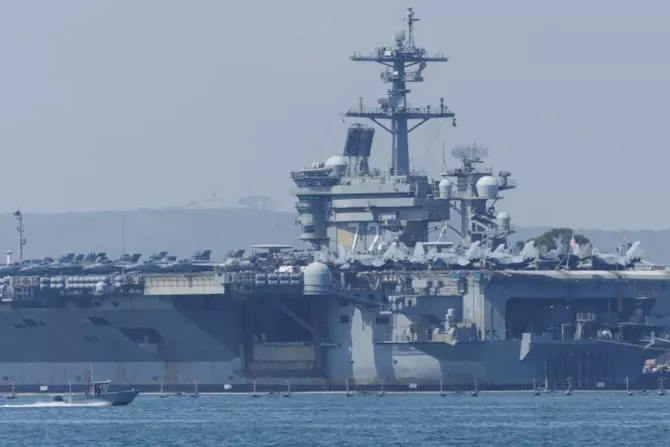
The United States and Iran have intensified hostile rhetoric as US warships deploy to the Arabian Sea, even as regional countries push for diplomacy to avert a military escalation.
US President Donald Trump warned this week that “time is running out” for Iran to return to talks to reach a new deal on its nuclear programme, The Caspian Post reports, citing foreign media.
Trump said the naval forces he was sending to Iran’s neighbourhood were even greater than those that he deployed to the coast of Venezuela before US special forces abducted the South American country’s president, Nicolas Maduro, in a military assault on Caracas on January 3.
Iranian Foreign Minister Abbas Araghchi hit back at Trump’s threats, warning that his nation’s military was ready “with their fingers on the trigger”. He added that they would “immediately and powerfully respond” to any new US attack.
The escalation comes seven months after US bombers attacked Iranian nuclear facilities during Tehran’s 12-day war with Israel last year. Iran retaliated by striking Qatar’s Al Udeid Air Base, which is used by US forces. During its war with Israel, Iran also struck several Israeli cities with missiles.
Earlier this month, Trump told Iranian protesters who were clashing with security forces that “help” was on the way, threatening to bomb Iran. However, he has since walked back his warning, seemingly accepting Tehran’s assurances that arrested protesters would not be executed.
As Iran and the US appear to be headed towards a new military escalation, key demands from both sides appear to be primarily the same as they have been for years.
What the US wants Iran to do
Historically, the US has imposed sanctions on Iran for a range of reasons, from punishment for the hostage crisis in 1979 – when, after the Iranian Revolution, students took over the US embassy with staff inside – to supposed concern for the human rights of Iranians.
But over the past two decades, US pressure against Iran, including through crippling economic sanctions that have devastated the country’s middle class, has largely focused on Tehran’s nuclear and ballistic missiles programme.
Nuclear programme
The US and some of its Western allies insist that Iran’s programme is aimed at building nuclear weapons, even though Tehran has insisted that it is only developing a civilian programme to meet energy needs.
Under a nuclear deal that Iran agreed with the US during the Obama administration – known as the Joint Comprehensive Plan of Action (JCPOA) – Tehran capped its uranium enrichment at 3.67 percent and its enriched uranium stockpile at 300kg (660lb). This was enough for Iran to use for nuclear power plants, but far from adequate for weapons. In exchange, the US lifted most sanctions previously imposed on Iran.
At 60 percent enrichment, uranium is considered ready to be developed for weapons. At 90 percent, it is considered fully weapons-grade.
But Trump withdrew the US from this deal in his first term as president, in May 2018, and reimposed sanctions against Tehran. Iran appeared to try to stick to its end of the agreement for a while, along with European powers, Russia and China, who were all co-signatories to the Obama deal. Trump’s successor, Joe Biden, however, kept most of Trump’s sanctions in place, even though he had been Obama’s vice president.
In his second term as president, Trump has further ramped up economic coercion against Iran, which also began rapidly enriching its uranium.
In May 2025, the International Atomic Energy Agency (IAEA) warned that Iran had stockpiled more than 400kg (880lb) of uranium enriched to 60 percent. Though weapons need uranium that’s more than 90 percent enriched, no non-nuclear weapons state is known to keep uranium enriched to levels as high as 60 percent.
The US and Israel cited the IAEA warning as justification for bombing Iran in June.
“There has been a consistent lobby in Washington arguing that Iran achieving nuclear weapon capability is an enormous threat to the US and the wider world, and the US government knows that this fear is widely held in America,” Christopher Featherstone, associate lecturer at the Department of Politics, University of York, told Al Jazeera.
The US now demands that:
Iran must not build nuclear weapons, and it must abandon even a civilian nuclear programme.
Iran must not enrich uranium at all – not even to very low levels that would be useless for military purposes.
Iran must hand over any enriched uranium it already has.
Ballistic missiles
Israeli bombs and missiles killed more than 1,000 Iranians during the June war. But while far fewer – 32 – Israelis died in retaliatory Iranian attacks, Tehran’s ballistic missiles frequently managed to breach Israel’s vaunted Iron Dome, hitting several cities.
Since then, US and Israeli concerns about Iran’s ballistic missiles have grown. Iran’s Emad, Khorramshahr, Ghadr, Sejjil and Soumar ballistic and cruise missiles have ranges between 1,700km and 2,500 km (1,056-1,553 miles).
That puts Israel and all US military bases in the Middle East within the range of these missiles.
The US now demands that:
Iran must curb the number and range of its ballistic missiles.
Regional influence
Iran’s alliances and partnerships in its neighbourhood are embedded in a complex web of ideological affiliations, political commitments – such as to the Palestinian cause – and strategic calculations.
It has lost al-Assad as an ally, and Hezbollah has been weakened. But Iran’s Supreme Leader Ayatollah Khamenei alluded in December 2024 to Tehran’s belief that:
Its alliances and influence in the region can continue to survive these losses.
How close are we to a war?
This all depends on Trump, and how back-channel negotiations that are ongoing between the US and Iran proceed.
US allies in the region, including Saudi Arabia and the United Arab Emirates, have stated that they will not allow their airspace to be used for any attack on Iran. Qatar has been leading efforts to find a diplomatic solution.
Still, the US has been beefing up its military presence off Iran. The USS Abraham Lincoln, a nuclear-powered aircraft carrier, is now in the Arabian Sea.
Over the past seven months, Trump has bombed Iran, including deeply buried nuclear facilities like Fordow.
And while Trump has called for talks, Featherstone from the University of York said “it will take an enormous diplomatic effort to see a negotiation of any real meaning.”
Given Trump’s track record of ripping apart the Obama-era nuclear deal, Iran “will be unlikely to trust him as a negotiation partner”, Featherstone said. “I also don’t think European allies will want to help Trump with these negotiations, as he is so unpredictable and erratic.”