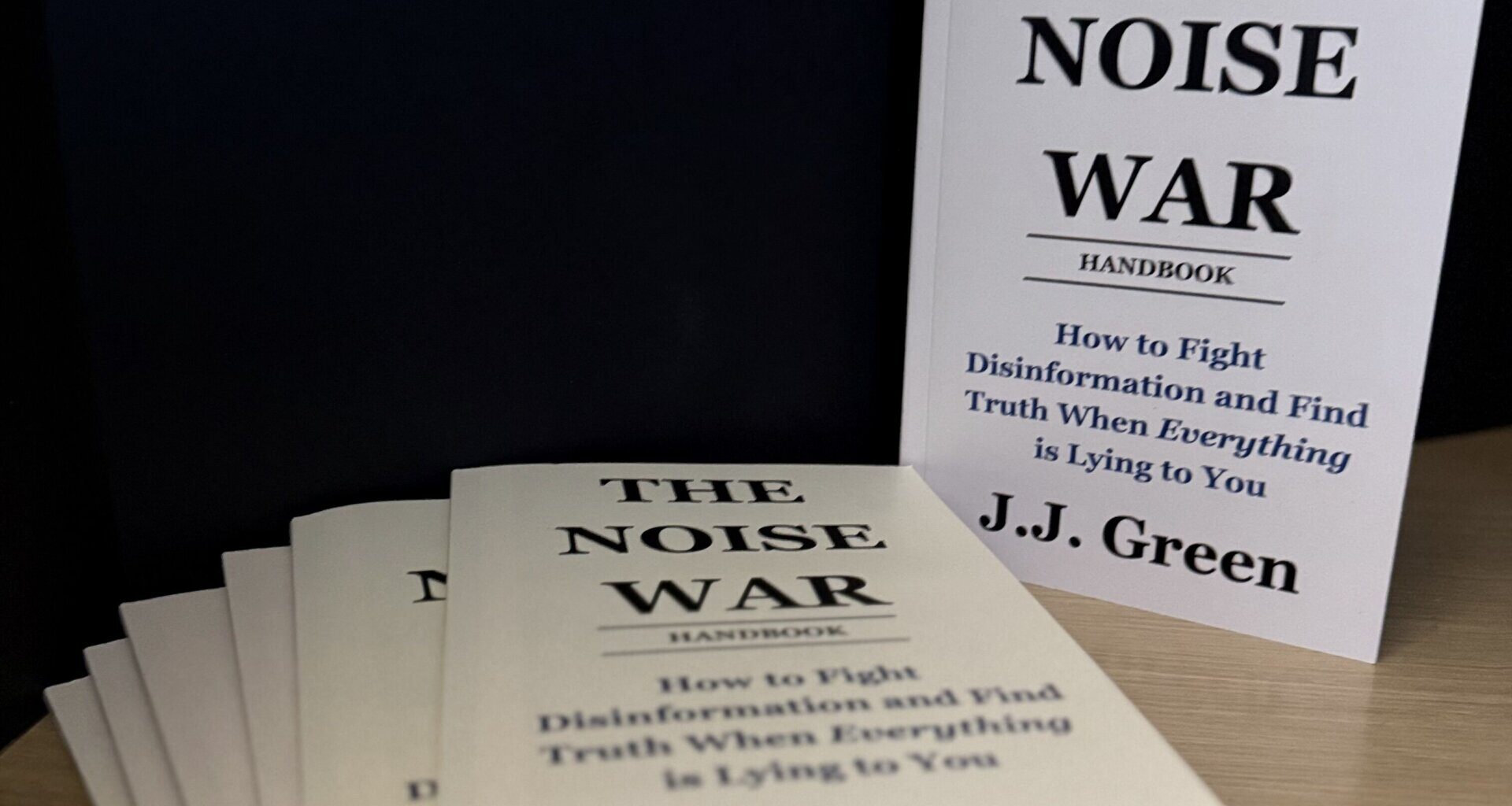
WTOP National Security Correspondent J.J. Green confronts the disinformation crisis in his new book, “The Noise War Handbook.”
I woke up startled, at about 3 a.m. on Oct. 25, 2025.
The room was dark and still, but my mind was not. It was the kind of wake-up you snap into it, as if someone has shaken your shoulder and said, “Pay attention. This matters.”
In 24 hours, I would be on a plane to Brussels, headed for a critical disinformation conference filled with fellow journalists, content creators and fact-checkers — the architects of anti-disinformation narratives. People with slides. People with frameworks. People trying to stop the fire hose of falsehoods that seem to blanket the world, and the apparatus that supports it.
Ten days earlier, I had walked out of the Pentagon. Not alone, but alongside some of the best journalists America has ever produced. They were people who have covered wars honestly; and like me, had buried friends, told uncomfortable truths and were proud of their work.
We refused to sign a memo that asked us to pledge something no journalist should ever pledge: to report only what had been cleared.
At the time, I told myself I was fine with the decision to walk. I believed it. I meant it.
But at 3 a.m., the bravado was gone. The adrenaline had burned off. And what remained was something akin to fear.
I worried about my career. I worried about how people would remember me. I worried about whether I had just stepped off a cliff without a parachute.
I have spent more than two decades reporting from the world’s fracture lines and conflict zones, intelligence shadows, moments when truth is the first casualty and lies travel faster than bullets. I’ve watched propaganda harden into policy. I’ve seen disinformation move from the margins into the center of power. I knew this terrain.
And yet, lying there in the dark, I realized something unsettling: knowing about the problem was no longer enough.
For five years, I had been circling a project. I didn’t even have a name for it. Just a “something” on disinformation. Notes. Fragments. Observations scribbled between flights and filing deadlines. I knew the system was broken. I knew citizens were being overwhelmed. I knew journalists, educators and even policymakers were being outrun.
But I hadn’t yet understood my obligation.
At 3 a.m., the questions finally stopped circling and clarity landed. A voice in my head asked, “If you understand how this works — if you’ve watched the noise being manufactured, amplified, weaponized — what are you going to leave behind?”
“The Noise War” isn’t abstract. It’s not academic, it is lived.
It’s the feeling that nothing is solid anymore. That every headline might be bait. That truth requires exhaustion to reach, while lies arrive prepackaged, emotionally tuned and algorithmically boosted.
Disinformation doesn’t just distort facts, it corrodes trust. It turns citizens against each other. It convinces people that democracy is fake, journalism is rigged, expertise is a scam and power is the only truth left standing.
And here is the dangerous part: It works not because people are stupid, but because we are human.
According to the doctrine of disinformation, speed beats accuracy. Repetition outpaces correction. Emotion conquers evidence. It always has.
Lying there that morning, I realized this book could not be another warning siren. The world is already deafened by alarms. It could not be a glossy manifesto or a shelf ornament meant to signal virtue.
It had to be powerful and useful, but understated. Approachable.
A handbook. A field manual.
Something you could put in a backpack, a briefcase, a bag — and carry into the real world.
I wrote “The Noise War Handbook” because too many people are being asked to navigate an information battlefield with no training and no map.
I wrote it for journalists under pressure to move faster than verification allows. For educators trying to teach critical thinking in a culture optimized against it. For leaders, parents, students and citizens who feel something is wrong but can’t quite name the mechanics of it.
I wrote it because disinformation thrives in confusion and clarity is an act of resistance.
That early morning, fear didn’t disappear, it sharpened. It focused me.
I understood that what scared me most wasn’t losing access or status or comfort. It was becoming someone who knew what was happening and chose silence anyway.
So I got up. I wrote, and I didn’t stop.
“The Noise War Handbook” exists because the moment demanded more than commentary. It demanded tools, language and discipline. A way to think clearly when everything is designed to make you react blindly.
I didn’t write it because I was unafraid. I wrote it because at 3 a.m., when the noise of the previous 10 days subsided, I understood exactly what the truth required of me.
Get breaking news and daily headlines delivered to your email inbox by signing up here.
© 2026 WTOP. All Rights Reserved. This website is not intended for users located within the European Economic Area.