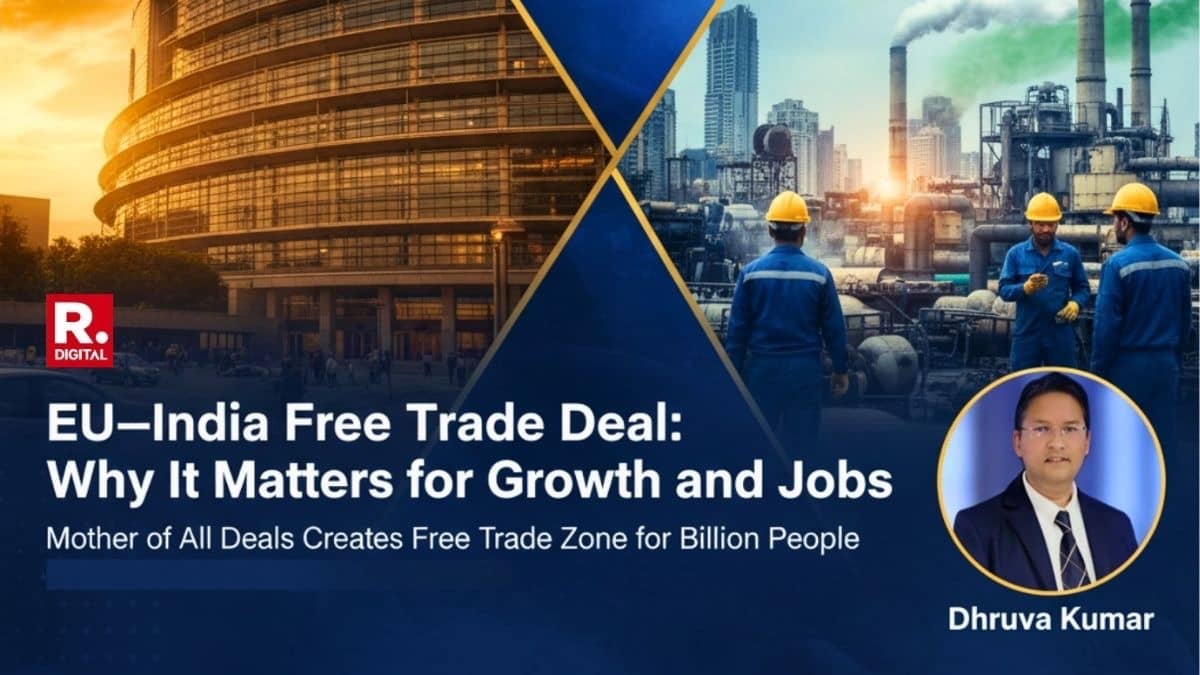
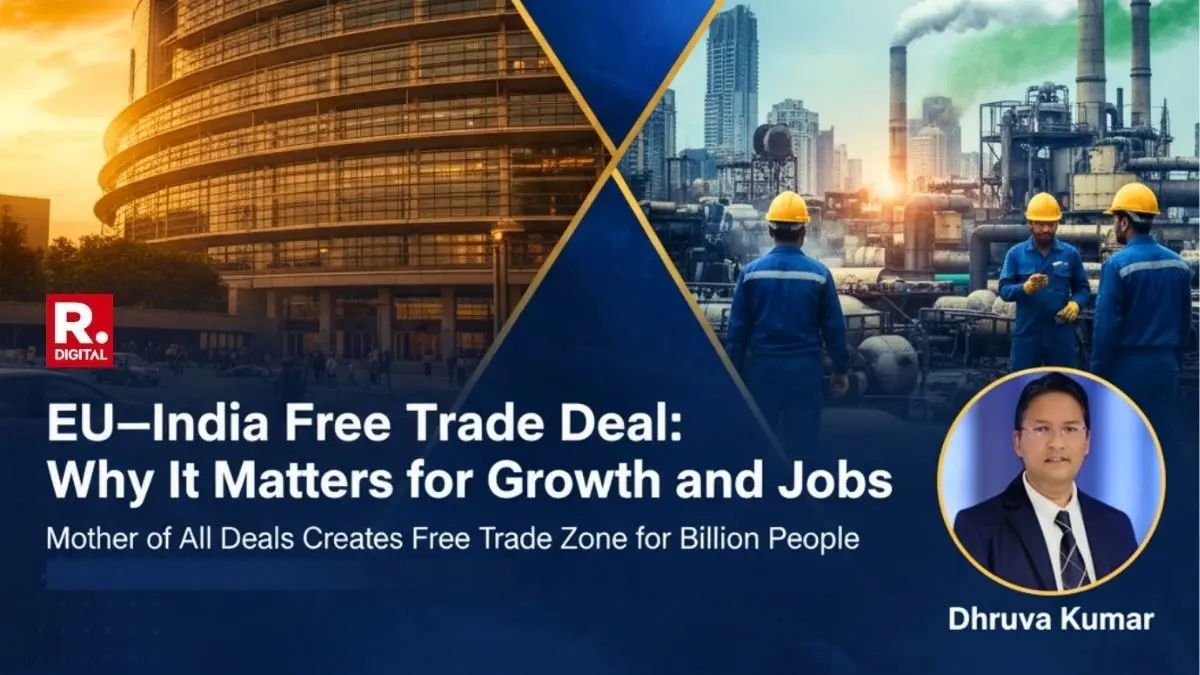
Brussels Meets Bharat-Can the Historic EU–India Trade Deal Deliver on Its Promise-Dhruva Kumar from Scotland | Image:
Dhruva Kumar
New Delhi: The newly concluded Free Trade Agreement between the European Union and India marks one of the most consequential economic pacts of the decade. Covering nearly two billion people and nearly a quarter of global GDP, the deal represents not only an economic milestone but a strategic recalibration at a time when global trade is increasingly shaped by geopolitical rivalry and supplychain fragmentation.
European Commission President Ursula von der Leyen described the agreement as historic, noting that “rules-based cooperation still delivers great outcomes.” Her words capture the deeper significance of the FTA: it is as much a political signal as an economic arrangement.
A Timely Partnership in an Uncertain World
Prof Dhruva Kumar, a renowned, notable Scottish Politican states that the global trading system has become more fragile over the past five years. The US–China rivalry continues to reshape supply chains, while protectionism has resurfaced across many economies. Both the EU and India have felt the pressure. European manufacturers seek diversification away from China, and India’s ambitions to position itself as a manufacturing and innovation hub hinge on deeper access to global markets.
Dhruva Kumar further adds that this FTA arrives as both sides attempt to hedge against volatility. For the EU, India is the world’s fastest-growing major economy and a vast untapped consumer market. For India, the EU remains its second-largest trading partner and a critical source of investment and advanced technology.
Market Access, Tariff Cuts, and a Boost for Jobs
Dhruva Kumar analyses the agreement, which promises substantial tariff reductions across key sectors. India is likely to benefit from increased access for textiles, pharmaceuticals, leather goods, and IT services, sectors that collectively support millions of jobs. Meanwhile, European exporters will gain from lower tariffs on automobiles, machinery, and high-value manufactured goods.
For India, a reduction in customs duties on European machinery could accelerate industrial modernisation, supporting “Make in India” and boosting productivity. For the EU, gaining better access to India’s large consumer base could offset stagnant demand within the bloc itself.
Services, which account for more than 50% of India’s GDP, will also see expanded opportunities. Digital services, data flows, and professional mobility chapters are expected to open doors for Indian tech firms and skilled workers.
A Strategic Response to China’s Dominance
Beyond economics, the FTA reflects a geostrategic realignment. Both partners are recalibrating their Asia strategies amid China’s expanding economic and political influence.
The EU has long sought to deepen ties with democratic Indo-Pacific partners. India, meanwhile, is pursuing “de-risking” rather than “decoupling” from China by strengthening trade relations with alternative partners such as the EU, Japan, and Australia.
By combining India’s demographic weight and growth trajectory with Europe’s technological and regulatory leadership, the FTA strengthens a multipolar balance within global trade—reducing overdependence on any single economic bloc.
Sustainability, Standards, and the Green Transition
One of the EU’s priorities was embedding sustainability and labour protections within the deal. Although India pushed back against stringent climate conditions, both sides reached a compromise that supports green technologies without constraining India’s development goals.
The pact includes cooperation on clean energy, hydrogen, critical minerals, and circular economy standards, areas essential for India’s long-term economic resilience and Europe’s green transition.
A Foundation for Future Growth
The EU-India FTA is more than a trade agreement, it is a strategic partnership for a shifting global era. Economically, it promises new jobs, diversified supply chains, and expanded market access. Geopolitically, it aligns two large democracies seeking stability in an increasingly polarised world.
As global uncertainty deepens, the deal exemplifies how open, rules-based trade can remain a source of growth and a tool of strategic statecraft.
Mr Kumar says, as always with trade deals, the danger lies in complacency. Tariff cuts alone do not create exports; firms do. India will need to move quickly on trade facilitation, logistics, skilling and credit access for MSMEs if the promised jobs and investment are to materialise rather than be captured by a narrow band of large conglomerates. Europe, for its part, must resist the temptation to weaponise regulatory standards as hidden protectionism, or the political backlash in India will be swift. It can become the backbone of a Eurasian growth corridor that generates high-quality employment, accelerates green industrialisation and gives democracies leverage in a century defined as much by geo-economics as by geopolitics.