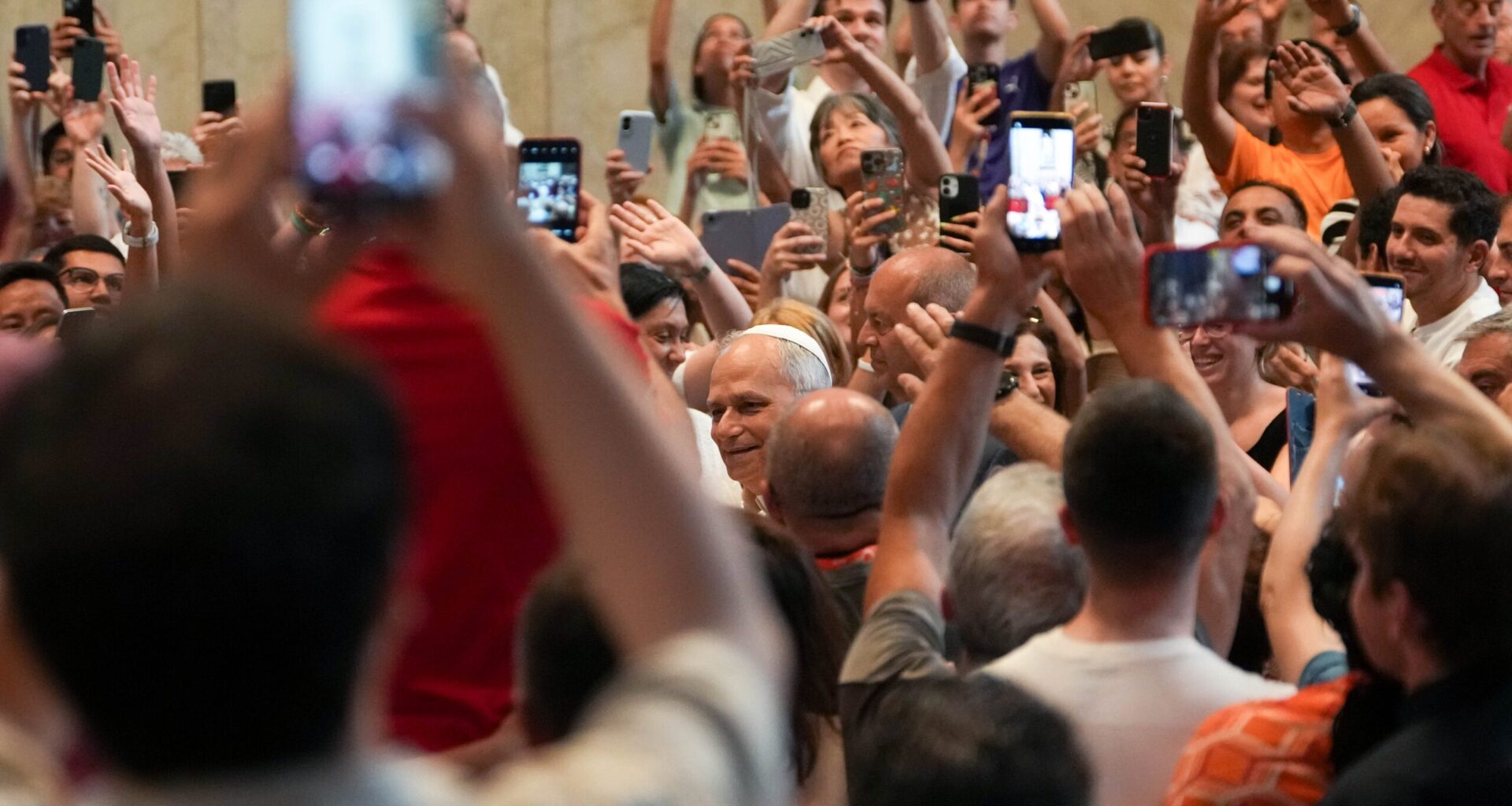
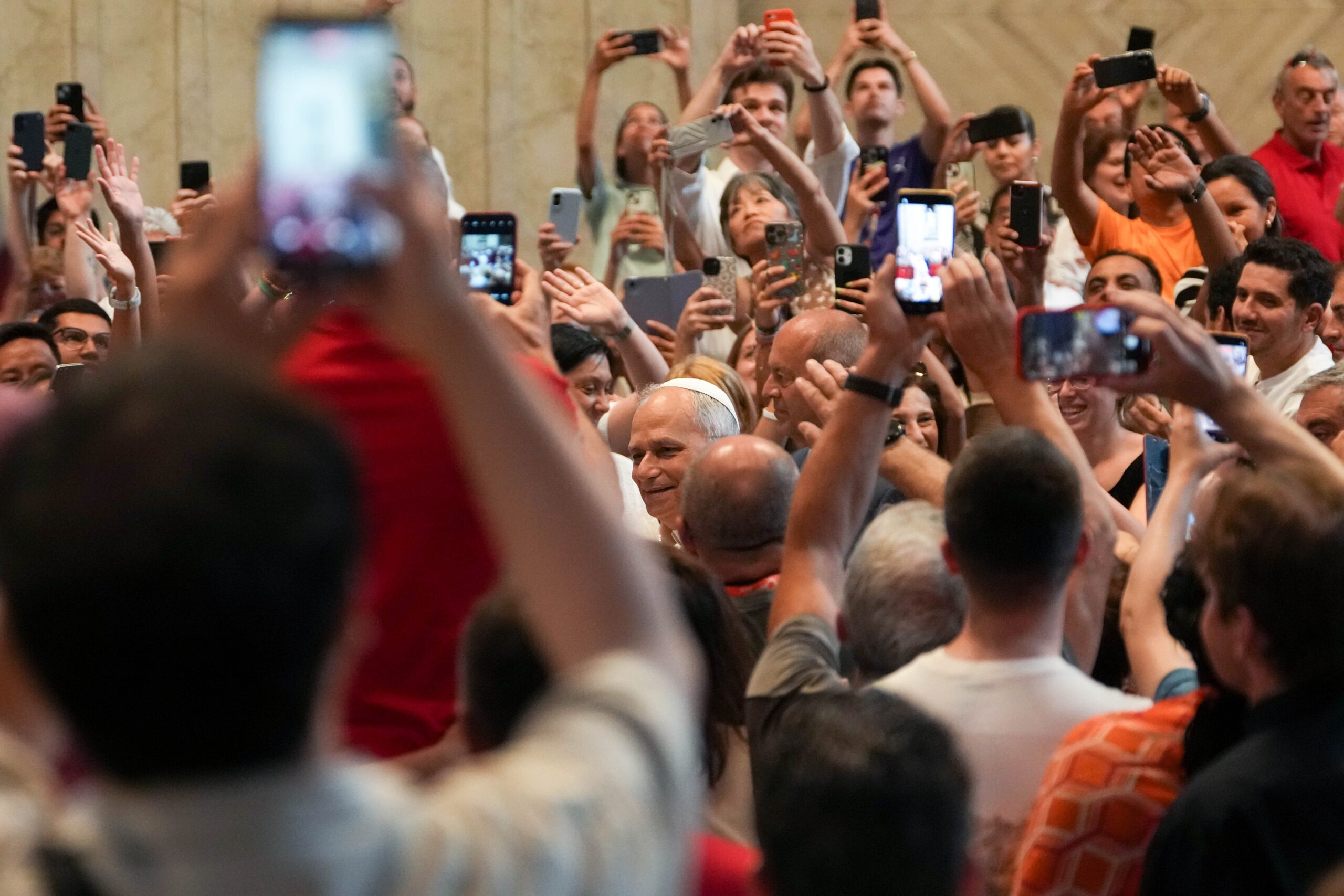
 Pope Leo XIV, in choosing a theme for World Communications Day 2026, highlights the need to safeguard human voices and faces in the digital era, ensuring technology like artificial intelligence serves humanity rather than replacing it. In this file photo from June 14, 2025, Pope Leo greets people as they hold up cellphones to take photos and videos as he enters St. Peter’s Basilica for an audience with pilgrims in Rome for the Holy Year 2025. (CNS photo/Lola Gomez)
Pope Leo XIV recently published his first Message for World Communications Day, which will be celebrated this year on May 17. Entitled “Preserving Human Voices and Faces,” the five-page document elaborates upon a fundamental concern of this papacy and a foundational truth of our technological age.
That concern led to the Holy Father’s selection of his name, as he explained in his first formal speech. His predecessor, Leo XIII, faced the first great industrial revolution.
“In our day,” says Leo XIV, “the church offers to everyone the treasury of her social teaching in response to another industrial revolution and to developments in the field of artificial intelligence that pose new challenges for the defence of human dignity, justice and labour.”


In confronting the current revolution, however, the means at the church’s disposal are not technological but anthropological.
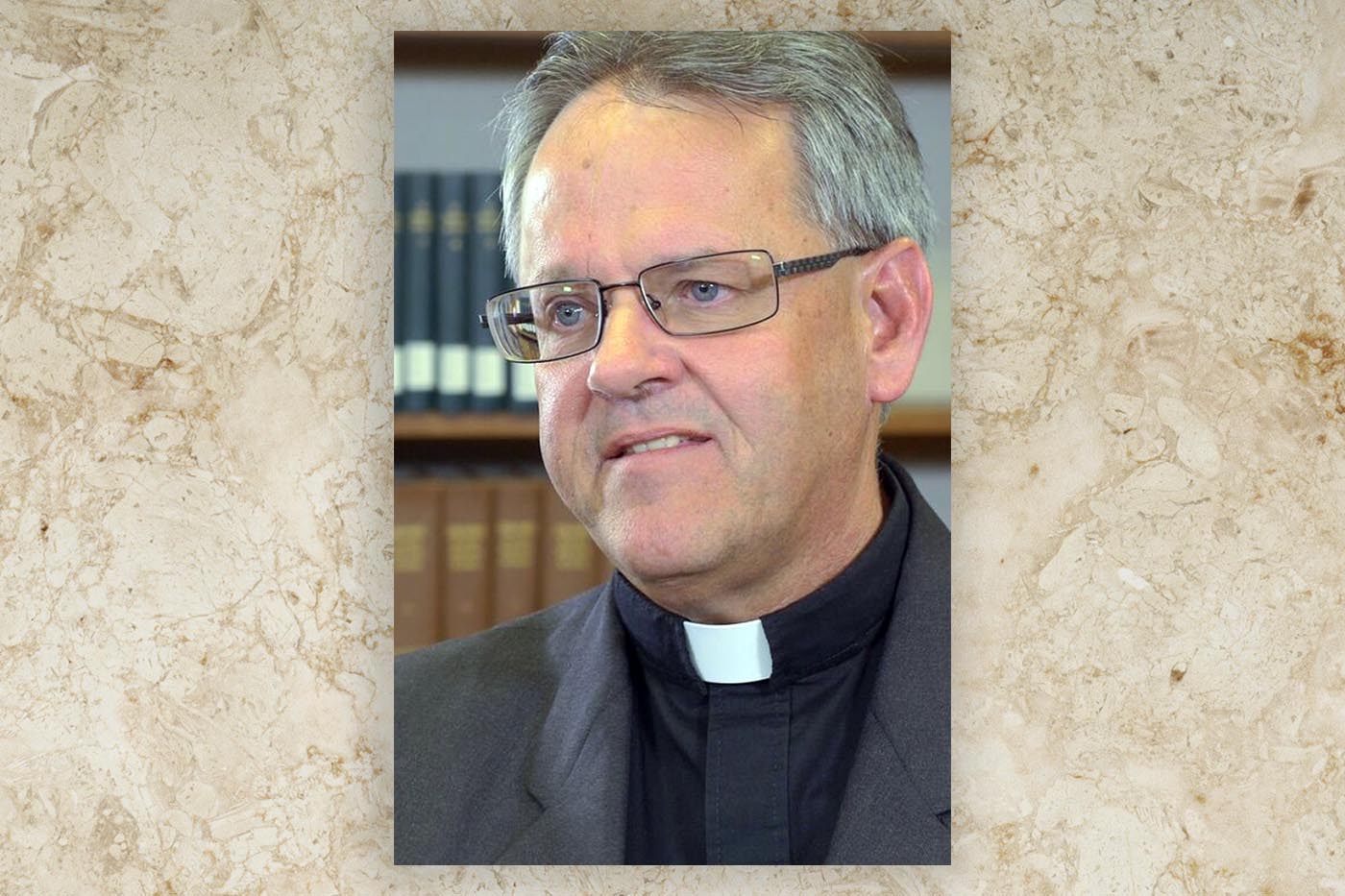 Father Thomas Dailey, OSFS
As Pope Leo claims, “We need faces and voices to speak for people again. We need to cherish the gift of communication as the deepest truth of humanity, to which all technological innovation should also be oriented.”
From his Augustinian roots, the pope champions this right orientation or proper order of things. In this context, Leo XIV identifies in his message two major disorders that AI has foisted upon us.
The first reflects a common phenomenon: “a naive and unquestioning reliance on artificial intelligence as an omniscient ‘friend,’ a source of all knowledge, an archive of every memory, an ‘oracle’ of all advice.”
We may not understand the ins and outs of how AI functions, but we do value its helpfulness. AI saves us time and energy. We can ask Google anything and get a response in seconds. We learn DIY via YouTube. Thanks to the internet of machines, we don’t have to figure out or remember what needs our attention.
Owing to the ease and efficiency of such technological aides, we now have come to rely on them. We plug our travels into the GPS even when we already know where we’re going. We compose our writings confident that Grammarly will fix our mistakes. We turn automatically to Alexa and Siri and delight in “her” voice as she tells us whatever we want to know.
Yet, as Pope Leo notes, an increasing reliance on technology erodes something fundamentally human and profoundly personal: “renouncing creativity and surrendering our mental capacities and imagination to machines would mean … hiding our faces and silencing our voices.”
The second challenge posed by AI is more visionary. As it becomes increasingly sophisticated in its operations, what AI does appears to be ever more “human”.
AI-powered chatbots and robots not only answer our queries rationally; they now simulate affections and stimulate relations. Recent research finds that about one-third of teenagers nationwide “find conversations with AI companions to be as satisfying or more satisfying than those with real-life friends.”
Pope Leo rightly decries the anthropomorphization of AI. Simulation may be entertaining, but it is also deceptively dangerous.
By so invading and occupying our interpersonal spheres, ”Technology that exploits our need for relationships can lead not only to painful consequences in the lives of individuals, but also to damage in the social, cultural and political fabric of society.”
The pope is no luddite. He knows that AI is here to stay. AI will get “better” at what it does and will increasingly affect our work and our world.
So, what are we to do?
Pope Leo first reminds us that “no one can elude personal responsibility for the future we are building.”
We may not be developers or regulators of AI; we may not be professional communicators in the digital realm. But in a world inescapable from AI, all of us need to cultivate “real” intelligence with which we communicate to, with, and for other persons. As the pope puts it, “Safeguarding faces and voices ultimately means safeguarding ourselves.”
Then the Holy Father urgently calls for continuing education in media, information, and AI literacy.
“As Catholics,” he exhorts us, “we can and must contribute to this effort, so that individuals — especially young people — can acquire critical thinking skills and grow in freedom of spirit.”
After all, it’s a sign and expression of intelligence to know what you’re doing! Learning how to use AI intentionally and purposefully makes that “intelligence” human.
In the reflections Pope Leo XIV offers for contemporary communications, we see the face and hear the voice of a true friend on whom the church and world can rely.
Oblate Father Thomas Dailey holds the John Cardinal Foley Chair of Homiletics and Social Communications at Saint Charles Borromeo Seminary in the Archdiocese of Philadelphia, where he also directs the new Catholic Preaching Institute.

