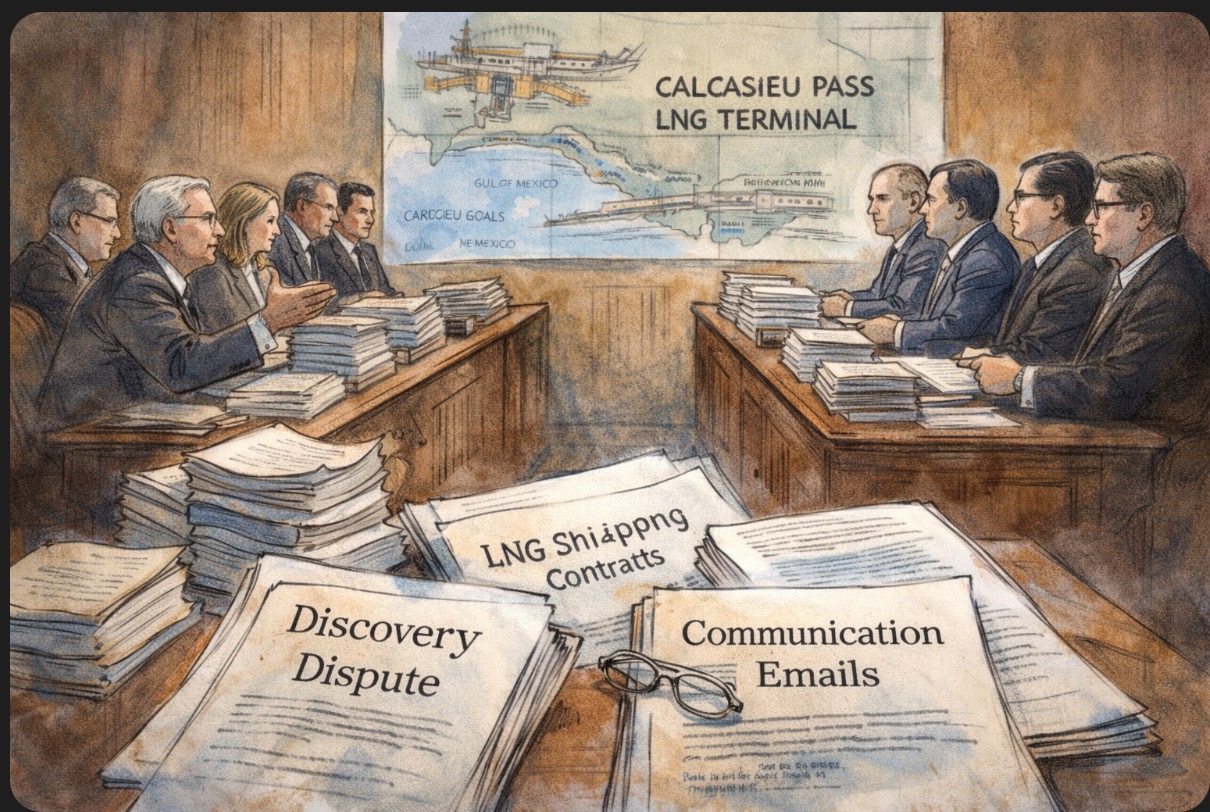
Shell plc likes to present itself as a disciplined, rules-based operator in global energy markets — a company that respects contracts, arbitration outcomes, and the sanctity of carefully worded legal agreements.
Unless, of course, it loses.
Then the fine print suddenly becomes a battleground, and the missing emails start to matter a great deal.
From ‘Binding Arbitration’ to ‘Let’s See the Emails’
Shell’s long-running dispute with U.S. LNG producer Venture Global was supposed to end neatly with arbitration. In August 2025, it did — and not in Shell’s favour.
An arbitration tribunal rejected Shell’s claim that Venture Global had improperly diverted LNG cargoes into lucrative spot markets instead of delivering them under long-term contracts tied to the Calcasieu Pass LNG project in Louisiana. The tribunal found that Venture Global was not contractually obliged to begin long-term deliveries until the facility reached its official commercial operations date — which it eventually did in April 2025.
Game over. Case closed.
Except Shell wasn’t done.
Enter the Engineer
Having lost on the contract wording, Shell has now shifted its focus to process — specifically, whether Venture Global failed to disclose communications with its independent engineer, Lummus Consultants, during the arbitration.
According to Reuters, Shell argues that emails or drafts exchanged in 2022 between Venture Global and the engineer may have influenced evidence presented to the tribunal and should have been disclosed. The suggestion is not that the contract language was misunderstood — but that the evidentiary playing field may not have been perfectly level.
It is a subtle pivot, but an important one: when the rules don’t deliver the desired result, challenge how the game was refereed.
Discovery: The Last Refuge of the Disappointed
In a New York court hearing in January 2026, Shell pressed its case before Justice Joel Cohen, arguing that undisclosed communications could justify vacating the arbitration award.
The judge, to his credit, appeared unconvinced that one set of emails — assuming they exist — would outweigh an arbitration record reportedly running to hundreds of thousands of pages. But the court has allowed Shell to keep asking the question.
Venture Global, for its part, insists that all required documents were produced and that Shell is simply trying to relitigate a commercial loss through the courts.
Which is another way of saying: this was settled — until it wasn’t.
An Awkward Industry Contrast
What makes Shell’s persistence particularly awkward is that BP, another LNG buyer, has succeeded in its own arbitration against Venture Global — securing a substantial award by persuading a tribunal that Venture Global breached its obligations.
Shell has taken note.
If BP can win, Shell reasons, perhaps Shell can too — if not by rewriting the contract, then by reopening the filing cabinets.
The Unspoken Issue: Spot Markets and Billions
Hovering over the legal arguments is the uncomfortable reality that Venture Global reportedly earned vast sums by selling LNG into spot markets while long-term buyers waited.
Shell has suggested that the figure could run into tens of billions of dollars.
That may be commercially galling. But arbitration panels tend to care less about what feels fair and more about what the contract actually says — a lesson Shell knows well when it is on the other side of the table.
Why This Matters Beyond the Courtroom
This dispute is not really about emails or engineers. It is about power in the LNG market.
If arbitration outcomes can be reopened whenever a losing party suspects undisclosed nuance, then “binding arbitration” becomes a polite suggestion rather than a conclusion. Future LNG contracts may grow longer, denser, and even more lawyer-proof — if such a thing is possible.
And smaller players may wonder whether arbitration only remains final until a supermajor decides otherwise.
Conclusion: Contracts Are Sacred—Until They’re Not
Shell insists this is about fairness and transparency. Venture Global insists it is about accepting defeat.
Both can’t be right — but both are behaving entirely predictably.
When oil and gas giants sign contracts, they praise certainty.
When those contracts don’t deliver, certainty suddenly looks negotiable.
And somewhere in the middle — buried under shipping schedules, commissioning milestones, and now disputed engineer communications — lies the real lesson of the LNG boom:
In global energy markets, the fight doesn’t end when the ruling comes down.
It just moves to a different courtroom.
DISCLAIMER:
This article is opinion and commentary only. It does not constitute financial or investment advice.
This website and sisters royaldutchshellgroup.com, shellnazihistory.com, royaldutchshell.website,
johndonovan.website, shellnews.net, and shellwikipedia.com,
are owned by John Donovan – more information here. There is also a Wikipedia segment.