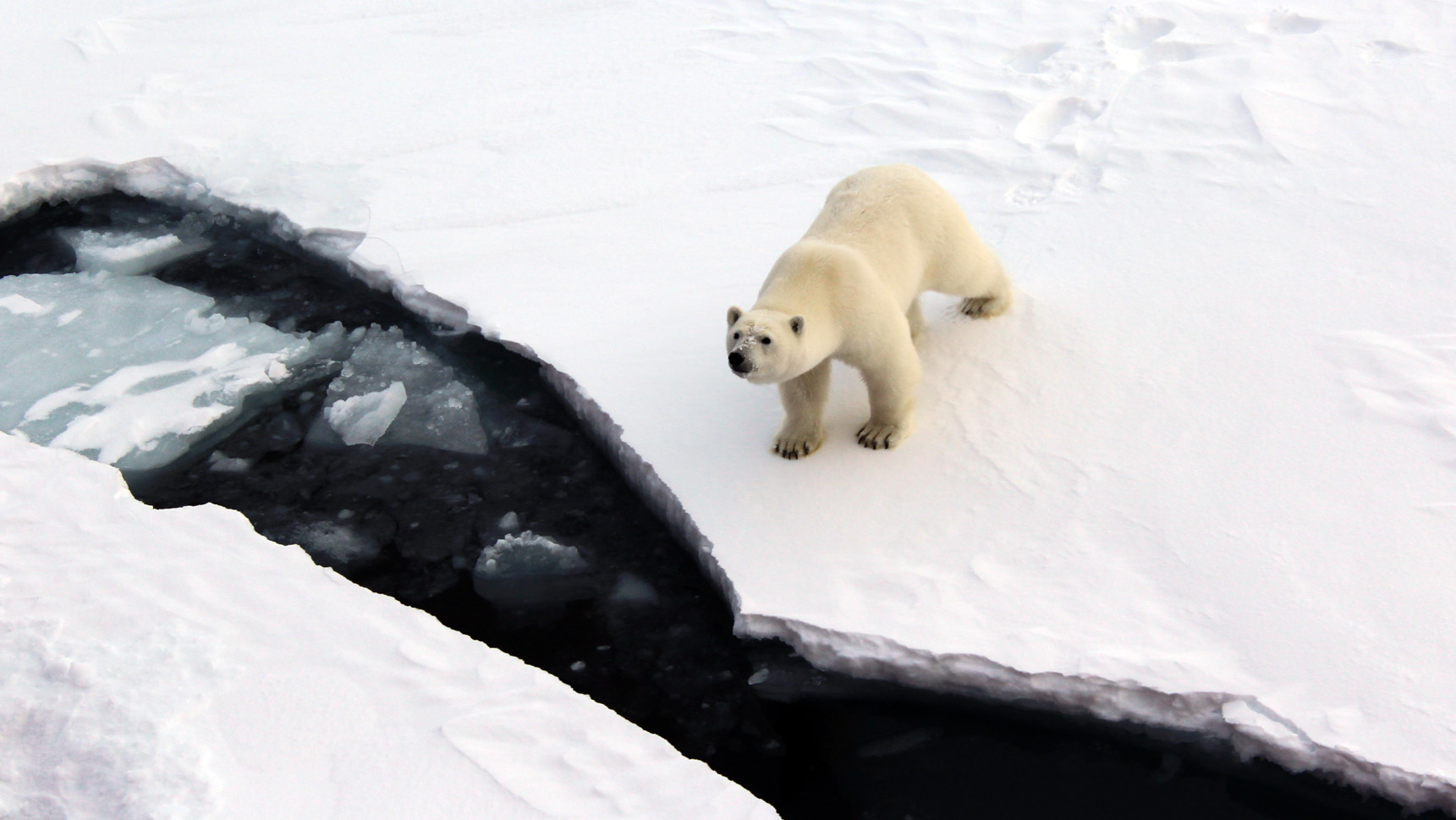
The deep recesses of the Arctic Ocean are remarkably stable, despite how rapidly ice is melting on the surface.
New research led by Arizona State University scientists reveals that the same pool of water that came to rest hundreds of years ago in the frigid depths of the Arctic Ocean remains there, largely unchanged.
Only tiny amounts of water from the surface have managed to infiltrate this salty, warmer layer located nearly a mile or more beneath the surface.
“These parts of the water column turn over extremely slowly — on the order of several hundred years,” said Angelica Pasqualini, an assistant research scientist with the Julie Ann Wrigley Global Futures Laboratory who authored the study.
“As a result, they are effectively isolated from, and insulated against, climate change.”
Arctic ‘deep water’ is largely stagnant
The research vessel Polarstern docks in ice to collect deep-water samples during a recent Arctic expedition. Photo by Peter Schlosser/ASU
Most of the world’s oceans contain warmer, saltier water on the surface and cooler, fresher water deep below. But the Arctic has historically functioned in the opposite way.
There, cooler, fresher water lies below a thick layer of ice, while warmer, saltier water sinks deep below.
It has long been theorized that this layer of warm, salty water found more than 1,500 meters below the surface — what experts call “deep water” — was largely stagnant.
And now, for the first time, research firmly establishes how long it has been sitting there: about 450 years in the Arctic’s more isolated western basin.
It also provides a much-needed benchmark for conditions far below the surface, allowing scientists to watch for changes over time.
ASU researchers, alongside colleagues from Columbia University’s Lamont-Doherty Earth Observatory, measured a variety of trace substances present in deep-water samples to determine their age.
This includes chlorofluorocarbon and radiocarbon, substances that enter seawater at known times and places and change over time in predictable ways.
“It is somewhat surprising to find such old water in the deep basins of the Arctic Ocean,” said Peter Schlosser, vice president and vice provost of Global Futures and director of ASU’s Global Futures Laboratory.
“This new study confirms early findings that the deep waters in the Arctic Ocean are among the oldest in the world’s oceans.”
Schlosser is a pioneer in Arctic research and co-author of the study, recently published in the Journal of Geophysical Research: Oceans.
Why hasn’t this water moved for 450 years?
Scientists use a rosette to collect the deep-water samples. Photo by Peter Schlosser/ASU
Much of the Arctic’s deep water appears to have been formed centuries ago from the warmer Atlantic, but scientists aren’t sure how it happened.
What is clear is that this water isn’t moving now, largely protected from infiltration from above by an intermediate water layer that is salty and cooler.
If mid-depth and deep water moves to the surface, it could lead to “profound changes in global ocean circulation, which could further accelerate the depletion of the Arctic Ocean’s sea ice cover,” Pasqualini said.
Winter sea ice levels have already hit a record low in 2025, according to the National Oceanic and Atmospheric Administration.
“If you open up the Arctic Ocean and it gets warmer, it could also accelerate the melting of Greenland,” Schlosser said. “There’s enough glacial ice sitting on Greenland that if it would melt, you’d have 7 meters of sea level rise globally.”
That could inundate coastal cities like New York and Miami, disrupting critical shipping channels and infrastructure.
Continued warming could weaken the middle layer that protects the Arctic’s deep waters, Pasqualini said, allowing more water from the surface to infiltrate this stable deep layer.
For now, though, there are no indications that deep-water circulation has begun to change. It’s a rare bit of good news for the Arctic Ocean during a time of rapid change.