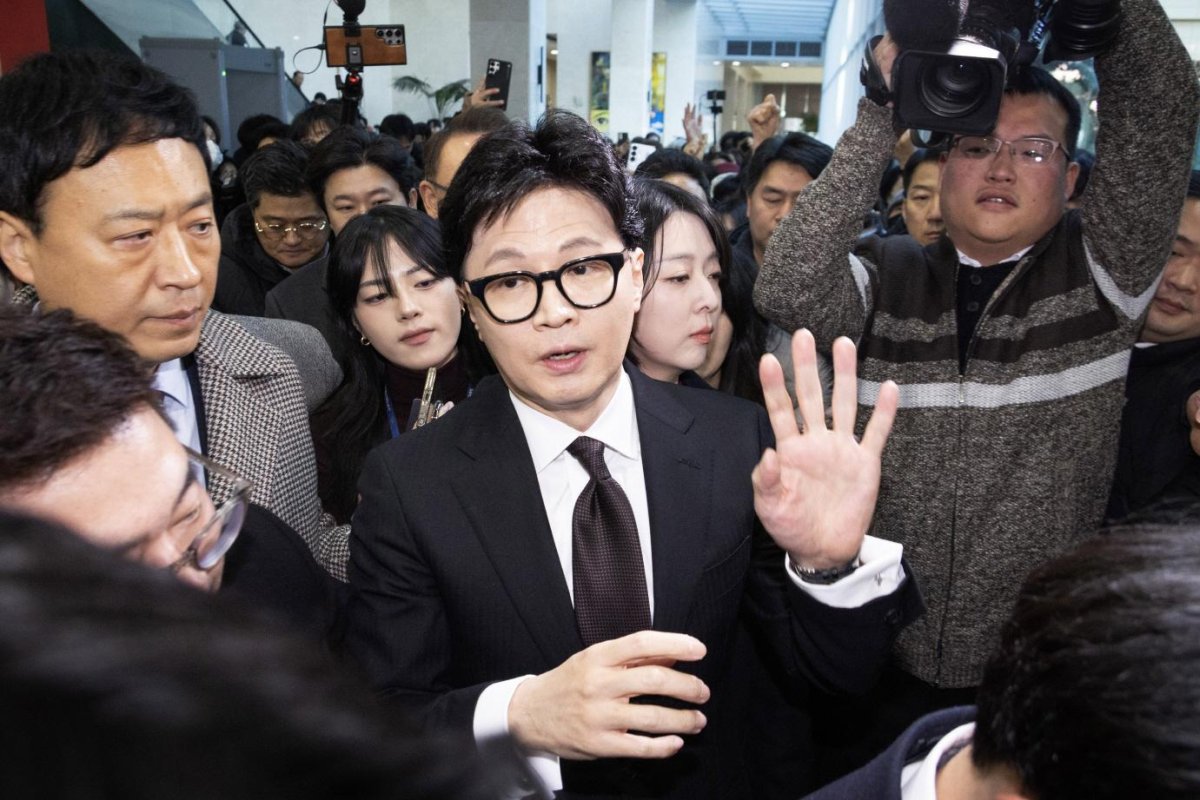
1 of 2 | Former People Power Party leader Han Dong-hoon speaks to reporters at the National Assembly on Wednesday following the party’s decision to expel him. Photo by Asia Today
Jan. 29 (Asia Today) — The expulsion of former People Power Party leader Han Dong-hoon has opened visible cracks within the party and could reshape its prospects in the June 3 local elections and related by-elections, political analysts said Wednesday.
Appearing on Asia Today TV’s political program, commentator Lee Jong-hoon said the decision to expel Han was “predictable,” arguing it followed a series of internal moves that made the outcome increasingly likely.
Lee suggested that party leader Jang Dong-hyuk’s recent hunger strike may have been a preemptive effort to blunt backlash ahead of the expulsion, noting that the disciplinary decision followed shortly after the protest ended and the leadership shifted its focus to economic issues.
“From Jang’s perspective, removing a political liability may bring short-term relief,” Lee said. “But the real test now is how the party handles the local elections and whether it can rebuild conservative unity.”
Eom Kyung-young, head of the Spirit of the Times Research Institute, said the expulsion reflected accumulated pressure within the party rather than a sudden leadership decision.
“Han bears responsibility for openly opposing the party line while holding a key position during the martial law and impeachment period,” Eom said, adding that many party members had already been calling for his removal.
Some analysts argued the expulsion could paradoxically provide Han with a political opening by creating a narrative of persecution. Lee said past political figures often consolidated support after similar setbacks, suggesting Han may now feel compelled to challenge in upcoming elections rather than retreat.
“If he remains silent and avoids elections – what some call an ‘Ahn Cheol-soo-style’ approach – he risks fading from political relevance,” Lee said. “Even a loss can be politically meaningful if it establishes presence.”
Eom, however, predicted Han may choose caution. He cited Han’s brief press remarks following the expulsion, noting their restrained tone and lack of direct attacks on party leadership.
“That suggests he is not leaving the party outright,” Eom said. “At the same time, his limited electoral experience may make him hesitant to run.”
Analysts also debated the broader conservative realignment. Lee said the party’s pro-Yoon faction appeared determined to maintain control over nominations, potentially sidelining both Han and lawmakers aligned with him. Eom countered that a decisive defeat in the local elections could still force leadership changes or coalition talks.
Speculation has also emerged over whether Han might consider forming a new party or running independently. Lee said such a move would be risky but potentially worthwhile, while Eom said Han was more likely to remain inactive for now, interpreting his short statement as signaling restraint rather than confrontation.
With local elections approaching, analysts agreed the expulsion has heightened uncertainty for the People Power Party, raising questions about leadership stability, candidate selection and the future shape of South Korea’s conservative camp.
— Reported by Asia Today; translated by UPI
© Asia Today. Unauthorized reproduction or redistribution prohibited.
Original Korean report: https://www.asiatoday.co.kr/kn/view.php?key=20260129010013792