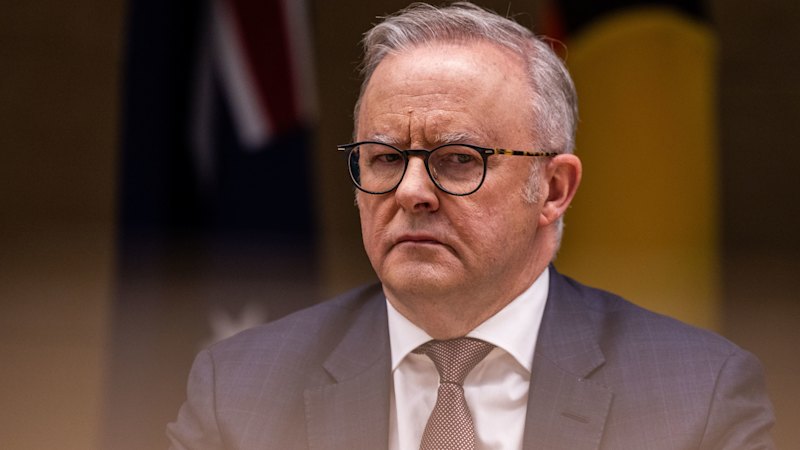
Updated January 30, 2026 — 5:44pm,first published 5:26pm
AAA
State and territory governments have squeezed an extra $2 billion out of the prime minister to strike a $25 billion deal to fund hospitals for the next five years, ending a long-running stalemate in negotiations.
Anthony Albanese sweetened his final offer to get state and territory governments on board to shoulder more early intervention work for children with mild-to-moderate developmental delays and autism under the new Thriving Kids program to move them off the bloated National Disability Insurance Scheme.
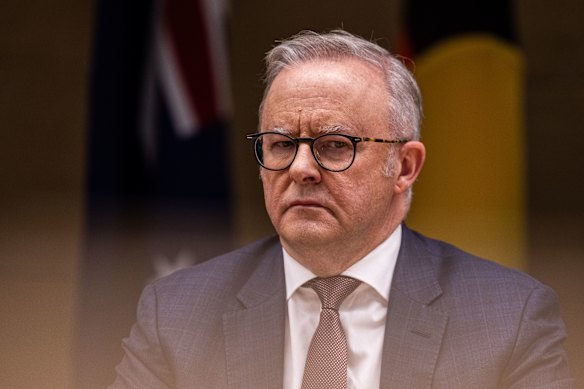
Prime Minister Anthony Albanese announced the $25 billion deal in Sydney on Friday.Sam Mooy
Premiers had rejected the government’s previous $23 billion offer in December, demanding more money to help ease the economic burden of an ageing population.
“This agreement represents one of the most significant national reforms in living memory,” Albanese told reporters in Sydney after national cabinet on Friday. “It is a major step forward in addressing the pressures that are there on our health and aged care systems, as well as on the NDIS ensuring their sustainability into the future as part of this deal.”
“The Commonwealth will provide an additional $25 billion for public hospitals to reach a record $219.6 billion over the next five years. This is three times more additional funding for public hospitals than was agreed to under the last five-year agreement.”
The governments had agreed in principle in 2023 that the federal government would increase its share of public hospital funding in exchange for help from the states and territories to fund disability services. But negotiations stalled after state premiers baulked at projections showing the December offer was several billion dollars short of the original proposal, while the Albanese government accused the states of overspending and demanded they curb their outlays.
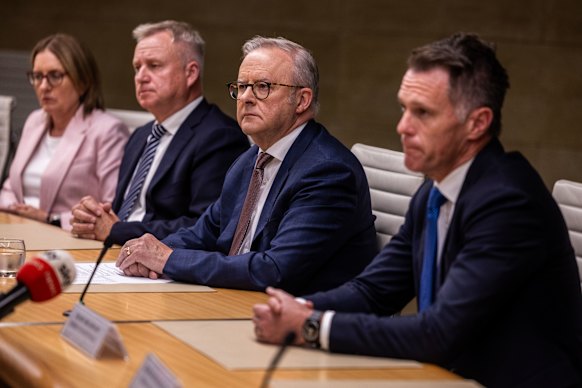
The deal ends a long-running stalemate between the federal and state governments.Sam Mooy
The funding agreement on Friday includes $24.4 billion for the Commonwealth share of estimated hospital activity from 2026-27 to 2030-31, and more than $600 million investment in the public hospital system.
States agreed to match a $2 billion investment to deliver Thriving Kids, though they asked for more time to begin implementing the program, delaying its start three months to October 1.
Albanese on Friday insisted the program would be fully rolled out as planned by the end of 2027.
Related Article
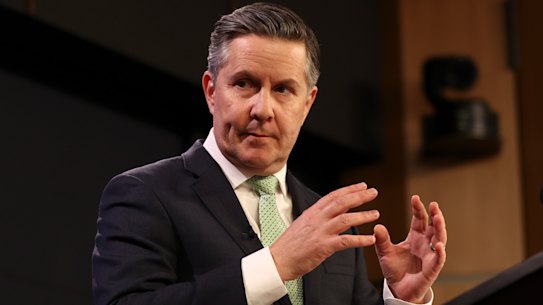
“The states put to us the possibility of a short delay in the full implementation of Thriving Kids. But Thriving Kids will start from this year, and the full implementation will be completed on the first of January, 2028. We agreed to that proposal. It was reasonable that we get this right,” Albanese said.
Children with serious disabilities, including autistic children with high support needs, will still be eligible for the NDIS and families can use its services until the Thriving Kids program is up and running.
The government said children with low to moderate support needs could start using Thriving Kids supports on October 1, but has yet to confirm what those services will include.
Premiers had been demanding more money to deal with the growing number of elderly patients waiting in hospital beds for places in aged care facilities. The states argued this “bed block” shifted the cost-burden of an ageing population from aged care, for which the Commonwealth holds responsibility, to hospitals, which are run by the states and territories.
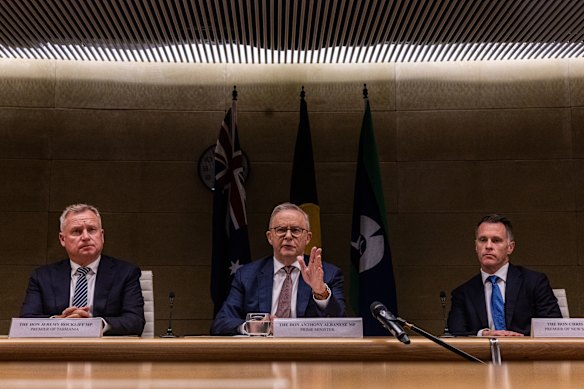
NSW premier Chris Minns (right) said an ageing population would continue to challenge health systems.Sam Mooy
“We know that we need to get older, longer stay patients out of hospital rooms and into dedicated care, and the aged care reforms will assist with that,” Albanese said on Friday.
The Queensland government had called on the federal government to find solutions to move the state’s 900 stranded aged care patients into long-term accommodation, including acquiring land sites and partnering with the private sector to deliver aged care facilities.
NSW, which will get $6.5 billion from the funding deal, had almost 1200 patients who had exceeded their estimated date of discharge in September – a 54 per cent increase in 12 months.
NSW Premier Chris Minns said the deal accounted for increasing future costs associated with an ageing population, but it would take a joint effort from all governments to keep costs under control.
“As much as the system is stretched today, we can expect even further problems in the future,” Minns said, speaking alongside the prime minister.
NSW is also in the middle of arbitration with both nurses and doctors over new pay deals, but Minns said these would be determined separately by the independent Industrial Relations Commission.
In Victoria, just over 40 per cent of emergency department cases involve lower urgency patients who could be dealt with via primary care services.
Opposition health and aged care spokeswoman Anne Ruston said the government needed to turn its attention to the aged care crisis, pointing to the Productivity Commission’s report released today that revealed older Australians were waiting up to eight months for in home care support, which had doubled in the past year.
The Albanese government was determined to secure the deal on Friday before the South Australian government goes into caretaker mode ahead of the state election next month, and the expiration of the current funding agreement on June 30.
Cut through the noise of federal politics with news, views and expert analysis. Subscribers can sign up to our weekly Inside Politics newsletter.
 Brittany Busch is a federal politics reporter for The Age and Sydney Morning Herald.Connect via email.
From our partners