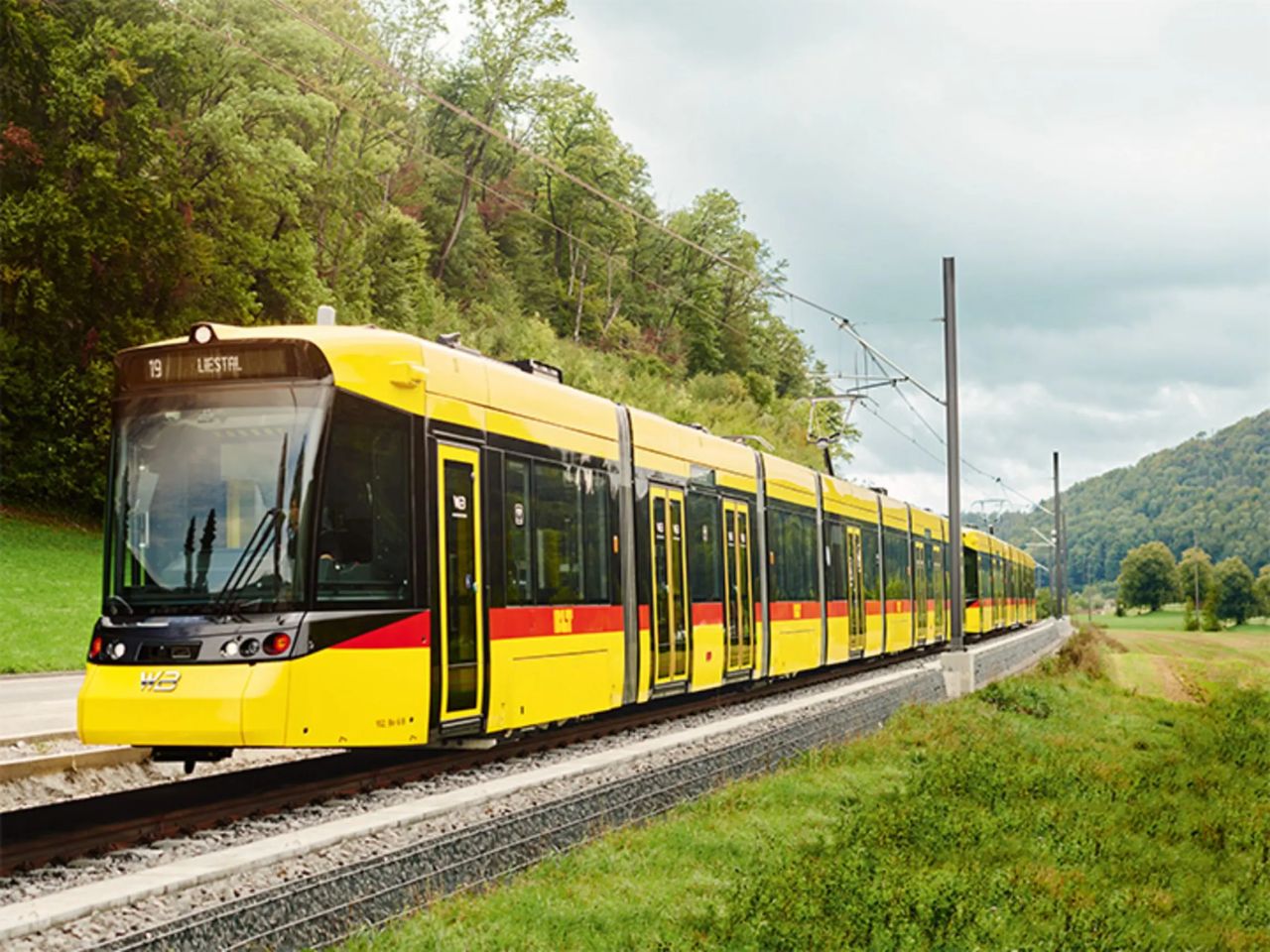
 BLT Baselland Transport has become the first railway company in Switzerland to introduce semi-automated train operation after the Federal Office of Transport (BAV) approved GoA2 operation on the Waldenburg–Liestal line.
The project marks a national first and an important step towards the automation of regional rail transport.
The implementation is made possible by new signaling technology provided by Stadler, which has developed a digital rail traffic control system specifically for this line.
CBTC technology developed specifically for semi-automated operation
GoA2 operation is based on the NOVA Pro train protection and control system, a CBTC (Communications-Based Train Control) system completely redesigned by Stadler at its Wallisellen facility.
This enables direct data exchange between trains and ground-based safety equipment, forming the basis for fully digitalised operation.
In this mode, once the doors are closed and the driver has authorised departure, the train runs automatically.
The CBTC system controls the speed, complies with the maximum permissible limits, optimizes level crossing management, and automatically stops the train precisely at stations.
The driver remains on board, monitors the route, and only intervenes if necessary.
Complete modernization of the Waldenburg–Liestal line
The introduction of semi-automated operation is part of an extensive modernization program carried out by BLT. Since 2022, ten new multiple units manufactured by Stadler in Valencia have been running on the line, and the entire infrastructure of the 13-kilometer route has been completely renovated: tracks, stations, signaling, and control systems.
A key element of the project is the replacement of classic line signaling with fully digital traffic control using CBTC.
Full automation in the depot from 2026
In addition to GoA2 commercial operation, BLT plans to introduce fully automated shunting in the new depot in Waldenburg. From the end of 2026, trains would be operated without personnel on board, in GoA4 mode, exclusively in the depot area.
This step will lead to the full automation of stabling and maintenance operations, strengthening the Waldenburg line’s position as a pilot project for digitized rail transport in Switzerland.
“GoA2 represents a major step forward in the automation of railway operations. Train traffic becomes more uniform, more efficient in terms of resources and energy consumption. At the same time, punctuality increases and the risk of premature departures from stations is reduced,” said Philipp Glogg, technical director of BLT.
Share on: 


