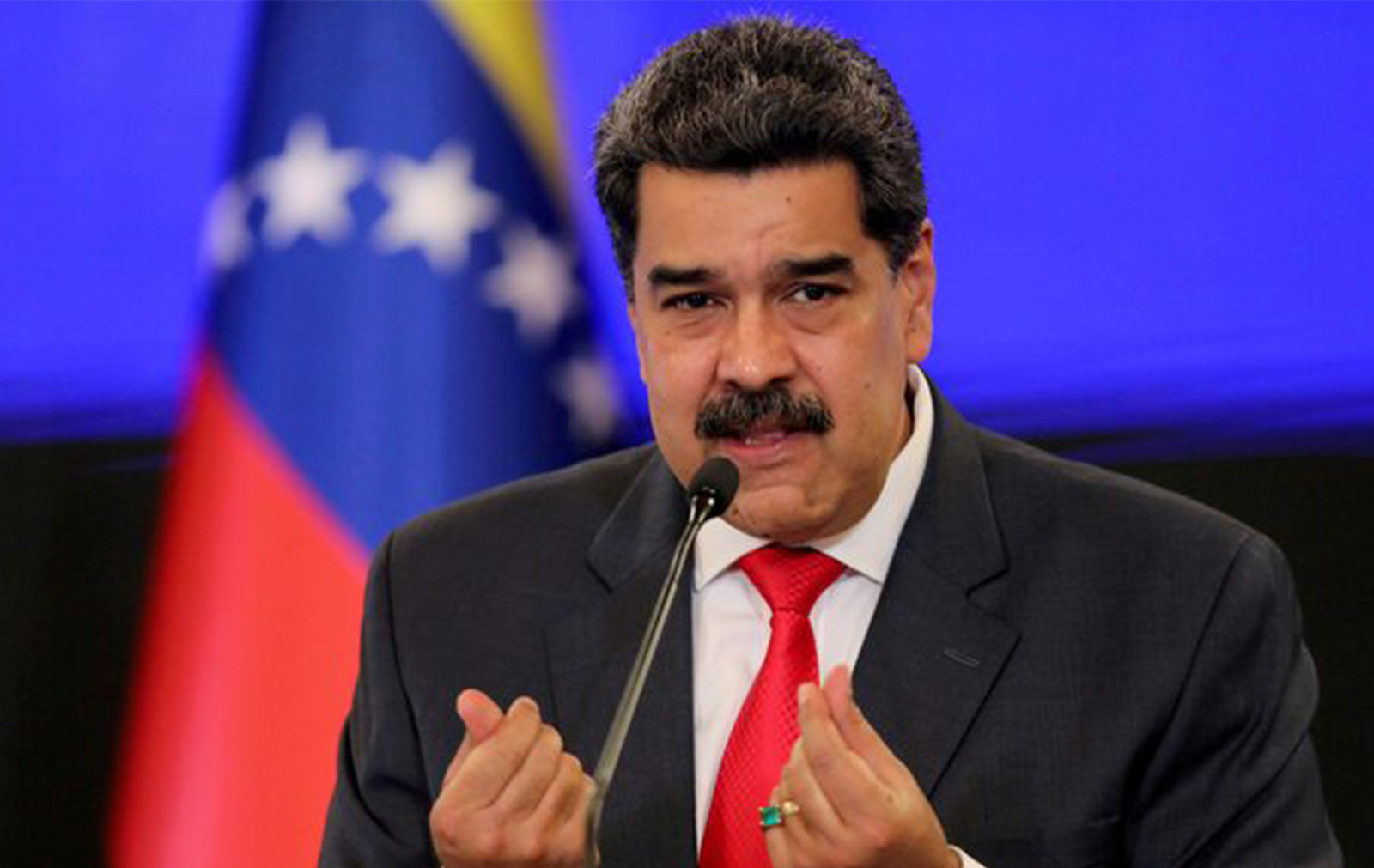
 File Pic: Venezuelan President Nicolas Maduro
Prof D Mukherjee
mukhopadhyay.dinabandhu@gmail.com
The pre-dawn detention of Venezuelan President Nicolás Maduro and his wife, Cilia Flores, by U.S. forces on January 3, 2026, represents a defining moment in modern geopolitics. Executed without reported bloodshed inside Caracas’s high-security presidential residence and followed by Maduro’s transfer to the United States, the operation has sharply challenged long-held assumptions about sovereignty, regime legitimacy, and the acceptable limits of unilateral action. Framed by President Donald Trump as a strike against authoritarian rule, drug trafficking, and corruption, the move has triggered intense debate well beyond Latin America. The episode is the culmination of a long deterioration in U.S.-Venezuela relations. Over more than a decade, ties have been shaped by sanctions, diplomatic isolation, and rival claims to political legitimacy. Yet the physical removal of a sitting head of state by foreign forces marks a clear escalation, rarely seen since the Cold War era. While Washington has defended the action on legal and security grounds, critics argue it risks destabilising an international system already under severe strain.
Maduro’s ascent followed the arc of Venezuela’s Bolivarian movement. Rising from a background as a trade unionist and bus driver, he entered national politics under Hugo Chávez, serving as foreign minister and later vice president. After Chávez’s death in 2013, Maduro narrowly secured the presidency of a deeply divided country. His tenure coincided with economic collapse, hyperinflation, and the emigration of millions. Politically, he consolidated authority through institutional changes, reliance on the military, and the sidelining of opposition bodies. Disputed elections and allegations of rights abuses intensified global criticism, while Maduro portrayed his rule as a defence of national sovereignty. The confrontation with Washington escalated gradually. Sanctions targeting oil revenues and financial access aimed to force change but instead pushed Caracas toward closer ties with Russia, China, and Iran. Failed efforts to empower opposition leadership gave way, under Trump’s return to office, to overt coercion.
The capture of Nicolás Maduro resonates globally, coming at a time of overlapping international crises. The Russia-Ukraine war, now in its fourth year, has already cost the West over USD 200 billion in military, economic, and humanitarian support, straining resources and attention. Meanwhile, U.S.-China tensions remain at a historic low, driven by trade disputes, technology restrictions, and escalating military activity near Taiwan, including large-scale Chinese exercises involving dozens of aircraft and naval vessels in 2024-25. In the Middle East, the Israel-Gaza conflict and wider regional instability continue to affect Red Sea shipping lanes, which handle roughly 12 per cent of global trade.
In this environment, Washington’s unilateral operation signals a shift toward power-driven geopolitics, prioritising strategic outcomes over procedural consensus. Energy markets reacted swiftly: Venezuela’s 300-billion-barrel oil reserves make the country central to global supply, and even minor uncertainty can move prices. Past geopolitical shocks have driven Brent crude from under USD 75 to over USD 90 per barrel in weeks, highlighting sensitivity to instability. Politically, the operation challenges norms of sovereignty and non-intervention enshrined in the UN Charter. Proponents argue decisive measures are warranted against abusive regimes, but critics warn that undermining these norms leaves smaller and medium powers vulnerable and weakens the international order that has underpinned relative global stability for nearly eight decades.
The arrest of Nicolás Maduro along with his present wife, Cillia Flores, has highlighted deep fractures in the international system. The UN Security Council convened an emergency session but quickly fell into deadlock. Russia and China condemned the U.S. operation as a clear violation of sovereignty and international law, warning that it undermines the UN Charter. Their position aligns with historical patterns: since 2011, more than a dozen Security Council resolutions on Syria, Ukraine, and related crises have been vetoed, showing how great-power rivalry has weakened collective security mechanisms. Latin America’s response was divided. Countries like Mexico and Bolivia reaffirmed non-intervention principles, reflecting sensitivities shaped by a history of external interference. Other states, including some in the Caribbean and Central America, cautiously welcomed the removal of a leader accused of democratic erosion and economic mismanagement, though none endorsed the methods used. This fragmentation mirrors broader ideological divides that have reduced the effectiveness of regional institutions like the Organization of American States. Europe’s reaction was measured. While recognising Venezuela’s human rights and governance issues, EU leaders emphasised due process and multilateralism, reflecting unease with unilateral action outside NATO frameworks. Past experiences, such as lengthy negotiations over Ukraine sanctions, have reinforced this cautious approach. Overall, the episode underscores a sobering reality: global institutions, designed for an earlier balance of power, are struggling to manage shocks from major powers, deepening the perception that multilateralism is increasingly subordinated to selective, interest-driven action.
The capture of Venezuela’s president has far-reaching implications, extending well beyond Latin America into some of the world’s most volatile regions. For Russia, the operation reinforces its long-standing narrative that Western powers selectively enforce international law while ignoring sovereignty when convenient. Moscow is likely to cite the event to justify its actions in Ukraine, which has already caused hundreds of thousands of military and civilian casualties and represents Europe’s largest land war since 1945. Russian officials portray their campaign as defensive against Western encroachment, and Maduro’s capture strengthens this framing. China views the episode through the lens of Taiwan. Beijing has intensified military activity near the island, with record aircraft crossings of the Taiwan Strait median line in 2024-25. Washington’s unilateral action in Caracas may be seen as proof that the U.S. will bypass international norms when core interests are at stake, reinforcing Beijing’s push for accelerated military readiness and deterrence planning in the Indo-Pacific. In the Middle East, Iran and allied actors have cited the operation as evidence of U.S. unilateralism, raising the risk of escalation in proxy conflicts across the Gulf and Eastern Mediterranean. Taken together, these responses highlight a global environment where coercive power increasingly supersedes diplomacy, heightening the risk of miscalculation and regional instability across multiple theatres.
India’s calculous to Maduro’s capture has been cautious, reflecting its long-standing policy of strategic autonomy. New Delhi has avoided explicit endorsement or criticism, instead calling for restraint, dialogue, and respect for international law. This measured approach is consistent with India’s handling of other crises, including the Russia-Ukraine conflict, where it has emphasised diplomacy over alignment pressures. While the U.S. is now India’s largest trading partner, with bilateral trade surpassing USD 190 billion, this does not imply automatic policy alignment on questions of sovereignty or intervention. Territorial integrity and non-interference remain vital for India, given its own security concerns. The ongoing standoff with China along the Line of Actual Control, involving over 60,000 troops on both sides, heightens sensitivity to precedents that might legitimise unilateral military action.
The episode also highlights the importance of multipolar engagement. While India’s ties with Bangladesh and Pakistan remain unaffected, it underscores that middle powers must carefully balance deepening U.S. partnerships, maintaining relations with Russia, and managing China, all while defending international norms that constrain arbitrary power. The Maduro episode offers a critical moment for global leaders to reflect on an increasingly fragmented international system. For India and the European Union, the priority is to strengthen multilateral mediation and clarify the legal boundaries of using force. Convening emergency diplomatic forums-through the UN General Assembly, where vetoes do not apply, or credible regional organisations-can help de-escalate tensions and foster dialogue on acceptable state conduct, especially as the Security Council has repeatedly failed to reach consensus during major crises.
Reforming sanctions regimes is equally urgent. Broad, economy-wide sanctions often inflict severe humanitarian harm without achieving intended political goals. More targeted measures with clearly defined exit strategies would improve legitimacy and effectiveness. Investments in conflict-prevention mechanisms, including early-warning systems, preventive diplomacy, and third-party mediation, can reduce the risk of escalation to military action. Strengthening international judicial mechanisms and upholding due process is vital. Even in cases of severe governance failure, sustainable political change is more likely through negotiated transitions than abrupt, force-driven removals. Normalising unilateral interventions risks worsening global instability rather than resolving crises.
The capture of Maduro by U.S. forces is more than a dramatic show of power; it tests the resilience of the international system. While it may yield short-term gains for Washington, its long-term consequences are uncertain and potentially far-reaching, as precedents set by major powers rarely remain isolated. If power increasingly outweighs principle in global politics, risks of instability, retaliation, and miscalculation will rise, leaving smaller and medium-sized states vulnerable. Reversing this trend requires renewed commitment to diplomacy, restraint, and institutional solutions, even when slow or politically inconvenient. Ultimately, the stability of the international order depends less on force and more on the willingness of states to uphold shared rules. In a world strained by overlapping conflicts, restraint-not spectacle-is the only sustainable path to collective security and lasting stability.
(The columnist is a Bengaluru based educationist, a management scientist and an independent researcher.)