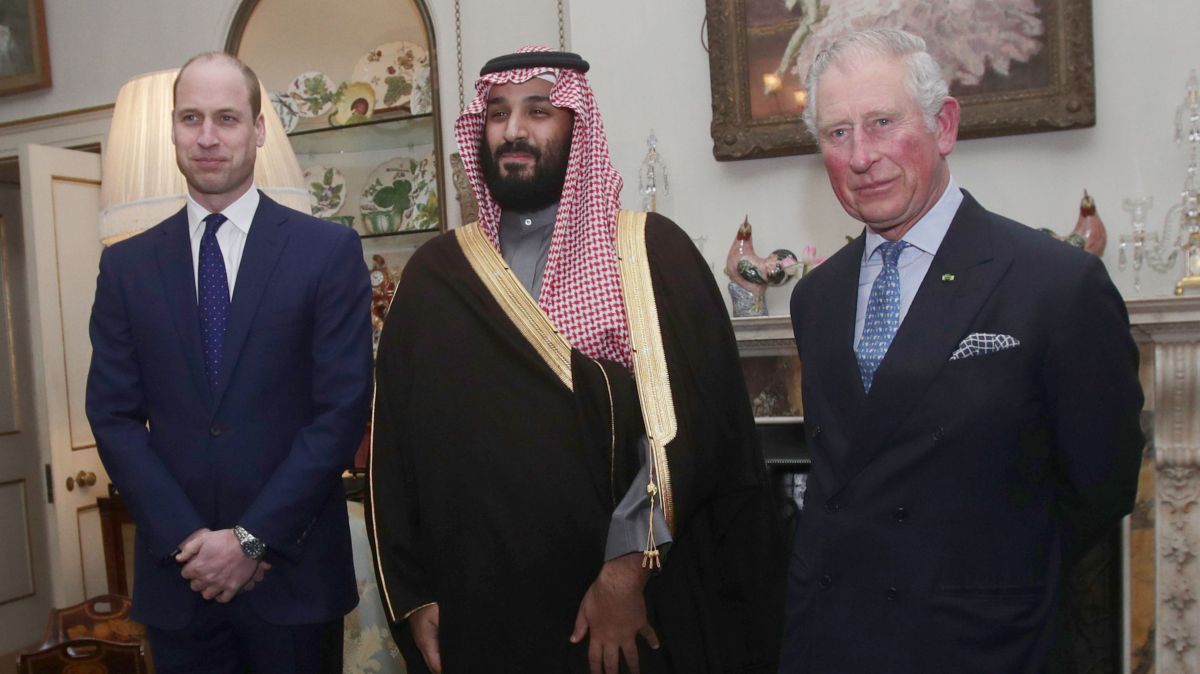
The Prince of Wales is no stranger to diplomatic tightropes in the Middle East. In 2018 he travelled to Israel and the occupied Palestinian territories during heightened tensions, navigating leaders on both sides bending his ear.
Next week Prince William will need his diplomatic wits about him again as he travels to Saudi Arabia for the first time.
The two-day visit, at the request of the British government, begins on February 9. William will be on a royal soft power mission celebrating “growing trade, energy and investment ties” with the richest state in the Middle East “as the two nations approach a century of diplomatic relations” next year.
Intelligence-sharing and security will also be on the agenda. William is expected to meet Crown Prince Mohammed bin Salman, known as “MBS”.
The controversial de facto ruler of the kingdom will be keen to use William’s visit to burnish his credentials as a reforming leader in a region of dictators.
But the Middle East is a region William follows closely. He is alive to the sensitivities of visiting a regime that continues to be dogged by questions of human rights abuses and the murder of the Washington Post journalist Jamal Khashoggi in the Saudi consulate in Istanbul in 2018. Mohammed recently described the killing as a “huge mistake”.
Sources close to William say he has become increasingly adept at handshakes and bilaterals with divisive world leaders — pointing to his warm relationship with Trump as a marker of what William knows is required of his role — in the national interest.
A royal source said: “William has emerged as a serious global statesman and a discreet but highly effective asset for the UK government. He has shown that, when called upon, he is willing and able to engage and deliver, quietly building bridges where diplomacy requires trust as much as visibility.
“His engagement on the international stage, including his ability to connect with figures such as President Trump, underlines why he is increasingly viewed as a secret weapon in Britain’s diplomatic toolkit: credible, measured and effective.”

The Prince and Princess of Wales with President Trump and Melania, the first lady, at Windsor Castle during their second state visit to the UK
AARON CHOWN/PA
William is conscious of his growing role as “the UK’s secret weapon of diplomacy” and the importance being placed on the government’s “number one ask of him this year”, following recent high-profile recent visits to Saudi Arabia by Trump, President Macron of France, the chancellor Rachel Reeves, who visited last year and Sir Keir Starmer, who went in 2024.
While William is expected to visit the US in the summer, at Trump’s invitation, to mark the 250th anniversary of American independence and to visit India in the autumn for his environmental prize, Earthshot, the Saudi trip is his only scheduled travel this year at the government’s request.
In the past two years, William held meetings with President Trump during his state visit to the UK last September and while they were both in Paris for the reopening of Notre-Dame cathedral in December 2024. In November that year, he met with President Ramaphosa of South Africa in Cape Town and the Emir of Qatar during his state visit to Britain the following month. At all meetings, discussions about geopolitics and a range of world issues were on the agenda — the same is expected of the anticipated bilateral with Mohammed.

Donald Trump meets Prince William at the UK ambassador’s residence in Paris last year
SUZANNE PLUNKETT/REUTERS
William’s engagements in the capital, Riyadh, and the ancient desert city of AlUla, a Unesco world heritage site, will be shaped by the government’s objectives on trade and investment. But due to his growing stature and confidence as a statesman, the programme will also reflect his personal interests, including wildlife conservation and football.
The prince deployed a similar tactic last year during a whistlestop visit to Estonia supported by the government, when he met with President Karis in Tallinn. He also visited British troops stationed with Nato soldiers protecting Europe’s eastern flank, making a point of highlighting soldiers’ mental health and wellbeing during the visit to the Tapa Camp near the Russian border.

William in a Challenger 2 battle tank at Tapa Camp
AARON CHOWN/PA
Like Estonia, where William was on the ground for less than 36 hours, the Saudi trip will be quick — just over 48 hours — reflecting his new approach to royal trips. Aides say that, when it comes to William’s vision for “the role that modern monarchy has in diplomacy”, it is “impact”, not endurance, that delivers. The prince makes no secret of scheduling his official work around his home life so that he can prioritise being a present father to Prince George, Princess Charlotte and Prince Louis and will return to the UK in time for his children’s half-term school holiday, which begins on February 13.
The government is drawing up a brief of talking points for William’s visit. Chief among them are trade and fighter jets, according to a senior British figure, who is regularly in the Gulf for high-level meetings with state officials. The UK is currently in the middle of negotiations over a free trade agreement with the Gulf Cooperation Council — comprising Bahrain, Kuwait, Oman, Qatar, Saudi Arabia and the UAE — which it is hoped will provide a multibillion-pound boost to trade with the region.
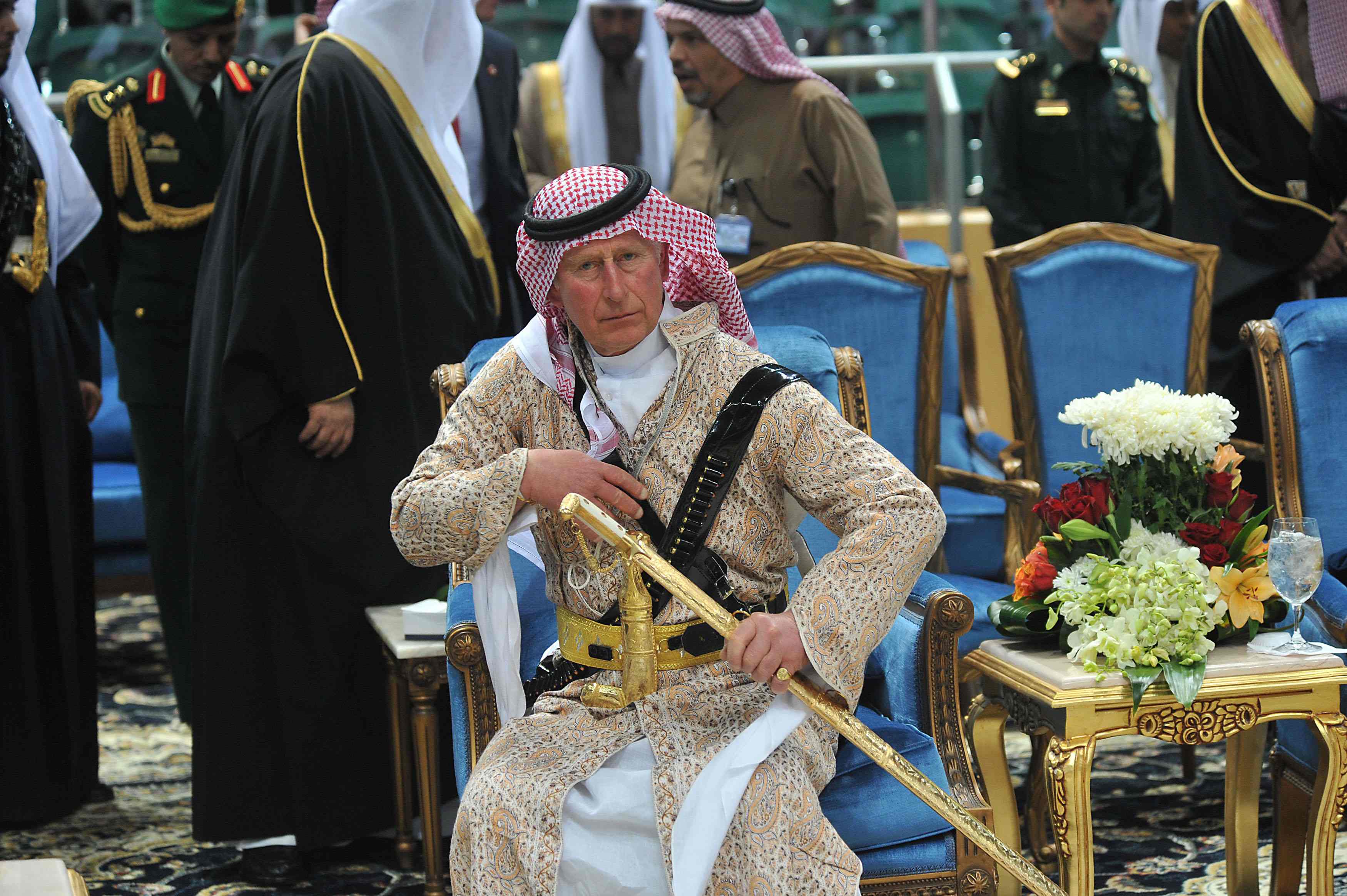
The future King Charles wears traditional Saudi uniform during a ceremony in Riyadh in 2014
REUTERS
William may also raise the government’s proposals for Saudi Arabia to join a multilateral pact with Britain, Japan and Italy to build a sixth-generation fighter jet, known as Tempest. The Global Combat Air Programme (GCAP) has been steadily progressing, but there has been concern about the UK’s ability to finance it given strains on the public purse and defence budgets. Saudi Arabia joining would not only make the economics easier — Riyadh is also expected to buy 48 fourth-generation Typhoon fighter jets from UK arms giant BAE Systems.
“He’s going out there for a reason,” said one source of the Prince’s visit. “It would be surprising if [his briefing papers] didn’t include GCAP. Royal family visits to Arabian states are for two reasons: to build business partnerships and to keep relationships strong.”
William is also understood to have discussed his imminent trip with the King, who has visited Saudi Arabia many times, and whose King’s Foundation charity runs programmes promoting the traditional arts in AlUla.