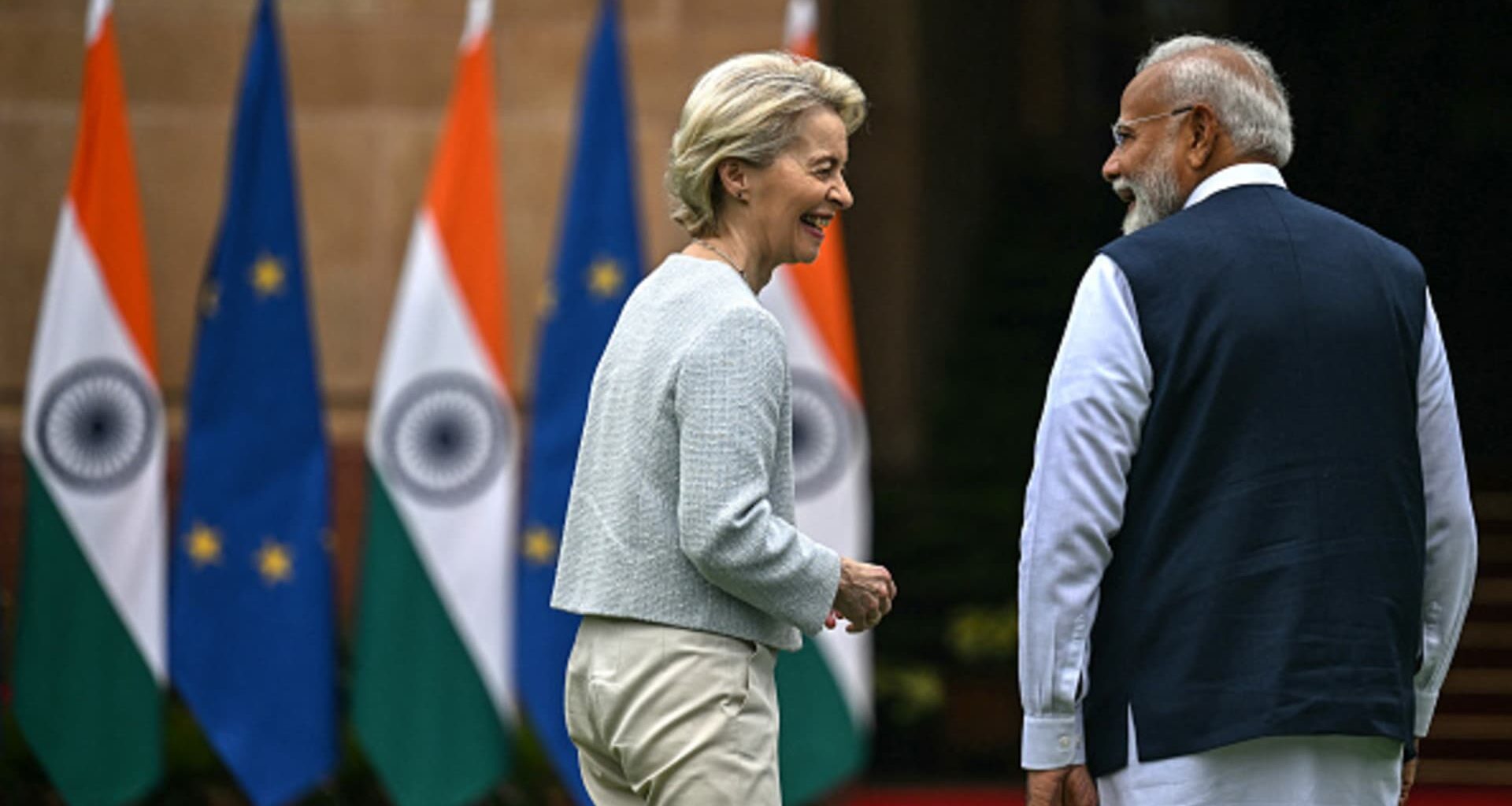
European Commission President Ursula von der Leyen (L) speaks with India’s Prime Minister Narendra Modi before their meeting at the Hyderabad House in New Delhi on February 28, 2025. The European Union is exploring a security and defence partnership with India, EU chief Ursula von der Leyen said on February 28 before meeting with Prime Minister Narendra Modi in New Delhi. (Photo by Money SHARMA / AFP) (Photo by MONEY SHARMA/AFP via Getty Images)
Money Sharma | Afp | Getty Images
LONDON — European stocks ended broadly higher on Tuesday, as investors reacted to the European Union’s landmark trade deal with India and braced for a flurry of corporate earnings.
The pan-European Stoxx 600 finished the session 0.6% higher, with most sectors and major bourses in positive territory.
Indian Prime Minister Narendra Modi announced on Tuesday that India and the EU had closed a “landmark” free trade agreement, touted as the “mother of all deals.” The agreement represents about 25% of global gross domestic product and about a third of global trade.
The EU’s biggest exports to India are machinery, transport equipment and chemicals, according to the European Council. The bloc’s biggest imports from India are machinery, chemicals and fuels.
Earnings season is getting underway again with regional investors keeping an eye on the latest financial reports from ASML, Volvo, LVMH and Deutsche Bank, among others, this week. On Tuesday, Atlas Copco, Sandvik and Logitech International were due to report.
Looking at individual stocks, Puma jumped after China’s Anta Sports confirmed it would buy a 29% from France’s billionaire Pinault family for 1.5 billion euros ($1.78 billion). Shares in the German sportswear firm ended the day up more than 9%.
Swedish medical equipment maker Getinge slipped toward the bottom of the regional index, down 5.8% by the end of dealmaking, after the firm reported a slight drop in order intake for the fourth quarter of 2025. Full-year revenue came in at 34.97 billion Swedish kronor ($39.1 billion), slightly below expectations set out in a consensus compiled by LSEG.
British bootmaker Dr Martens shed 11% after the company posted disappointing quarterly results and forecast roughly flat revenue growth for 2026. Revenue fell 3.1% to £251 million ($343 million) in its fiscal third quarter, led by a 7% drop in direct-to-consumer sales as the company scaled back its promotions. Wholesale revenue, however, increased 9.3%.
“This is a year of pivot, as we make the necessary changes to our business to set us up for future sustainable growth,” Chief Executive Ije Nwokorie said in a statement alongside the results, adding that he is “laser focused” on executing Dr Martens’ strategy of reducing discounts, driving growth in other products, opening in new markets, and simplifying its operational model.
Meanwhile, European banks have been on a tear. The Stoxx Europe 600 Banks Index hit its highest points since 2008 on Tuesday, advancing 1.8% to 374.71 points, as investors react to the sector’s ‘enhanced access to the Indian services market’ amid the U.K. and EU trade deal with India.
London-listed shares in HSBC were last seen 2.8% higher, representing a record high. BNP Paribas advanced 1.8%, also hitting a new high. Banco Santander followed suit, gaining more than 1% to take it to a new peak. UBS and Deutsche Bank also added value.
There’s been more global trade uncertainty overnight after U.S. President Donald Trump took aim at South Korea Monday, saying he would increase tariffs on Asia’s fourth-largest economy.
Trump said on Truth Social that the country’s legislature has not approved Seoul’s trade deal with Washington, and that tariffs on South Korean autos, pharmaceuticals and lumber would rise from 15% to 25%. Shares of South Korean autos fell sharply but pared losses overnight.
S&P 500 futures rose after the major averages started the busy earnings week on a positive note. Investors are also waiting for the Federal Reserve’s rate decision later this week.
The central bank is widely expected to keep its key rate at a target range of 3.5% to 3.75%, but traders will search for clues on when future cuts may come.
— CNBC’s Priyanka Salve contributed to this market report.