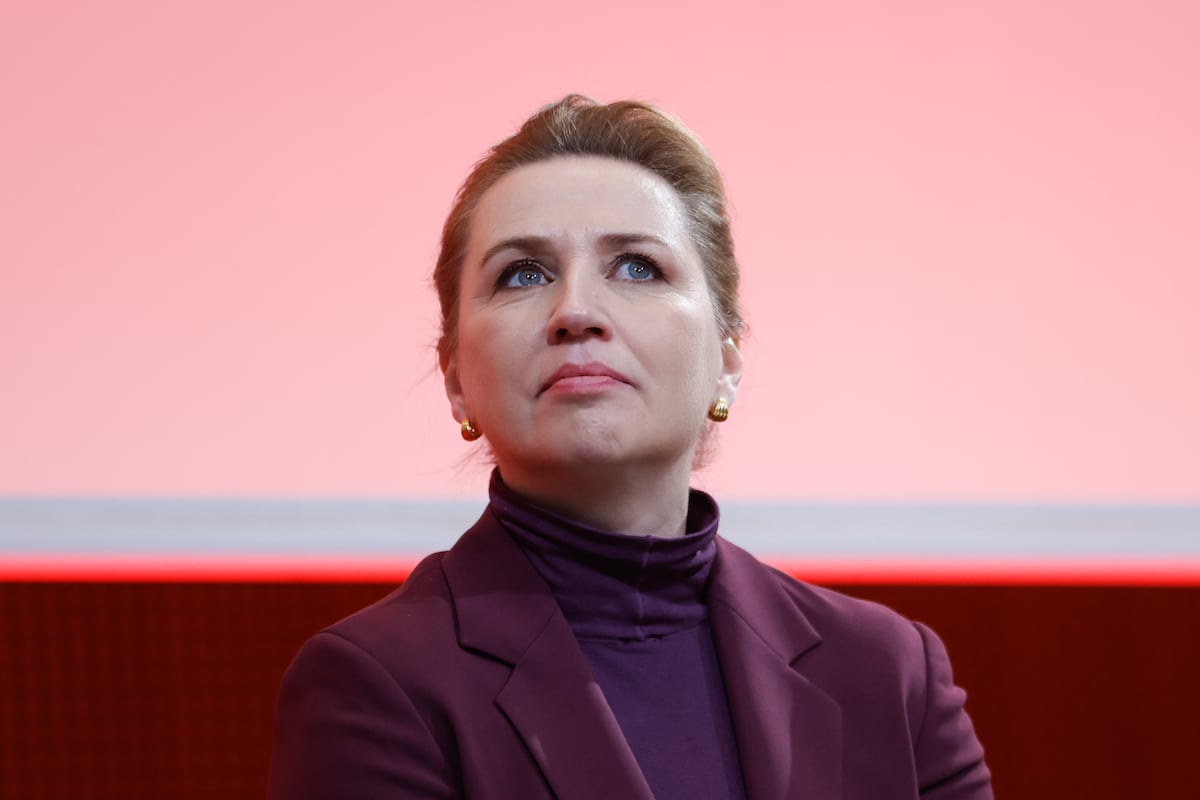
As 2025 drew to a close, Mette Frederiksen, 48, was facing a rough period. Her party, the Social Democrats, had just suffered a painful defeat in the municipal elections. For the first time in more than a century, they had lost the Copenhagen mayoralty. The Danish prime minister’s government — a coalition with centrist and center‑right parties — “looked like a funeral procession on its way to its own political burial,” a commentator on the TV2 network said. No one was certain she would be able to remain in power after the elections scheduled for 2026.
In her New Year’s address, the prime minister offered a mea culpa: “I haven’t always listened carefully. To everyone. To you. I haven’t done enough about the high price of food. I haven’t done enough about growing inequality. I haven’t done enough for the children who are not thriving. This must change. It is my responsibility.”
But then Greenland entered the picture, and everything changed. In early January, U.S. President Donald Trump stepped up the pressure to take control of this autonomous territory within the Kingdom of Denmark. Trump even floated the military option to force the hand of his NATO ally. A few days later, he backed down, though without abandoning his desire to acquire the Arctic island. This crisis — which in Copenhagen and in Nuuk, Greenland’s capital, is seen as far from resolved — marks the end of an era. “The world order as we know it, that we have been fighting for 80 years since the end of the Second World War, is over,” Frederiksen said last week in Paris, during a European tour that also took her and Greenland’s prime minister, Jens‑Frederik Nielsen, to Berlin.
The crisis has given the prime minister a political boost after her year‑end slump. Her party has recovered five points compared with December, according to the latest poll by the Megafon institute. The showdown with Trump is elevating her not only as a Danish leader but as a European one — a singular politician with social democracy in her DNA. While an Atlanticist to the core, today, she has is known for her strong commitment to Europe.
“She is a prime minister who manages very well when there is a crisis. We don’t know what kind of prime minister she would have been without crises,” says Jonas Parello‑Plesner, a former Danish diplomat and executive director of the Alliance of Democracies Foundation. Parello‑Plesner points to three crises in particular. The first was the Covid-19 pandemic, which broke out six months after Frederiksen took office in 2019, during which the government, like others in Europe, assumed exceptional powers and adopted controversial measures such as the culling of millions of mink. The second crisis was Russia’s full‑scale invasion of Ukraine in 2022. The Social Democratic leader’s response made Denmark the country that contributed the most aid to Kyiv relative to its GDP. Greenland and Trump’s pressure — the third of Frederiksen’s crises — are once again putting her to the test. Her response this time has been to draw a clear red line around the sovereignty of Denmark and of the Greenlanders, warning that an attack would spell the end of NATO.
“She was firm with him. She didn’t insult him, nor did she adopt Mark Rutte’s style,” says Parello‑Plesner, referring to the NATO secretary general, who has taken his flattery of the U.S. president so far as to call him “daddy.” “Mette Frederiksen has defended the Kingdom of Denmark and has shown firmness,” adds Social Democratic MP Ida Auken. “She’s not the daddy type.” She didn’t lower herself, she didn’t flatter. “She handled it with great calm and composure, and at the same time remained firm.”
Frederiksen is a leader of convictions, and at the same time pragmatic and adaptable. “She practically grew up in the Social Democratic Party,” explains her biographer Thomas Larsen. “Members of her family had belonged to the party or worked for the union.”
Her father, a typesetter, was a union activist, and she herself joined the party as a teenager. She has been an MP in the Folketing, the Danish Parliament, since 2001 and has led the Social Democrats since 2015. She is married to cinematographer Bo Tengberg and has two children. Those who know her describe her as a politician who is more intuitive than analytical — or, in Parello‑Plesner’s words, “capable of making quick, bold decisions.”
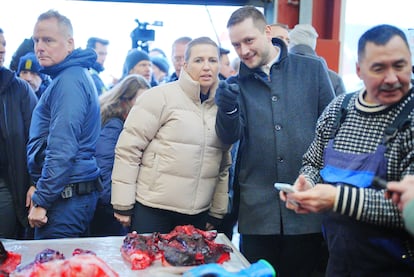 Danish Prime Minister Mette Frederiksen and Greenland’s Chief Minister Jens-Frederik Nielsen at a fish market in Nuuk on January 23.DPA vía Europa Press (DPA vía Europa Press)
Greenland has triggered a shift in her — a change in her stance and in Denmark’s, once one of the most pro‑American and Eurosceptic countries in the EU. Not anymore. With Ukraine, and later with Trump’s threats, Frederiksen has embraced the strategic autonomy championed by leaders such as France’s Emmanuel Macron, a concept she had previously viewed with skepticism. “I do not know what will happen in the United States, and therefore we need to be sure that we can protect Europe if something happens,” she said in Paris.
Another shift came more than a decade ago, when Frederiksen and her party began advocating strict controls on immigration and asylum. “You won’t earn your voters’ trust unless you control immigration, and she understands that,” explains MP Auken. “There are so many countries where social democrats can no longer govern because people don’t trust them on this issue,” she adds.
Danish Social Democrats were losing voters to the far right, and these policies helped them win them back and return to power. They are criticized for playing into the far right’s hands, and for aligning in the EU with Italy under the far‑right Giorgia Meloni. To this, Danish Social Democrats respond that if Denmark wants to maintain a strong welfare state, preserve social cohesion, and limit inequality, restrictive policies are necessary. They argue that they are not tough despite being social democrats, but precisely because they are.
Before becoming a European leader through her handling of the Greenland crisis, the prime minister had already reinvented European social democracy — or at least its Nordic branch — and had become a reference point. In these years of decline for this ideological family, Frederiksen and Spanish Prime Minister Pedro Sánchez have offered different responses to immigration and found opposite formulas for winning power — and keeping it.
Sign up for our weekly newsletter to get more English-language news coverage from EL PAÍS USA Edition