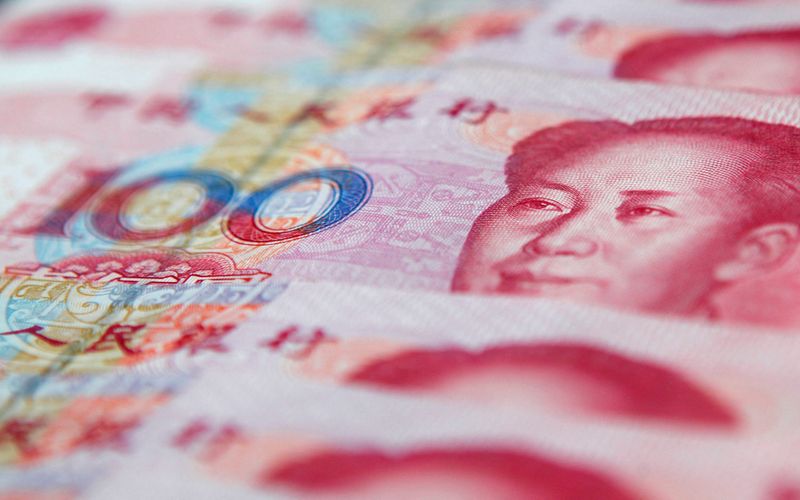
SHANGHAI, Feb 4 (Reuters) – Booming exports are pushing up China’s currency and while analysts think authorities will resist further gains, risks are to the upside and could test the country’s fragile economy.
As the yuan exchange rate tiptoed toward and then passed the strong side of 7-per-dollar last year, foreign currency flows into Chinese banks hit a record $452 billion in December.
The amount converted to yuan also hit a record of $311 billion, figures from the State Administration of Foreign Exchange showed, with the flow sending the exchange rate to its strongest point since 2023 at 6.9378 per dollar on Tuesday.
Bank analysts think that is more or less enough and say a toolkit of semi-official yuan selling, restraining the trading band, persuasive arguments from authorities and tweaks to reserve ratios for the banking system can be rolled out to keep it from gaining further.
An average of 13 forecasts from global investment banks has the currency at 6.92 to the dollar by year’s end, while market pricing points to around 6.8 in the derivatives market.
That sort of level is likely to frustrate the country’s trading partners, where manufacturers are under pressure from Chinese rivals, and add more fuel to a boom in offshore yuan borrowing.
But out-of-consensus calls point to it rising further if exporters ramp up their yuan conversions, with Goldman Sachs this week raising its 12-month yuan forecast to 6.7 per dollar, about 3.5% firmer than Tuesday’s trading level.
“The pace of appreciation has exceeded our expectations and that is even before the sharp move lower in the broad dollar,” said Goldman analysts, who based their outlook on record flows and what they viewed as a shift in tone from the central bank.
The People’s Bank of China manages the yuan by keeping it inside a band that is 2% on either side of a midpoint that it announces each trading day. It declined to comment on its stance on the currency or on analyst forecasts when contacted by Reuters.
Last month, central bank Deputy Governor Zou Lan said the yuan is expected to experience two-way fluctuations while maintaining flexibility.
BASE CASE
A stronger yuan erodes a competitive advantage for exporters, so analysts believe a runaway rally is unlikely. They point to state bank selling and signals from the PBOC’s midpoint settings as evidence authorities will weigh in against gains.
“Given that China’s economic growth is still highly dependent on exports, the People’s Bank of China may not yet be willing to risk a more significant appreciation of the currency,” said Wei He, an economist at Gavekal Dragonomics.
Story Continues